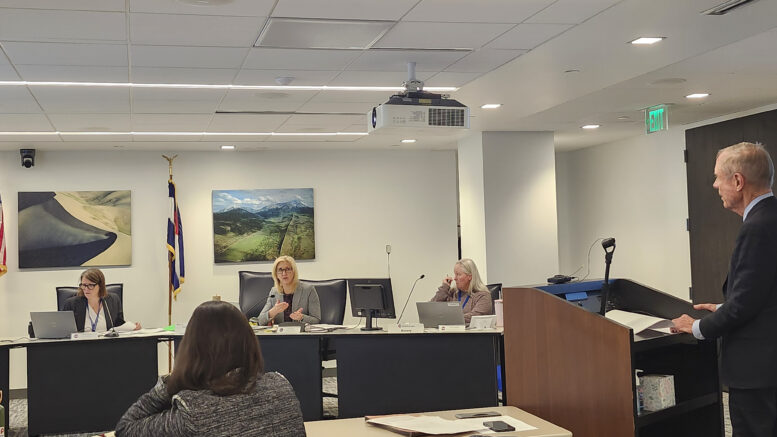
A Colorado election board gave proponents of a graduated income tax the OK for a third time Wednesday to move ahead with an initiative that’s proposed for the 2026 ballot — and members of the coalition said they’ve made enough changes to make this approval stick.
A group of organizations including the Bell Policy Center, Colorado Fiscal Institute and Colorado Center on Law and Policy want to remove the state’s 34-year-old requirement that all residents and businesses pay the same income-tax rates. They’re hoping to get state voters instead to back a progressive tax system where individuals and companies pay higher rates as they make more money, which in turn could generate as much as $3.6 billion a year more in tax revenue for state government.
Twice since October, the three-member board that determines if proposed ballot initiatives have a single subject and whether backers can begin collecting petition signatures have given the Protect Colorado’s Future coalition the OK on their proposed title. But in both cases, the board reversed course just two weeks later under appeals and determined that the initiative has more than one subject and can’t advance under Colorado law.
Why proponents believe this approval is final
Chris deGruy Kennedy, president of the Bell Policy Center, said after getting approval from the title board on Wednesday that he believes the third time is not just the charm but the vote that will stick because of changes the coalition made in response to the two reversals. While board members had different concerns about previous ballot language, their biggest worries were that establishment of the graduated tax system, combined with a “de-Brucing” provision allowing the state to keep all new money generated by the change above the Taxpayer’s Bill of Rights revenue cap, would constitute separate subjects.
So, backers tweaked the language of the title, which previously stated they could keep and spend excess revenue notwithstanding any other provisions of law, to say that they could keep and spend the money notwithstanding any other provisions of TABOR. By narrowing the allowance for removing the TABOR cap on this particular new source of revenue — a term known as “de-Brucing” after TABOR author Douglas Bruce — they persuaded board members that this cap-lifting is in line with past measures that did the same.
“We made clear that there’s not something coiled in the folds here. We made clear that the Legislature does not have to turn around and give back the new money that it just raised,” deGruy Kennedy said in an interview after the unanimous approval from the title board. “I’m very pleased. I’m not surprised. We kind of knew we were on the path to getting here, and it just took moving through all of the repetitions.”
A summary of changes to income tax measure
Opponents of the measure, who include Advance Colorado and government watchdog Natalie Menten, are expected to appeal the decision at the Feb. 4 title-board meeting. Both argued Wednesday that the creation of a graduated income tax, in addition to launching a new tax system in the state, also constitutes an added tax, which is banned now by TABOR and must be a second subject.
However, Protect Colorado’s Future, which got eight separate ballot titles approved on Wednesday, seeks to deal with that issue if the board agrees with the interpretation. Four of the approved ballot titles not only remove the state prohibition against Colorado adopting different levels of taxation for people and entities of different incomes but also seek to remove TABOR’s prohibition against creating an added tax.
In addition to the title wording, proponents also offered changes Wednesday that could bring down the amount of revenue that the change in tax system would raise for the state. Where they previously estimated it could cost state residents and businesses as much as $4.1 billion annually, the new estimates peg the cost at $2.7 billion to $3.6 billion.
While all Colorado residents and businesses now pay 4.41% income tax rates, the proposals would vary the tax rate between 3.75% for the lowest tier of income (the first $25,000 earned) to 9.5% on any amount earned over $1 million. Previously, the lowest tier of income was proposed to be taxed higher at 4.2%, while the highest tier of income — $10 million or more — was proposed to be taxed at 9.2%.
Breaks for many, big income tax hikes for some
According to charts accompanying the proposals, Colorado residents or businesses with income below $500,000 annually would get annual tax breaks ranging from an average of $9 (for those making $25,000 or less) to $325 (for those closer to $500,000). The increased revenue would come from individuals or companies making more than $1 million, including an average tax hike of as much as $15,502 for those making $2 million to $5 million.
Proponents have pushed the measures by arguing that 97% of state residents will receive tax breaks from the new system and that the new money will help underresourced functions of state government. The ballot initiatives specify that any new money would go toward health care, child care and public-school education, with about half of the measures going further to specify that education funding must be directed at K-12 schools.
Opponents, including fiscal conservatives and business leaders, say Colorado’s flat and relatively low income-tax rates are one of the few competitive advantages the state retains in attracting jobs as increasing costs and regulations are slowing economic growth. They also argue that small and closely held businesses like LLCs will get particularly hard as the revenue on which they will be taxed includes both profits and salaries for owners, who already must invest significantly just to get their ventures started.
If coalition leaders are allowed to proceed with signature-gathering, the initiative could be one of the most hotly debated issues on the 2026 ballot, which also includes an open-seat gubernatorial election and a U.S. Senate contest. Highway backers also are collecting signatures on a measure that would direct two-thirds of state sales taxes on vehicles and auto-related products to go toward road maintenance and widening — another proposal that could bring significant change to state spending.