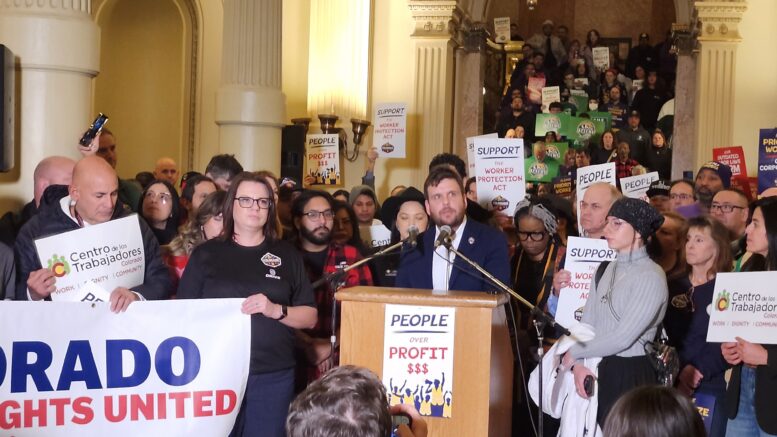
After extensive debate and lengthy negotiations last session, Colorado legislative Democrats passed a bill to eliminate the second-election requirement for unionization in the Colorado Labor Peace Act, only to see Gov. Jared Polis veto it. That seemed to end conversation on the issue, as least until the term-limited Polis leaves office in 2027.
But, no, it didn’t end debate on this exact issue, because most of the same legislators who sponsored the bill in 2025 reintroduced it on the first day of the 2026 session as House Bill 1005, with no material changes to the proposal. Given that Polis has already said he’ll veto the bill again if it lands on his desk in the same form, the biggest question in advance of Thursday’s first committee hearing on the measure might be: Why are supporters replaying this film if it’s just going to have the same ending?
Rep. Javier Mabrey, who is cosponsoring HB 1005 with fellow Denver Democratic Rep. Jennifer Bacon, said the answer is simple: The underlying problems leading to the bill haven’t changed, and this is the best solution to those problems. Mabrey feels that business operators still hold too much power over both workers and government and that changing the LPA will lead to increased unionization, which in turn will lead to higher worker salaries across the state.
“The affordability crisis did not go away,” Mabrey said in an interview on the “Colorado Chamber Office Hours” podcast. “I intend to bring this piece of legislation back until we get it passed. This is the right policy for the state of Colorado.”
Is this bill more about voters and gubernatorial candidates?
Other Capitol observers, however, wonder if the organizing that the bill seeks to increase is less related to the unionization of private workplaces than it is to organizing labor advocates around the 2026 election. Democrats need to pick up just more seat in both the House and the Senate for veto-proof majorities, and a unified vote could send a message too to Democratic gubernatorial candidates Michael Bennet and Phil Weiser, neither of whom have committed to supporting a similar bill in the future.
Colorado’s 83-year-old Labor Peace Act requires a majority of workers participating in a unionization election to vote in favor of organization in order to form a union, just as laws in all other states do. But to achieve union security — the automatic deduction of union negotiating fees of roughly 2% from all workers’ paychecks — Colorado requires a second election that must pass with 75% approval.
Advocates for change, such as Mabrey and union leaders across the state, say this is an unfair burden that allows companies to hire union-busting advocates to scare workers into voting “no” and has made it very hard to unionize. The 8% of Colorado workers that are unionized represent the lowest percentage of such employees in any state that is not a right-to-work state where union membership can’t be required as a condition for employment, according to the U.S. Bureau of Labor Statistics.
Mabrey calls that low percentage a “crisis” and argues that it’s one of the reasons that workers struggle so much to afford to live in Colorado, which is commonly ranked in the five highest-cost-of-living states in the U.S. Higher unionization will lead to higher salaries across the board for workers, he and others argue.
Arguments center around affordability
Yet, on various charts ranking the average annual wages earned by workers, Colorado already ranks somewhere between 7th and 9th, ahead of more than half of the states that permit union security after just a majority organizing vote. And business leaders told legislators across committee hearings on the same bill last year that raising salaries will lead to an increase in the costs of goods and services, which will only exacerbate the affordability crisis.
Rep. Chris Richardson, an Elbert County Republican who is the ranking minority member on the House Business Affairs and Labor Committee that is slated to hear HB 1005 at 1:30 p.m. Thursday, said there are other considerations beyond salary levels. There should be a different bar between voting to create a union and voting to allow that union to take money directly from your paycheck even if you didn’t support it.
“That’s not only a right-to-free-speech thing but a right-to-free-association issue that I think it trips over,” Richardson said in an interview.
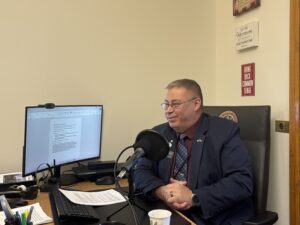
Colorado state Rep. Chris Richardson speaks in his Capitol office about the proposed Labor Peace Act overhaul.
Does Labor Peace Act help Colorado competitiveness?
Additionally, he and other opponents have said, the LPA gives Colorado an advantage in trying to recruit and retain growing businesses at a time when many company leaders have said they won’t consider expanding in states with union-favorable laws. The state has lost some of its competitive advantage as legislators have passed new rules that have made this the sixth-most-regulated state in the country, according to a study commissioned by the Colorado Chamber of Commerce, and the LPA partly offsets that.
“We’re often very proud of things that only Colorado does,” Richardson argued. “In this case, it seems we’re not so proud — or at least the sponsors are not so proud — of something that really uniquely benefits us.”
In retort, Mabrey pointed to the often-touted CNBC Top States for Business rankings, where Colorado sits at No. 11, and noted that three of the 10 states ahead of it are places that allow union security after a single vote. And he noted that every state with a higher average annual wage than Colorado also falls into that category.
Regardless of arguments, however, Polis, even as a Democrat, has said he does not like the bill because he believes it could create negative consequences for both workers and for Colorado’s ability to recruit and retain companies. He was very involved in negotiations last year to discuss potential compromises, including bringing down the 75% bar for the second election but keeping it well above a simple majority, but could not strike a deal.
Would Polis sign Labor Peace Act overhaul?
Mabrey said he hasn’t given up hope of flipping the governor on this version of the bill, saying that he has worked with him before on proposals that have generated skepticism from Polis but that eventually got signed. He thinks his arguments are particularly cogent during a year that the governor and leaders from both parties have declared is about increasing affordability for Coloradans.
“There are a lot of bills this year that are targeted at affordability,” Mabrey said. “This bill is actually aimed at increasing wages across the state. There aren’t other bills that are evidence-based that you could say would increase wages across the state.”
Leaders in Polis’ administration have hinted that the x factor that could get him to sign this bill is the possibility of cutting a compromise deal this year, specifically because he’d prefer to do that than to leave the matter altogether in the hands of the next governor. But proponents have yet to suggest that they are willing to look at one of the compromise suggestions that they rejected in 2025.
Richardson said he expects the committee vote Thursday to mirror the fully partisan vote of last year, and Mabrey too said he is confident the votes remain in the Legislature to get HB 1005 onto Polis’ desk. What happens between Thursday and that arrival with potential changes, however, could determine the fate of the bill — or at least this year’s version of it.