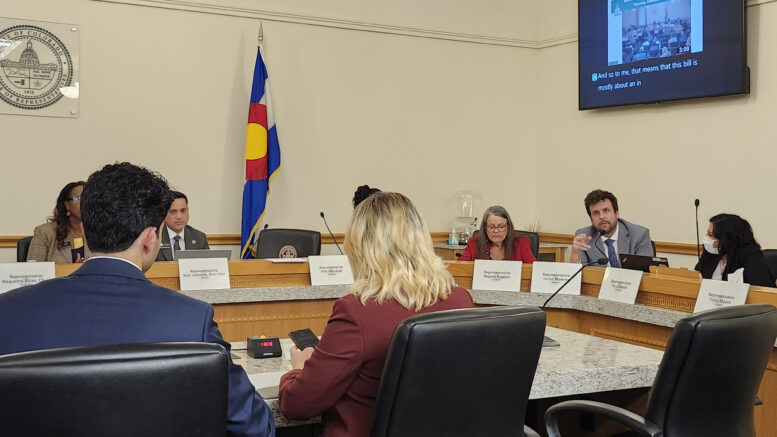
Frustrated with a proposed rollback of federal workplace safety laws, legislative Democrats want to give the state enforcement authority in this area— and took the first step to do so Thursday with committee approval of a bill to push Colorado into uncharted territory.
House Bill 1054 won’t create a state-level Occupational Safety and Health Administration like 23 other states have done, as sponsoring Democratic Reps. Manny Rutinel and Elizabeth Velasco acknowledged that would require funding that Colorado doesn’t have. Instead, it would allow state regulators to create new rules anytime the federal government repeals a workplace-safety regulation, and it would allow the Colorado Attorney General’s Office and private citizens to file civil lawsuits to ensure the rules are followed.
Business leaders complained such a hybrid system not only would be wildly confusing for employers regarding which government agency’s rules they must follow but could conflict with the state’s workers’ compensation law that regulates workplace-injury payouts. Colorado Department of Labor and Employment leaders opposed the bill, saying they don’t have expertise in workplace-safety laws despite the bill’s tasking the agency with drawing up new rules, and they also questioned whether this hybrid system would benefit workers.
But seven of the eight Democrats on the House Business Affairs and Labor Committee, backed by unions and worker-advocacy groups, said Colorado can no longer rely on OSHA to enforce workplace safety under President Donald Trump. In the first nine months of Trump’s second term, investigations completed by the federal agency fell 35% compared to the average of the previous 16 years, and OSHA penalties fell 47%, said Siobhan Standaert, a research analyst at national group Good Jobs First.
Workplace-safety bill pared back
Colorado state Rep. Max Brooks asks a question of House Bill 1054 sponsors Manny Rutinel and Elizabeth Velasco during a committee hearing on Thursday.
HB 1054 originally tasked CDLE with creating new rules when the federal government amended or repealed regulations and laid enforcement of the new rules upon the department and the AG’s office, as well as private lawsuits. But in an effort to eliminate any cost to the state at a time when the Legislature faces an $850 million budget shortfall, sponsors made a slew of changes during the committee hearing.
Under the latest version of the bill, CDLE would be permitted to develop new rules only when the state government repeals regulations — but it wouldn’t be required to do so. Only the AG’s office and lawsuits from individuals or workers’ groups would enforce the new rules. And state agencies would be exempt from the rules that apply to private-sector companies, just as they are now exempt from OSHA enforcement.
Rutinel, of Commerce City, acknowledged that he expected few legal actions to come from the proposed law, saying: “We anticipate most employers will do the right thing.” But Velasco said it’s still important to send a signal to “bad-apple employers” that the state can step up in place of a retreating federal regulatory regime and hold them accountable if conditions get unsafe.
“I do believe we are meeting the moment right now with this bill,” the Glenwood Springs representative told the committee. “We wish we could do more. We are doing the best with what we have.”
Critics say bill won’t protect workers
HB 1054 advanced to the House Appropriations Committee only on a 7-6 vote after all five committee Republicans and Democratic Committee Chairwoman Rep. Naquetta Ricks voted against it. All said they feared that it will create duplicative rules that will create confusion for employers, and most said the limited enforcement that the state has over new rules will do far less to help workers than a state OSHA plan would do.
“I don’t think this bill’s going to make it safer,” said Rep. Chris Richardson, R-Elbert County. “There is a process for a state plan. And frankly, claiming ‘That is what’s best but we don’t have the money’ is a dodge.”
What sparked the push to give the state regulatory authority over what’s now an exclusively federal matter was a July proposal by OSHA to amend the General Duty Clause that requires employers to provide workplaces that are free from serious hazards. But even the extent of that change was subject to debate on Thursday.
Velasco said she fears that the Trump administration could nix the clause as a whole, pulling back on the federal government’s longstanding mission to enforce workplace safety rules. But Cole Wist, a former legislator representing the Colorado Chamber of Commerce, said the proposal only seeks to exempt sports and entertainment jobs, affecting a narrow set of workers but offering an excuse “to propose legislation that is an overregulation.”
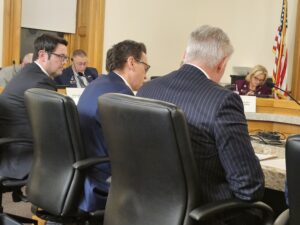
Former legislator Cole Wist testifies against House Bill 1054 Thurdsday while Colorado Association of Home Builders CEO Ted Leighty looks on.
Business: New rules will spark employer confusion
If the plan becomes law, employers could find themselves having to comply with two sets of regulations, Wist said. Were a fatal accident to occur, he hypothesized, OSHA could penalize a company while that worker’s family or union could file a lawsuit in Colorado. That would open the possibility of two judicial processes leading to separate conclusions and creating a legal limbo.
Ted Leighty, CEO of the Colorado Association of Home Builders, suggested that the bill would allow unions and others to file lawsuits claiming unsafe workplaces in order to get concessions from builders or other employers, as he said has happened in California. And Alenka Han, an attorney for Pinnacol Assurance, said that allowing a civil action from a worker to proceed at the same time as a workers’ compensation action violates a state law that such actions must go through the workers’ compensation system.
Several other business groups complained that the duplicative regulation will be another strike against Colorado at a time it’s already become less competitive for job expansions.
“I have members saying that if they have to start again with all new regulations, they will close their doors,” warned Ale Spray, president/CEO of the Hispanic Contractors of Colorado.
Labor: Workplace-safety improvements needed to reduce deaths
Supporters pushed back on claims that allowing state oversight of workplace-safety laws would be a economic-development disaster.
Where OSHA fines can be as high at $16,500 for a first violation, HB 1054 proposes maximum first-time fines of $1,000, noted Matt Schechter, general counsel for United Food and Commercial Workers Local 7 union.
The damage limits would disincentivize attorneys from going after companies for big payouts, Schechter. And they ensure that legal actions more likely would focus on forcing employers to fix a dangerous piece of equipment or clean mold from an office, said Nina DiSalvo, policy manager for the Towards Justice law firm.
Instead, the allowance for the state to step in on behalf of workers will send a message to e employers trying to skirt safety laws that they cannot rely on the passivity of federal regulators to avoid retribution for their actions, several union leaders argued. They pointed to the fact that 92 people died on the job in Colorado last year after 83 perished at work the year before and said that the state has a chance to step up and prevent further losses.
Are costs to launch new law being considered correctly?
“The complacency that is taking place here is appalling. We need urgency to do something better to make sure less Coloradans are dying,” Colorado AFL-CIO Executive Director Dennis Dougherty said. “This isn’t about regulation. This isn’t about competitiveness. It’s about making sure everyone comes home safe when they go to work.”
The next committee to debate the bill will look specifically at the cost of implementing the proposed new law, which was estimated at about $183,000 before the amendments added on Thursday.
CDLE officials estimated that if they were to set up a full state workplace-safety division as other states have done, it would take years to get the rules in place with federal certification and could involve hiring 100 workers at a cost of many millions of dollars.
Bill backers argued, however, that the unique enforcement scheme relying on civil lawsuits will cost far less and can be done without adding new workers.