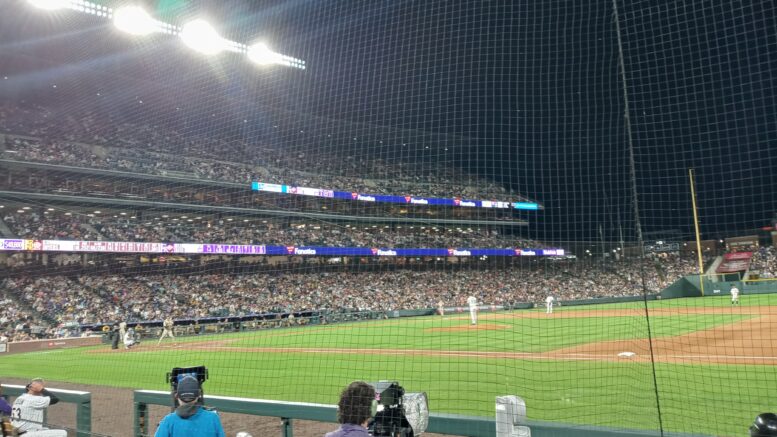
Colorado legislators who took a small step in 2025 to boosting state regulation of price-gouging will consider Tuesday whether to go after the problem in a bigger way — requiring airports, entertainment venues and other facilities to limit pricing on food and goods.
The House Judiciary Committee is slated after several delays to hear House Bill 1012, which would insert the state government into product pricing in two ways. It would bar vendors at “captive-consumer” facilities from sports stadiums to hospitals to large outdoor festivals from selling things like food or drinks above the average cost of that product in the county in which the venue is located. And it would require food-delivery apps to list for consumers when the price for the good they are buying is more expense online than it is in a store or restaurant.
Rep. Yara Zokaie, the Fort Collins Democrat sponsoring HB 1012 with Democratic Rep. Kyle Brown of Louisville, says the measure is part of the legislative effort to increase affordability — an effort being approached in very different ways by her party and by Republicans. The delivery-app provisions address the cost of everyday necessities, and the captive-consumer part of the bill is meant address what she calls “fun-flation” that is sapping the ability of average families to enjoy Colorado events.
“It seems to be more acceptable to gouge a family in that situation, and that is just not the type of environment I would like to create for working-class families in Colorado,” Zokaie said on the “Colorado Chamber Office Hours” podcast. “I believe that we should have an economy where working people can have fun, can go out with their family — and where they’re not just working and not just surviving but they’re able to thrive and enjoy their lives as well.”
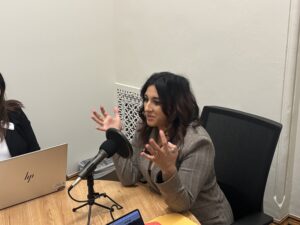
Colorado state Rep. Yara Zokaie discusses her price-gouging bill on the “Colorado Chamber Office Hours” podcast.
An issue of price caps and lawsuits
Business leaders and Republicans, as well as the operators of a slew of affected venues, believe there is nothing fun about the debate, however. They argue HB 1012 would take the dangerous step of forcing price caps onto businesses without understanding the economic situation in which they operate — and could open them to high-dollar lawsuits, based a significant legal change that is tucked into the bill.
Opponents’ arguments, in fact, go to the greater issue being debated at the Capitol over whether excessive regulation or often-cited “corporate greed” is driving price escalation of everything from homes to cheeseburgers in one of the nation’s most high-cost states.
Many point to higher prices of goods at a Broncos game or Denver International Airport and note that vendors operating at these high-traffic facilities must pay fees to be able to get their menus or retail items in front of audiences that can’t leave facilities to buy elsewhere. Restricting what vendors can charge would mean that vendors could have to reduce profit margins significantly or that venue operators would have to eliminates such fees — a restriction that the bill does not contemplate.
Zokaie proffered that if vendors faced the possibility of losing money because of the price caps, deep-pocketed sports and music venues would have to cut their fees or face a loss of businesses wanting to operate in their facilities.
Would price-gouging law limit prices or vendors?
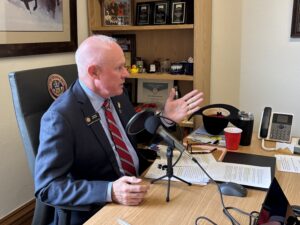
Colorado state Rep. Anthony Hartsook discusses the price-gouging bill on the “Colorado Chamber Office Hours” podcast.
House Republican Caucus Chairman Anthony Hartsook scoffed at that notion, however, saying that businesses and public facilities like airports are far more likely to see a significant loss of vendors, particularly smaller businesses who can’t afford profit loss. Those vendors instead will seek unregulated venues where they can make acceptable margins, and both the business operators and consumers will be losers as vendor options decrease and waiting lines grow at facilities that attract thousands of visitors.
“We have piled regulations on regulations for businesses … and that cost gets passed along to a consumer,” Hartsook said. “Do we really want to make it to where a business pulls out and then the consumer has fewer choices about what to eat and where to shop?”
This is not the state’s first attempt to crack down on what legislators call price-gouging. During the pandemic, a new law allowed the Colorado Attorney General’s Office to go after excessive pricing during times of declared disaster.
Then last year, Zokaie sponsored a proposal that would have declared that any hike in prices of 10% above the previous 90 days’ average for those goods was considered price gouging punishable by civil action. However, business groups and Gov. Jared Polis objected to what they called an unprecedented price limitation during normal market conditions, and the bill was rewritten to implement the 10% cap only during disaster declarations.
How proposed price-gouging law would work

Large outdoor festivals would fall under the jurisdiction of the proposed price-grouping bill as well.
HB 1012 grants rulemaking authority to the AG’s office for how to enforce the law were it to pass, but it specifies that the cap on captive-consumer pricing will be the average of that good in the surrounding county. It remains to be seen, however, what an average price for a good like a hot dog is deemed to be when compared to a market where such a food can be gourmet or dirt-cheap, can be naked or slathered in toppings or can be a variety of meats or meat substitutes, for instance.
In addition, the bill creates a private right of action to allow lawsuits for captive-consumer violations — though not for the food-app pricing restrictions — that groups like the Colorado Chamber of Commerce worry will lead to costly litigation. And it makes those lawsuits potentially pricier with a provision that seems in some ways to be an end run on the unsuccessful efforts to make it easier to file deceptive-trade-practice claims.
For the past three years, bills have died in the Senate that sought to remove from state law a provision that requires filers of deceptive-trade-practice lawsuits to prove a defective product or service had a significant public impact, not just an impact on one individual. That is important, because without such a claim, which also allows for collection of treble damages and attorneys’ fees, many lawyers are reticent to take on claims that require significant work to prove but could have limited payout.
Bill tweaks “significant public impact” requirement
On page six of HB 1012, however, a provision states that violation of captive-consumer rules is an unfair or deceptive trade practice and is presumed to have a significant public impact — a rare clause that paves the way for lawsuits. Hartsook said that would undercut legislative rejections of the premise from the past three sessions and open the door to far more lawsuits.
“To circumvent the whole system … that is what I think is deceptive, and I don’t think we should be doing that,” he said.
While most of the criticism of HB 1012 so far has been aimed at the captive-consumer provisions, Zokaie argued that the food-delivery-app sections are important too to ensuring that people understand that they could be paying more — for food items, not just in delivery fees — than if they went to the stores in person. Especially for people who are older or don’t have ways to get to a grocery store, that is an added cost of living that they at least should be able to understand, she said.
“What we have right now is a system where people are paying fees and not knowing it,” she said. “The consumer has a right to know that this is a hidden fee they are paying, so they can make the choice of whether to order groceries through those apps.”
The hearing is slated to start upon the adjournment of House floor work in the morning in House Committee Room 107.