
Less than 10 months after Gov. Jared Polis vetoed a bill to add safety-focused restrictions on transportation-network companies like Uber and Lyft, the issue is far from dead. In fact, regulators and legislators are pushing to add new rules on the rideshare firms via four different channels.
First, the Colorado Public Utilities Commission is in the midst of rule-making — stemming from Polis’ veto — aimed at cracking down on driver impersonation. Meanwhile, a broader bill continuing the existence of the PUC, which was introduced Wednesday, would boost several regulations on the companies, including requiring TNCs to submit an annual, publicly inspectable report detailing all safety-related incidents made to the PUC.
Another bill seeks to require TNCs to train drivers on the rights of people to bring service animals along in rides and report violations of that policy; that passed its first committee with bipartisan backing. But a more controversial third bill, which is scheduled for its first hearing on Wednesday, would make Colorado the first state to cap the portion of consumer fares from each ride that TNC parent companies could take — a cap proposed at 20%.
The scrutiny on these companies comes amid a national wave of allegations from passengers that they were assaulted during rides — passengers that notably include Rep. Jenny Willford, a sponsor of several of the bills, including the one that Polis vetoed. And it comes as unionized drivers, who led the push for a pair of network reform laws in 2024, argue more vehemently that they believe the companies are making it difficult for them to make a living.
A new plank in the battle with rideshare companies
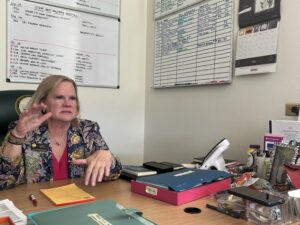
Colorado state Rep. Meg Froelich discusses her TNC-fare regulatory bill in her Capitol office on Thursday.
Rep. Meg Froelich, a sponsor of the vetoed bill and of the fee-cap bill, said the issues of rider safety and drivers’ rights are intertwined because the more that legislators talked with drivers about passenger safety, the more they too said they needed help. And just as she hopes the state can do more to hold bad-apple drivers responsible for their actions, she also believes it should hold companies responsible when their contracted drivers ask it to step in and ensure they get an equitable share of wages.
“We just want to make sure that the people doing the work are the ones who get paid,” Froelich said about the fare-cap proposal, House Bill 1273. “(The companies) are making a lot of money. And the drivers are not. And we have an affordability crisis in Colorado.”
TNCs have attempted to work with legislators and regulators as much as possible. They worked to amend the service-animal bill, HB 1043, and dropped their opposition to it. They have suggested changes to the proposed PUC regulations on driver impersonation.
But at least for Uber, HB 1273 is a bridge too far at a time when Colorado regulations already have made it one of the most expensive states in terms of the company’s operational costs. Adding more rules that would drive up the cost of each ride would end up hurting many of the people who are without personal vehicles and rely on the companies to get around, the company said.
Will regulations increase rideshare pricing?
“While well-intentioned, this bill is yet another proposal that targets the rideshare industry and raises costs for Coloradans, potentially doubling the price of Uber rides — hurting those who need affordable transportation and the drivers who rely on these earnings,” Uber said in a statement to The Sum & Substance. “Uber drivers are currently making nearly $35 per hour while on trip, and legislators should study the impact on costs and livelihoods before passing a law that ultimately harms the very people it claims to help.”
Few industries as narrowly focused as TNCs are subject to as wide a range of legislation and rulemaking being directed at them.
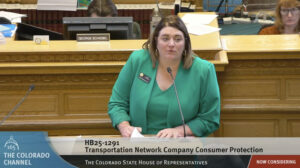
Colorado state Rep. Jenny Willford explains her 2025 bill to impose more safety regulations on rideshare companies.
Polis vetoed HB 25-1291 last year because he warned that its legal constrictions on the companies — particularly those dealing with rider privacy and drivers’ rights, including a mandate of swift deactivation for drivers accused of crimes — were legally unworkable. So, officials with the Colorado Department of Regulatory Agencies, in performing their sunset review on whether to continue the PUC, which regulates TNCs, incorporated several suggestions made by watchers of the sector that didn’t appear to run afoul of Polis.
PUC addressing driver impersonation
HB 1326, the PUC sunset bill, would require companies to report to the PUC instances in which a driver refused to pick up a potential rider, make it easier to hold TNCs liable for such violations and double the maximum per-violation fine to $1,100. It also would make it a misdemeanor for someone to impersonate a TNC driver and a felony to impersonate a driver in the commission of a felony, and it would require TNCs to conduct period checks using facial-recognition software to prevent driver impersonation.
At the same time, the PUC is conducting rulemaking to prevent TNC driver impersonation. The proposed rules explore harsher penalties against both drivers and the TNCs for such missteps and consider whether to require TNCs to share lists of driver impersonators and drivers whose credentials were used by imposters without their knowledge.
Several organizations involved in the rulemaking have suggested that the PUC focus the rules on TNCs to stop the practice of driver impersonation. The Colorado Coalition Against Sexual Assault, for instance, suggested that TNCs should be held directly accountable to incentivize them to take a more proactive approach to the issue, such as monitoring drivers’ activities for irregularities, according to a Dec. 18 rulemaking notice.
How responsible are rideshare firms for impersonation?

Kouri Marshall, senior director of state and local public policy for the Chamber of Progress, speaks during a Public Utilities Commission online rulemaking hearing on Feb. 23.
But TNCs and technology industry groups, while expressing solidarity on the need to stop driver impersonation, warned that some of the provisions under consideration, particularly those that could increase their liability, would do little to stop impersonation but could increase compliance costs, which in turn could increase ride costs. And they also have questioned whether the mandated sharing of lists of drivers with other companies — including those whose only “wrong” was having their identity stolen — would force companies to hand over proprietary information to competitors.
“We should be focusing on bad actors, not the companies who are doing, from my understanding, everything in their power to institute safety checks,” said Kouri Marshall, senior director of state and local policy for the tech-sector Chamber of Progress, during a Feb. 23 public hearing.
Both Uber and Lyft went neutral on HB 1043 after the bill changed from one that focused on increasing reporting and penalties around the broader topic of ride refusal to one that requires training to drivers to inform them that they can’t refuse rides to service animals. Both companies say they have policies in place that acknowledge these rights already and are working to inform drivers about them.
But HB 1273 appears poised to be more contentious.
Regulating companies’ share of fares
Froelich, D-Greenwood Village, admitted in an interview last week that the Democratic governor’s veto of last year’s rideshare-safety bill remains “very painful,” but she said she expects that many of her concerns will be addressed in the PUC sunset bill. And if that bill falls short of expectations, she and Willford have already pulled a title for another rideshare-safety bill, in which they would seek to address lingering concerns, she said.
HB 1273 came about after drivers reported to the duo that TNCs often keep anywhere from 20% to 70% of the total cost of rides, a total that Froelich said she found astonishing.
Meanwhile, many TNC drivers are responsible for the cost of gas, insurance and maintenance of their vehicles, Froelich said. However, Uber officials have noted that the company provides the commercial insurance that its drivers need.
TNCs report that 14% of each ride fare in Colorado now goes to government-mandated insurance — making Colorado one of the 10 highest-cost insurance states for the companies — and another 7% goes to taxes and fees. Those costs don’t include credit card fees, support costs or other costs of doing business, all of which contribute to the percentages that TNCs take — but that are still a minority of the overall trip fare, they argue.
TNCs battled legislators two years ago over bills that imposed new regulations, including longer time periods for drivers to accept or decline rides and a ban on the companies penalizing drivers who decline rides, but eventually got the bills to a place where the tech-supporting Polis would sign them. This new round of regulations is beginning to stir concerns similar to 2024, and it will be interesting to see whether these debates lead to more new rules, more vetoes or some combination thereof.