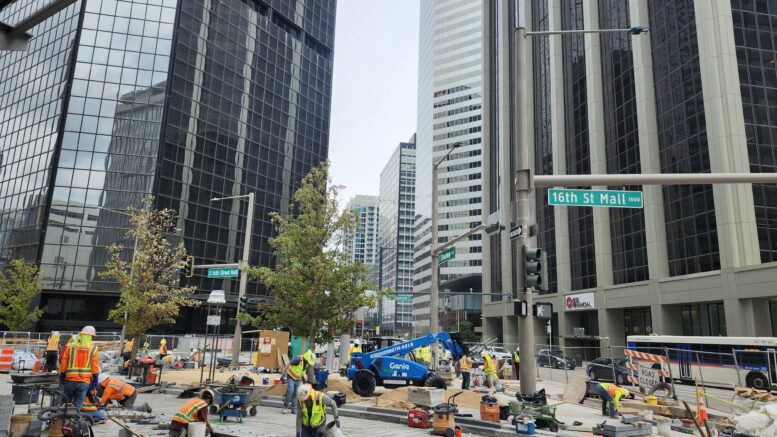
Backers of a bill to protect workers laboring in extreme temperatures amended the already heavily changed proposal further this week — rendering it a “carcass,” in the words of one sponsor — but passed it out of committee to continue discussion of the idea.
House Bill 1272 has devolved from a very prescriptive set of rules in its original version last year to a bill that seeks now just to have the state collect data on heat- and cold-related workplace injuries and develop a model plan on how employers can protect against them. While cosponsoring Rep. Meg Froelich, D-Greenwood Village, told the House Health and Human Services Committee that supporters have “dreams we hope will happen” about the state eventually making rules to protect workers based on the information it collects, such rulemaking ability was stripped from the bill with a major amendment Wednesday.
Still, sponsors and a coalition of environmental, Latino and immigrants-rights organizations continue to push the bill because they have heard too many stories of lower-wage workers being forced to labor outside without adequate shade or water, officials testified. And they feel President Donald Trump is planning to gut temperature-related workplace protections now overseen by the federal Occupational Safety and Health Administration — a claim that was disputed by several opponents — and want Colorado to be able to step up.
Democrats passed the bill on an 8-5 party-line vote to the House Appropriations Committee, where Froelich acknowledged she and cosponsoring Rep. Elizabeth Velasco, D-Glenwood Springs, plan to cut further to reduce its $100,000 fiscal note. And in doing so, they gave a little bit more life to a bill that sponsors killed at its first hearing last year, saying they think this is an important discussion to have during a time of climate change and federal regulatory rollbacks.
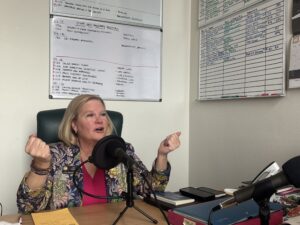
Colorado state Rep. Meg Froelich discusses her extreme temperatures bill on the “Colorado Chamber Office Hours” podcast.
Taking the first steps on work in extreme temperatures
“We ask you to let us begin this journey, to listen to workers, to let us consider workers,” Froelich said. “If we can plan ahead, we can keep workers healthy and we can keep Colorado going.”
No one knows exactly how big a problem extreme heat or cold are for workers right now, as the state doesn’t keep statistics on temperature-related injuries. So, HB 1272, in its current form, does two things to lay the groundwork for discerning whether this is an issue that officials need to address and allowing Colorado Department of Labor and Employment leaders to take the first step in that direction.
The proposal directs CDLE to gather data from existing sources about how many Coloradans have suffered heat stroke, frostbite or other temperature-related injuries while on the job. And then it directs the department to create a model temperature-related injury and illness prevention (TRIIP) plan that can be given to all employers.
Wednesday’s amendment removed two key provisions from the bill. HB 1272 no longer requires workplaces to develop their own TRIIPs, and it no longer gives CDLE the authority to make future rules in this area.
Yet, even in its scaled-down form, proponents and opponents offered starkly different viewpoints on what the bill could mean for employers and employees.
An aid to workers or source of regulatory confusion?
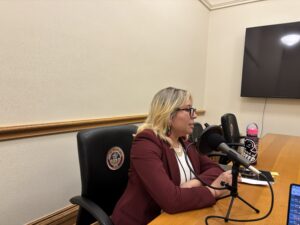
Colorado state Rep. Elizabeth Velasco talks about another one of her workplace safety bills, HB 1054, on the “Colorado Chamber Office Hours” podcast.
Velasco said she envisioned it setting up pathways to protect a range of workers, from landscapers to roofers and from resort employees working for hours outside in the cold to teachers trying to impart lessons in schools without air conditioning. The state’s development of a model TRIIP plan is a “common-sense policy,” she said.
Patricia Garcia-Nelson, Colorado fossil-fuel just-transition advocate for GreenLatinos, said that earlier in her career, she worked in the fields of northern Colorado without adequate access to bathrooms or to shelter when it rained. As long as employers are not required to meet any standards, employees won’t have adequate protections, she said.
But Rep. Carlos Barron, a Fort Lupton Republican who operates an oil-and-gas services company. said regulated businesses already have OSHA standards that they have to meet. He must provide shade, breaks and water under federal regulations when it’s hot, and he must clothe workers in gloves, jackets and facemasks rated to a certain cold resistance when it’s cold, he said.
Michael Cox, an attorney at Squire Patton Boggs representing the Colorado Chamber of Commerce, said that having the state step in to create model practices will sow confusion among employers about whether they must meet federal or state benchmarks. And if sponsors seek in the future to develop state rules, that could spur litigation over potential pre-emption of federal rulemaking, he added.
Workplace safety a hot topic this year

Sun shines through the trees in Denver.
In some ways, the debate mirrored that over HB 1054, which seeks to allow CDLE to craft workplace safety rules anytime a federal rule is repealed. That bill passed out of its initial committee last month and remains parked for the moment in House Appropriations.
Froelich and Velasco both said the state must step in because Trump is gutting OSHA and reducing worker protections, spurring Froelich to say that “essentially the federal OSHA is gone.” Velasco asserted that Trump has ordered the agency to eliminate 10 rules before developing more heat-protection standards and that he’s put 85% of the National Institute for Occupational Safety and Health staff on administrative leave pending layoffs.
“No worker in Colorado should have to risk their health or their life just to earn a paycheck,” said Velasco, who also noted that 92 Colorado workers died on the job in 2024 but added there are no counts of how many of those fatalities were due to extreme temperatures. “These workers power our economy. Too often they are doing our jobs without protection.”
Temperatures bill faces uncertain future
Industry leaders said the talk about the dismantling of OSHA amounted to nothing more than hyperbole, however. Colorado Stone Sand and Gravel Association Treasurer Chris Oestreich noted that OSHA funding dropped just 0.5% for the current federal fiscal year. And Cox said the agency has not given any notice of significant rule rollbacks.
“There’s not a systemic dismemberment of OSHA or a gutting of OSHA,” Cox said. “We’ve seen nothing to indicate that OSHA is going to be rolling back anything along those lines, especially when it comes to temperature-related illness or injury.”
Despite business leaders’ warnings about the bill seeking to solve nonexistent problems or creating regulatory confusion, committee Democrats got behind it, even if just to send it to a committee that is likely to ask sponsors to narrow it even more to limit its costs. And a proposal that was very short-lived in 2025 has more of a heartbeat in the heat of 2026.