

Legislative efforts to increase Colorado’s housing supply, particularly workforce housing, are moving quickly during Gov. Jared Polis’ final year in office, with the governor signing two key bills into law and committees or chambers having given initial approval to four others.
The lack of housing has become a bigger issue for employers over the past decade as Colorado has risen to being the fourth-most-expensive state in the country, according to CNBC rankings. Many company operators report that they have trouble recruiting talent from states with lower costs of living, and urban employers report that their workers can only afford to live far from their jobs. The state demographer’s office has estimated that Colorado is 106,000 houses short of what is needed, which is a major factor driving average home prices statewide above $525,000.
Polis has spent much of his second term trying to address the issue, seeking specifically to boost the stock of housing statewide as a way of slowing escalating prices through increased competition. The Democratic governor has signed laws since 2024 that required greater zoning density near transit lines, removed parking minimums for some multifamily housing, allowed the building of accessory dwelling units by right of the property owner and limited liability surrounding condominium construction.
His top-priority effort of 2026 — House Bill 1001, also known as the HOME Act — became law on Wednesday. Sponsored by Democratic Reps. Andy Boesenecker of Fort Collins and Javier Mabrey of Denver, the bill permits school districts, regional transit agencies, housing authorities and nonprofits to construct housing by right on plots of as much of five acres of land that they may own if the development conforms to certain height standards.

Gov. Jared Polis signs the HOME Act into law while surrounded by supporters on Wednesday.
Why backers believe the new housing law can help
By allowing construction to proceed via administrative processes rather than having to go through a public-hearing or zoning process, the new housing can go up 28% faster, Boesenecker told a House committee during the bill’s first hearing on Feb. 3. And the nonprofit or public agencies building the housing can save the costs now associated with rezoning — a price that can be so high in terms of staffing and financial resources that it can stop a project before it begins, said Katie McKenna, a developer with Archway Communities.
As with previous housing bills — some of which remain tied up in court — much debate around HB 1001 centered on local-government concerns that it will take away a zoning and planning process that allows local leaders to determine the buildout of their community. Beyond the cities-versus-state narrative, Sen. Lisa Frizell, R-Castle Rock, argued that the blanket allowance for increased urban infill development doesn’t consider whether an area has the proper electric or utility-transmission capacity to support more development.
But backers of the bill insisted that if the state wants to bring more housing to market, it must reduce obstacles that can slow the construction of that housing.
“By allowing nonprofits, transportation districts, schools, housing authorities and others to build housing on underutilized and unused land, we are breaking down barriers that block partners who want to be part of the housing solution,” Polis said in a news release. “This bill allows underutilized land to be turned into homes people can afford, in communities we want to live in.”
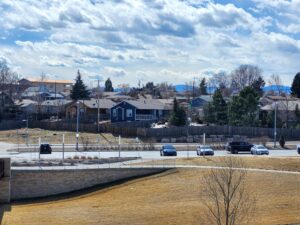
A neighborhood sits just south of the Westminster Station public-transit area. Gov. Jared Polis wants more housing built around transit centers.
Tax credits and loosening of spending restrictions
And that is the same reasoning that underpins at least five other bills that have passed the Legislature or are in the process of likely becoming law.
Polis on Wednesday also signed Senate Bill 1, which is designed to let county governments that want to play a bigger part in affordable-housing creation to be able to do so. It permits them to use general-fund revenues toward housing creation, allows the sale or acquisition of public property for housing and gives them more flexibility in the use of Middle-Income Housing Tax Credits.
Two bills awaiting second hearings in the House Appropriations Committee — but more likely than many bills to exit the committee successfully despite the state’s $1 billion budget shortfall because they are Polis priorities — seek to expand housing tax credits. HB 1065 would create new tax credits for the building of housing in newly designated districts around transit hubs, and HB 1066 would expand an existing tax credit for construction of owner-occupied affordable housing to affordable rental housing as well.
While all those bills were part of a package that Polis and Democratic legislators announced to fanfare early in the legislative session, several more housing bills have been introduced to and passed out of the House since then.
Large-lot-mandate prohibitions and lot-splitting
HB 1144, sponsored by Democratic Reps. Rebekah Stewart of Lakewood and Steven Woodrow of Denver, would ban local governments from requiring a minimum lot size of any more than 2,000 square feet under zoning statutes. While homebuyers could still purchase bigger lots if desired, the proposal would ensure that homebuilders have the opportunity to produce more houses on smaller lots, which could boost affordability by reducing land costs and increasing housing options, backers have said.

Colorado state Reps. Andy Boesenecker and Steven Woodrow describe HB 1308 to the House.
And HB 1308, sponsored by Woodrow and Boesenecker, follows up the 2024 law that allows property owners to build ADUs on their lots by allowing property owners also to split their lots as long as each of the remaining parcels is at least 1,200 square feet. This would allow property owners to make money by selling parts of their lots for home construction, and it also could bring more housing at smaller sizes to areas where it now is costly and limited, proponents said.
Though the business community has remained more of an interested observer than a passionate advocate in this year’s housing debates, Rep. Ken DeGraaf, R-Colorado Springs, referred to HB 1308 as a “developers’ bill.” The people who stand to benefit the most from its passage, he argued, are developers who will double revenues by putting up twice as many homes on split lots without concern for whether neighborhoods can handle increased utility usage or traffic.
Will smaller lots equal more and cheaper housing?
Woodrow has countered such arguments by saying that the proposal, which wouldn’t take effect until December 2027, is a private-property-rights bill that stops landowners from being held hostage to use-limiting zoning by letting them employ their land as they wish. Unnecessarily oversized lots that otherwise could accommodate everything from duplexes to other single-family homes are inflating housing prices and keeping workers from being able to afford to live in the communities where they work, sponsors said.
During debate before the House passed HB 1308 on a 39-26 vote on Tuesday, Republicans argued that while sponsors of these bills continue to focus on limiting oversight from local governments, they are not attacking what is just as big a problem in boosting housing prices — the increasing regulations under which the homes must be built.
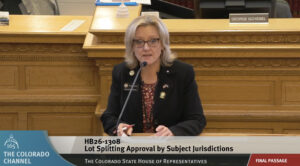
Rep. Rebecca Keltie explains her concerns with the lot-splitting bill to the Colorado House of Representatives.
Green building standards have added tens of thousands of dollars to the cost of new-build homes and made them more inaccessible to first-time buyers, Rep. Rebecca Keltie of Colorado Springs argued. The continued permissiveness of laws to construction-defects lawsuits makes it infeasible to build lower-cost homes and incorporate legal risk into their price tags, said Rep. Ryan Gonzalez of Greeley. Rising home-insurance rates add to the price tag and keep other buyers out of the market, said Rep. Max Brooks of Castle Rock.
Should deregulation get more consideration?
The 2025 construction-defects law was supposed to boost construction of moderately priced condominiums, which now make up less than 5% of the new-build housing stock. But a report issued Thursday by the Common Sense Institute found that it’s done little to change the underwriting behavior of insurers leery of condominium projects and has left the percentage of total cost taken up by liability insurance on condos several times higher than that percentage for apartments.
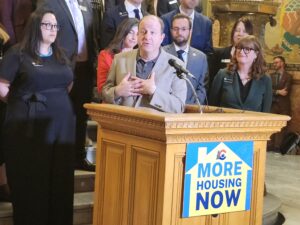
Gov. Jared Polis speaks Jan. 22 at a Capitol news conference on Democrats’ affordable-housing package for the 2026 session.
Meanwhile, Senate Bill 49, a bipartisan effort to offer homeowners more incentives to hail-proof their homes and make them more resistant to wildfires, remains without a scheduled first committee hearing date, despite having been introduced on Jan. 27. The business-backed bill could see competition from a revived state effort to charge fees on insurance policies to fund a financial-aid program for disaster mitigation, even though legislators rejected a similar bill last year because they said constituents are tiring of new fees.
Backers believe that the two bills that already have become law will help to spur more dense construction in urban areas and, by doing so, cut into the housing-affordability crisis. But like with the bills that have passed over the past two years, it may take time to see how much the state can spur the market in this fashion versus how much it must deregulate the market to see downward price movement.
“This bill simply aligns development policy with what recent surveys tell us 90% of Coloradans say they want: More affordable housing in the communities they call home,” Neighborhood Development Collaborative Executive Director Jonathan Cappelli said in a news release about the HOME Act. “It’s hard to build your way out of this crisis — but impossible if you don’t let us try.”