
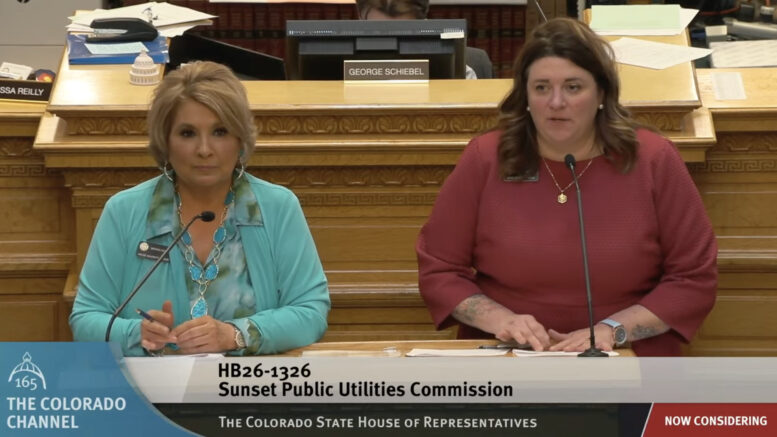
After a pair of contentious committee hearings in which business groups and utilities asked for several big changes to a proposal authorizing continuation of the Colorado Public Utilities Commission, sponsors acquiesced Saturday on most of their major concerns.
Through a series of amendments added during a rare Saturday session for the House, sponsoring Democratic Reps. Monica Duran and Jenny Willford nixed two controversial new utility requirements and agreed to study two other areas of business concern. And they added several other provisions that could please business leaders, including an amendment requested by Climate Jobs Colorado requiring the PUC to consider workforce implications when debating decisions related to the clean-energy transition.
House members then gave preliminary approval to House Bill 1326 with less than a week to go before the required May 13 adjournment of the 2026 regular legislative session, likely setting it on track for a smoother and quicker passage through the Senate. The House still must give final approval to the bill when it reconvenes on Monday, but the changes seem to make that all but guaranteed.
“A sunset (bill) like this takes a lot of conversation and collaboration, and we wanted to make sure we get this right,” said Duran, the House majority leader from Wheat Ridge. “House Bull 1326 is a vital measure to continue the Public Utilities Commission for the next seven years.”
Why the PUC sunset matters so much
Colorado state Rep. Carlos Barron argues Saturday for his amendment to expand the size of the Public Utilities Commission.
Legislators approve a dozen or so sunset bills to continue programs or regulatory bodies each year, but the PUC sunset takes on added weight because of the power and scope of the commission. The three gubernatorially appointed fulltime members oversee utilities, motor carriers, transportation-network companies, railroads, telecommunications and certain natural-gas and propane pipelines, and recent decisions to boost clean-energy requirements have drawn ire from utilities, unions and business groups.
Utilities and business groups, including the Colorado Chamber of Commerce, asked at two committee hearings to expand the three-member PUC to five appointees, arguing this would lead to greater ideological and geographical diversity among its members. And while Duran and Willford wouldn’t go that far, they added an amendment Saturday that requires a third-party study of the structure of the PUC, including the size of the commission and of its staff and how the state could fund expansion of both if it is deemed the best option.
While that represented a significant give after environmental groups pushed back for the past month on proposed expansion, claiming it will cost too much and make the commission less efficient, it wasn’t enough for House Republicans. Rep. Carlos Barron, R-Fort Lupton, ran amendments to require the PUC to expand to five members, have three of them represent geographic areas and mandate that no more than three be from the same party. However, those amendments died in what sounded like largely party-line voice votes.
Securitization, third-party contracting changes nixed
Duran and Willford did agree, however, to remove from the sunset bill two provisions suggested by the Colorado Department of Regulatory Agencies that would have given the PUC more power over how utilities finance and run new initiatives. And because of those changes, it still will be up to individual utilities to determine when they use securitization and when they hire third-party contractors to operate public-facing programs.

Robert Kenney is president of Xcel Energy Colorado
Securitization means that rather than recouping the cost of some programs, such as wildfire mitigation or grid-infrastructure upgrades, through base-rate increases, utilities would issue revenue bonds to fund those investments. This can result in lower financing costs for the upgrades — a move that can limit base-rate increases but also limit the revenue that utilities can gain from such base-rate increases — but also can require longer periods of repayment of interest.
HB 1326 originally allowed the PUC to require securitization for certain initiatives if commissioners felt it was in ratepayers’ interests, and environmental groups said that is necessary because utilities have incentives not to go that route and just to raise rates. However, Robert Kenney, president of Xcel Energy Colorado, said told the House Finance Committee on April 30 that such that such a move could make utilities less credit-worthy and could make it harder to sell bonds for some upgrades and initiatives.
Other concerns about Public Utilities Commission addressed
The bill originally also granted to the PUC the ability to require that utilities farm some consumer-facing programs, such as residential installation of electric-vehicle-charging stations, out to third parties if it deemed that helpful to the initiatives. But utilities pushed back that this was undercutting their ability to run their companies as they saw fit, and a separate amendment added Saturday by Duran and Willford removed that provision.
Finally, several business groups had asked that the PUC be required to return to in-person meetings for major issues, as those have become a rarity since the advent of the coronavirus pandemic.
So, Duran and Willford added another amendment Saturday that requires the PUC to adopt rules by March setting criteria to determine which meetings should be in person or virtual — and allowing affected parties to request in-person meetings to the commissioners. That same amendment gives the PUC maximum timelines of 250 days in most cases to rule on applications like those utilities must put in to raise rates, and it declares that failure to act on applications in that timeline constitutes approval of those applications.
Local control of utilities’ decisions still a pinch point

Black Hills Energy workers install a natural-gas pipeline.
One major issue that remains is a provision in the bill that expands who can turn to the PUC to appeal local land-use decisions on transmission-line sitings. While PUC-regulated utilities can do that now, the provision would give municipally owned utilities, cooperative electric associations and independent power producers — groups that aren’t regulated by the PUC — the same appeal ability.
While state leaders say this will allow the PUC to be the arbiter of matters of statewide concern, such as whether transmission lines must be built through objecting counties to connect wind and solar installations to the greater grid, local-government advocates say this violates local-control principles. Rep. Chris Richardson, an Elbert County Republican and former county commissioner, tried on Saturday both to pull the new provision out of HB 1326 and to add a separate provision to make it harder for utilities to use eminent-domain powers for the same purpose.
However, Richardson’s efforts were rejected along what sounded like party-line voice votes, leaving that as arguably the biggest issue that the Senate will have to deal with when HB 1326 is introduced in that chamber, likely on Monday afternoon.