Two bills seeking to boost the state’s role in ensuring workplace safety have sprung back to life after being buried for months in the House Appropriations Committee, and both are advancing quickly as the session nears its end.
House Bill 1054 would allow the Colorado Attorney General’s Office to enact workplace-safety rules — an area where the state government now has no authority — if the federal Occupational Safety and Health Administration roles back any regulations. And HB 1272 would require the state to collect data on workplace injuries due to extreme hot or cold temperatures and then create a model temperature-related injury and illness prevention plan that can be distributed to all employers.
Both proposals hinge on the premise that President Donald Trump’s administration is rolling back OSHA protections significantly and that the state must step up to be a guardian for employees laboring in potentially unsafe workplaces. But proponents and opponents offer differing statistics on whether that massive regulatory rollback is reality or hyperbole.
Is OSHA really going away?
Backers like national group Good Jobs First note that in the first nine months of Trump’s second term, investigations completed by the federal agency fell 35% compared to the average of the previous 16 years, and OSHA penalties fell by 47%. Ninety-two Colorado workers died on the job in 2024, statistics show.
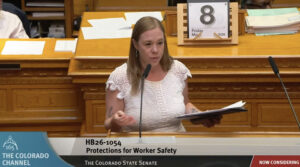
Colorado state Sen. Katie Wallace explains House Bill 1054 on the Senate floor Friday.
“In the face of the Trump administration’s decision to stop enforcing OSHA policy, this will ensure Coloradans have a right to a safe workplace,” Sen. Katie Wallace, the Longmont Democrat sponsoring HB 1054, told the Senate State, Veterans and Military Affairs Committee on Thursday. “Workers deserve robust safety protections. And while the federal government is failing them, Colorado will once again step up.”
But critics like Squire Patton Boggs attorney Michael Cox, testifying for the Colorado Chamber of Commerce, said the “dismantling” of OSHA’s general-duty clause that bill backers like to cite is entirely blown out of proportion. The agency proposed in July to exempt professional athletes and some animal-focused entertainers, like trainers at SeaWorld, from the general-duty clause to require safe workplaces, but the change is still just a proposal and would affect very few people in Colorado, he said.
“This bill is misguided,” Cox told the same committee of the effort to have the AG’s office write new workplace-safety rules. “HB 1054 is an overreaction to a narrow, largely innocuous proposed federal regulation.”
Workplace-safety bills carry price tags
One reason that both bills sat so long in the committee responsible for approving state spending — HB 1054 had been there since late February and HB 1272 since mid-March before both advanced on May 1 — is because of potentially high implementation costs during a year when the Legislature had to close a $1.5 billion budget shortfall. Sponsors of the measures used different tactics, however, to get around committee leaders’ strict “no new costs” demand.
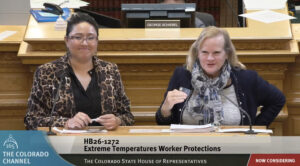
Colorado state Reps. Elizabeth Velasco and Meg Froelich discuss House Bill 1272 on the House Floor on Tuesday.
The authors of HB 1272 — Democratic Reps. Meg Froelich of Greenwood Village and Elizabeth Velasco of Glenwood Springs — cut back what their bill will do. Originally planned as a three-step process in which the state would collect data on temperature-related workplace injuries, require individual TRIIP plans from employers and then create rules to enforce those plans, the bill now just permits limited data collection and directs the state to write the model TRIIP plan for voluntary use.
Still, even those steps will require an additional $91,400 in funding for the Colorado Department of Labor and Employment, and Senate Appropriations Committee members on Friday stalled the bill while asking why the department should get that funding. Other departments that have seen small-dollar new programs as a priority have agreed to fund them within their existing budgets, but CDLE leaders haven’t stepped up to do that or say this is a priority, said Sen. Chris Kolker, D-Centennial.
HB 1272, which passed the House on a Democratic-led party-line vote on Tuesday, is set to go back before the committee on Monday morning.
OSHA-related-bill funding dependent on actions
In the case of HB 1054, staffers at the nonpartisan Legislative Council estimated that the AG’s office would need nine new employees and an extra $1.4 million to write and then enforce the new rules it would have to create. But the bill’s authors — Velasco and Democratic Rep. Manny Rutinel of Commerce City — removed the fiscal note by saying that they do not expect the office to have to write any new rules in the next year and that if it does, it would have to come back to the Legislature to approve the extra funding needed to do so.
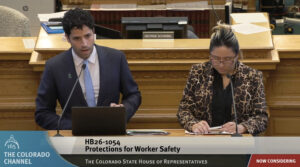
Colorado state Reps. Manny Rutinel and Elizabeth Velasco discuss House Bill 1054 on the House floor on Tuesday.
This prompted Rep. Lori Garcia Sander, R-Eaton, to question why the bill was necessary if sponsors didn’t expect it to lead to any rule creation or enforcement. Cox and fellow Squire Patton Boggs attorney Cole Wist both testified that if any state rules were made, they could create extreme confusion about whether employers need to follow federal law or state law — and whether workers or advocacy groups could file lawsuits against them in state court at the same time they are dealing with federal enforcement.
“I don’t understand why we’re making legislation on speculation,” Garcia Sander said during House debate on Monday, one day before the bill passed on a largely party-line 42-23 vote. She added that the potentially competing state and federal rules give employers a “moving target” on workplace safety with which they’re being asked to comply.
Labor groups laud workplace-safety efforts
Aaron Contreras, a representative with Western States Regional Council of Carpenters Colorado Local 555 said that what’s important about HB 1054 is that it creates a state-level general duty for employers to maintain a safe workplace and a state-level right to a safe workplace for employees. Not only does it give the AG the ability to make rules to back this up and to fine employers who violate them, but workers themselves can file private rights of action to get stop-work orders requiring employers to fix safety violations before reopening, he said.

Sun shines through the trees in Denver.
Meanwhile, while HB 1272 has been cut back significantly — a predecessor bill that died last year proposed very specific regulations that employers must follow when temperatures exceed 80 degrees or drop below 30 degrees — it’s a first step, backers said. While sponsors pulled out any specific CDLE rulemaking authority to reduce its cost, the data collection it authorizes is likely to validate the need to come back in future years and implement a more regulatory measure, several said.
“This, to be clear, isn’t the final bill that we would like to see. We would like to see real protections for the people who are outdoors,” Ean Thomas Tafoya, vice president of state programs for GreenLatinos, told the Senate state affairs committee Thursday. “And I think I can speak for many people from my community who have been disappointed, particularly in this Legislature, as outdoor workers have lost hours of overtime among other things, that at least they could get protections to have access to shade, water, heating.”
What happens next
HB 1054 received preliminary approval in the Senate on Friday and needs just a final vote there and then a vote of House concurrence for it to be on its way to Gov. Jared Polis’ desk. HB 1272 first needs to get out of Senate Appropriations on Monday and then needs two affirmative votes on the Senate floor.
It’s unknown whether Polis would support either of the bills yet. However, the possibility that he could veto HB 1054 is more than just a remote one, given that CDLE leaders testified against the bill, questioning whether this proposed hybrid system — it doesn’t seek state primacy over workplace-safety laws, as 23 other states have — actually would benefit workers.
Legislators are constitutionally required to adjourn the 2026 regular session by the end of the day Wednesday.