
Environmentalists and technology industry leaders came into the 2026 legislative session with different goals on how to regulate or incentivize development of data centers in Colorado. Both will end the session without making any progress.
Sen. Cathy Kipp on Monday afternoon killed her bill to put guardrails around development of the high-cost facilities that process, store and transmit the data that powers the cloud. The Fort Collins Democrat had been engaged for months in conversations about whether she could combine her regulatory focus with an allowance for some incentives — talks that picked up after a competing bill died last week — but admitted Monday that time’s run out.
As a result, Colorado won’t have the nation-leading environmental and community protections she sought to impose, including 100% renewable-energy usage and a requirement that the centers pay all costs to upgrade the grid to accommodate the facilities’ massive electricity use. Nor will it join the roughly 30 other states that are offering financial incentives to bring in centers whose construction costs can exceed $250 million, providing years of construction work and local boosts in sales- and property-tax revenue.
After asking the Senate Transportation & Energy Committee to postpone Senate Bill 102 indefinitely on Monday, Kipp declared that she would be back with another bill in 2027. And she directed a message specifically at industry leaders, telling them that they need to negotiate in good faith, particularly as she and others have heard far more from constituents seeking a ban on incentives than seeking for the Legislature to create them.
An unbridgeable divide on data-center policy
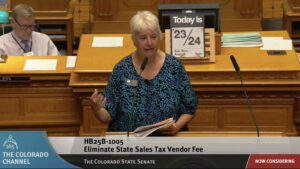
Colorado state Sen. Cathy Kipp speaks on the floor of the Senate during the 2025 special legislative session.
“Industry needs … to come to the table understanding the harms that these data centers can cause to our air and to our grid,” Kipp said. “We expect companies that show up to Colorado to have respect for the communities they will operate in.”
Proponents for these data centers, including labor unions, also argue that they bring good-paying jobs — jobs that are going to locations such as Wyoming and Utah that encourage their construction and are now recruiting Colorado workers to come build them. That’s why House Bill 1030, sponsored by Rep. Alex Valdez, D-Denver, sought to offer 100% exemptions to facility operators on state sales tax for as long as 30 years if they met both spending requirements and conservation requirements regarding emissions and water use.
Unable originally to thread the needle between environmental groups’ concerns and business groups’ desires to make the incentives attractive enough to pull in investors, Valdez circulated a 58-page amendment to his bill three weeks ago. But after initial optimism, he asked the House Energy and Environment Committee to kill HB 1030 on Thursday, lamenting that he could not get Colorado in a position to both protect itself and bring economic benefits to what he described as in increasingly poor state.
Big changes seemed to be offered too late
Kipp also authored a major strike-below amendment where she sought compromise between the feuding sides on this issue. It aimed to solidify environmental requirements such as limits on diesel backup generators and renewable-energy requirements based on how close a utility is to meeting its emissions-reduction goals, but it also would have offered limited tax incentives to try to make the state competitive for projects.

Colorado state Rep. Alex Valdez speaks during an online news conference in January about his bill to incentivize data centers.
However, like with the case of Valdez, she said she couldn’t find consensus, and she was told by several senators that they didn’t want to see a massive makeover of such an important bill with just three days left to go before the session adjourns on Wednesday. So, she too had her bill killed, leading committee chairwoman Sen. Lisa Cutter to say she is “incredibly discouraged” at the lack of data-center policy from the Legislature this year.
“Now no one gets incentives for data centers, but we also don’t have any guardrails with data centers, and I find something troubling about that,” said Cutter, a Morrison Democrat and environmental advocate. “Solutions aren’t always perfect. But we have to start somewhere. And I’m disappointed we aren’t going to be starting with this bill this year.”
Next year’s discussions could be influenced by the results of the 2026 gubernatorial and legislative elections. Gov. Jared Polis has been an advocate for attracting data centers, which influenced the way the bills were approached, but he is term-limited and will be out of office by the start of the 2027 regular session. And majority Democrats must figure out how to reconcile competing views on these facilities between two of their primary interest groups — environmental advocates and labor advocates.
Eagerness, fear surround data-center development
Colorado is headquarters to 10 data-center companies, many here to take advantage of the large technology workforce, yet none of them are working on any in-state projects that would have been large enough to qualify for incentives under HB 1030. It also is home to a population that is drawn increasingly to electric vehicles and to heat pumps and needs a modernized grid to handle the increased demand for electricity — modernization that must come with data-center development.
Surveys show that consumers already stung by rising utility bills fear they will have to foot the bill for even further upgrades when data centers come online, but utilities like Xcel Energy have promised to put policies in place to ensure that the centers pay their way. A Public Utilities Commission hearing on large-load tariffs later this year is the likely battlefield for part of the debate that never fully happened at the Legislature this year.
On Dec. 12, utility, business and union leaders gathered for a day of discussion to accompany the formation of the Colorado Energy Crossroads coalition, meant to push for policies that consider utility costs and labor impacts when legislators make energy policy. Much of the discussion was around the negative impacts that could come with a long-discussed bill to require utilities to get to net-zero emissions by 2040 — a bill that did not get introduced this session in the face of business and labor pushback.

Kaitlin Monaghan, senior director for Vantage Data Centers, answers a question during a panel discussion on data centers at the Dec. 12 Colorado Energy Crossroads event.
Next steps in debate uncertain
But a panel at that event also dug into the costs and benefits of data centers, and manufacturing leaders who said they need a guarantee of grid stability before they expand somewhere pointed to states with data centers and noted grid modernization there. Meanwhile, Kaitlin Monaghan, senior director for Vantage Data Centers, said that if Colorado would offer some sort of significant data-center incentives, there would be “huge demand” among companies to take them and build here.
“It’s expensive for a business to operate in the state of Colorado right now, so any opportunity we have to get a large load to come in … would be helpful,” asserted Erin Hackett, a lobbyist for the Manufacturing Alliance of Colorado. “We need collaboration and connectivity between all the players.”
That collaboration could not produce consensus this year between groups worried about ratepayer and environmental impacts and those worried about economic-development and job-creation needs. So, data centers will remain regulated only by local governments for now, and interest groups will prepare for what surely will be another debate in 2027.