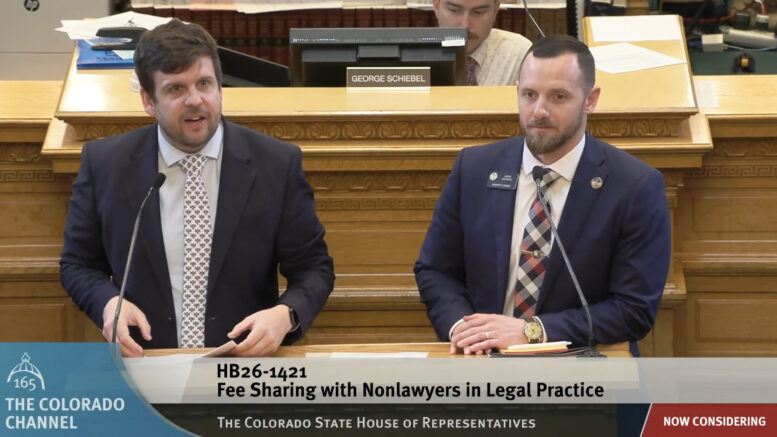
Colorado law firms would be unable to enter into financial agreements with any business not owned by attorneys — including those owned by private equity — to share the winnings of cases under a bill that the Colorado House sent to Gov. Jared Polis on Tuesday.
House Bill 1421 represents a collaboration for the second year in a row between the Colorado Chamber of Commerce and the Colorado Trial Lawyers Association to limit money from outside the legal profession from influencing how firms try cases. Last year, the often-feuding organizations teamed up to pass a measure that requires any law firm that has taken a foreign investment to handle a specific case to register with the Colorado Attorney General’s Office.
This newest effort, which passed the Senate by a 33-2 margin on Monday and then repassed the House on a 53-11 vote Tuesday, is a reaction to what is happening in some neighboring states, particularly Arizona. Five years ago, that state permitted alternative business structures in which non-attorneys can own law practices — something that is disallowed in most states — and there has been a rush of investment in the firms by everyone from private equity to accounting firms.
When non-lawyers fund firms or lawsuits, decisions on what cases to take or how to settle are driven more by profit than by a client’s needs, said Rep. Javier Mabrey, D-Denver, who sponsored HB 1421 with House Minority Leader Jarvis Caldwell, R-Monument. The bill reinforces that only attorneys can own law firms here in Colorado, but it also includes several provisions meant to stop the backdoor collaboration with out-of-state ABSs that attorneys say is happening now.
Specifics of the proposal

Personal-injury attorney Kyle Bachus discusses House Bill 1421 in April on the “Colorado Chamber Office Hours” podcast.
The bill prohibits Colorado law firms from entering financial or contractual deals with an ABS if the arrangement relates to providing legal services, and it bars Colorado firms from practicing with professional companies authorized to provide legal services if a non-lawyer owns that company or has the right to direct the judgment of a lawyer. This is meant to stop out-of-state ABSs from agreeing to cover, say, advertising costs for a local firm if they get a percentage of winnings from a case they may refer to them, attorney Kyle Bachus explained on the “Colorado Chamber Office Hours” podcast last month.
While CTLA leaders said this will protect the integrity of the legal system, business leaders said it will help to keep out of the state some of the nuclear verdicts that can ravage a defendant company and raise risk so much for employers that insurance costs rise for everyone. That’s a reason why groups like the American Property Casualty Insurance Association supported HB 1421 as well.
A 2022 U.S. Chamber of Commerce study found that the average Colorado household paid $4,149 a year more for health care, professional services and even household goods because increasing legal liability made everything more expensive. And Colorado Chamber President/CEO Loren Furman noted that Colorado, once ranked among the top 10 states for its lawsuit climate, had fallen to No. 21 in the latest rankings by the U.S. Chamber’s Institute for Legal Reform.
Diversity of opposition to bill
“This is a large enough issue that’s it’s getting national attention … For me, it comes back to the perverse incentive structure,” Caldwell said during debate on the House floor on May 1. “Is this how we should be doing law and lawsuits in the state of Colorado? And is this hurting our businesses? That’s why I’m on this bill.”
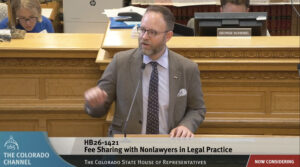
Colorado state Rep. Matt Soper speaks against House Bill 1421 on the House floor.
Despite the ideologically diverse backers, the bill encountered opposition on several counts as it moved through the General Assembly over the last month, culminating in its passage on the penultimate day of the session.
Rep. Matt Soper, R-Delta, noted there are only three law firms left in his hometown and said that small-town firms struggle to compete with the resources of bigger, typically urban firms. By cutting off a potential source of funding to launch a local firm or help it to grow, Soper said, it gives more of a monopoly to the largest firms in Colorado.
Dave Johnson, CEO/founder of Modern Family Law, characterized law firms’ ability to seek outside funding not as an ethical breach but as an innovation that brings vitality to a legal industry dominated by a handful of big personal-injury firms. The CTLA obviously would support it because its members would benefit most from limiting the entry of new, capitalized law firms to the state, he told the Senate Judiciary Committee on Wednesday.
HB 1421 would clarify rules for law firms
“This is what the Colorado Trial Lawyers Association doesn’t want coming into Colorado: They don’t want competition … They don’t have to innovate,” Johnson said. “If you give a mouse a cookie, they’re going to want a glass of milk. They’re going to want to come back next year and ban AI.”
And Rep. Cecelia Espenoza, D-Denver, said she is concerned that the Legislature is stepping inappropriately into the territory of the Colorado Supreme Court, which is the sole entity regulating issues like this now in Colorado.
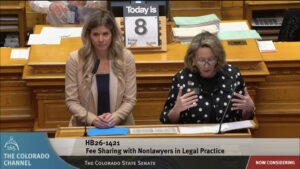
Colorado state Sens. Lindsey Daugherty and Lisa Frizell present HB 1421 in the Senate.
However, Sen. Lisa Frizell, the Castle Rock Republican who cosponsored HB 1421 in her chamber with Democratic Sen. Lindsey Daugherty of Arvada, said the Legislature has been forced to step up on this issue because the state’s highest court hasn’t. CTLA petitioned petitioned the court to issue an opinion on local law firms’ relationships with ABSs, but the court wrote that it is a gray area on which it didn’t want to act, Frizell said during Senate debate on Friday.
The final vote, like the sponsorship and backing of the bill, reflected a wide range of the political spectrum. Now Polis has until June 12 to sign or veto the bill.