
Negotiations over legislative bills typically happen behind closed doors. But thanks to an amendment added in the final days of the 2026 session to a controversial transportation-funding proposal, negotiations aren’t just out in the open; they’re literally part of the bill.
House Bill 1430, which is expected to receive its final necessary approvals just before the Legislature adjourns today, is a late-session bill meant to avert what its sponsors say would be the “irresponsible” fiscal policy of Initiative 175. That initiative, if it gets enough signatures to make it onto the November ballot and is passed by voters, would require that all sales taxes from automobile and vehicle-fuel sales and two-thirds of the taxes generated by sales of motor-vehicle parts go to road maintenance, repairs and expansion.
That would redirect about $700 million annually from the legislative budget’s general fund into the Highway Users Trust Fund — and, Democratic legislators say, would force further cuts to priority areas like health care and education. So, HB 1430 seeks to reduce existing transportation funding by the same amount if the ballot initiative were to pass, making the required transfers essentially a wash and not requiring further service cuts.
Amendment seeks to stop ballot measure
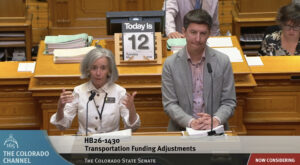
Colorado state Sens. Judy Amabile and William Lindstedt discuss House Bill 1430 in the Senate Tuesday.
As if the contingency on which the bill hangs weren’t unusual enough already, however, sponsoring Democratic Sens. William Lindstedt of Broomfield and Judy Amabile added another contingency late Monday that could shake up the dynamics around the issue. An amendment states that if the Initiative 175 proponents withdraw their ballot initiative by June 15, the state will facilitate a working group to discuss pathways on how to boost road funding in the future, populated by construction professionals, local-government officials, environmental leaders and more.
Lindstedt said the idea is based on separate governor-appointed working groups that met out of the public spotlight over the past year and reached previously elusive consensuses on artificial-intelligence regulations and reform of the Regional Transportation District. And with the addition of the amendment to the bill, he said that the choice now lays in the hands of the coalition, led by the Colorado Contractors Association, pushing the initiative.
“It’s kind of a choose-your-own-adventure for the proponents of 175. Do they withdraw their measure and get this thoughtful group to consider transportation funding?” he said to the Senate Finance Committee. “It is a better path forward that I hope they will accept.”
Initiative backers want guarantees on transportation-funding levels
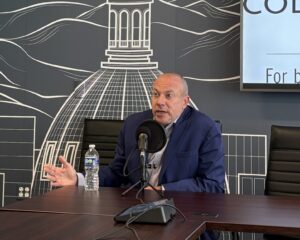
Colorado Contractors Association CEO Tony Milo speaks about road funding on the “Colorado Chamber Office Hours” podcast.
But while CCA CEO Tony Milo said that negotiations are ongoing with the sponsors of HB 1430, he indicated that the proposal is not an acceptable compromise yet, especially as polling shows high levels of support for Initiative 175. He particularly is concerned that the amendment would require his Restore Our Roads coalition to scuttle the initiative four days before members of the working group would be appointed and hope that it came up with a solution over the next four-and-a-half months that Initiative 175 backers would like.
“We are working with the bill sponsors on a working group,” Milo told the committee. “But we are absolutely going to have to see the results of the working group — and have it be enough money to move the dial — before we will pull the initiative.”
These unusually public negotiations are complicated by the fact that the Legislature must adjourn by the stroke of midnight tonight, meaning there are only hours left to discuss potential changes to the language of the amendment. In the meantime, the bill continues to zip ahead, receiving preliminary approval from the Senate Tuesday after passing the House Friday on a largely party-line vote.
Both sides have used strong language to discuss the merits or problems with HB 1430. Lindstedt, for example, called Initiative 175 an “existential threat” to a state budget that took some $1.5 billion in cuts this year to areas like public health care while also describing the ballot proposal as a money grab by a well-funded special-interest group.
Transportation-funding debate has touched nerves
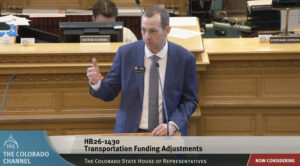
Colorado state Rep. Andy Boesenecker discusses HB 1430 on May 6th.
Opponents, including almost all the Republicans in the Legislature, describe HB 1430 in turn as a subversion of democracy that undercuts the will of the voters who are trying to tell their elected representatives that they want them to prioritize road funding. Sen. Bryon Pelton, R-Sterling, said that changing law to squelch a ballot initiative is more injurious to democracy than Democrats accuse President Donald Trump of being, and Sen. Larry Liston, R-Colorado Springs, equated it to threatening the voters.
“To me, it’s like you’re holding a gun to the head of the voters, saying ‘Hey, if you pass 175, there will be retribution,’” Liston said during the Senate Appropriations Committee hearing for the bill on Tuesday morning. “’Don’t dare put more money into roads and bridges, which we’ve underfunded for years.’”
Rep. Andy Boesenecker, the Fort Collins Democrat cosponsoring the bill in his chamber, told the “Colorado Chamber Office Hours” podcast that the claim that the Legislature has ignored roads is a red herring. The General Assembly has put an average of $465 million in new money from the general fund into transportation each year for the past decade, which the vast majority going to roads and bridges rather than to transit, he said.
What HB 1430 would do to transportation funding
But if Initiative 175 were to pass — and Milo said that HB 1430 on its own will not get proponents to pull the ballot initiative — the bill would impose significant cuts. It would eliminate $200 million in transfers now being made annually from the general fund to roads and would reduce the gas tax, the special-fuel excise tax, the road usage fee that acts like a tax, vehicle-registration fees and late-registration fees and backfill all of them with the sales-tax revenues Initiative 175 would require to be transferred.
The Keep Kids First Issue Committee — made up of about 40 healthcare, education, transit and fiscally progressive organizations — said in a statement late Monday that it hopes the new offer would convince proponents to withdraw Initiative 175.
“If they do so, the Transportation Improvement Advisory Working Group will be created, providing an opportunity to find solutions without destroying our state budget,” committee spokesperson Serena Woods said in a news release.
Alternative working-group proposal dies in Senate debate
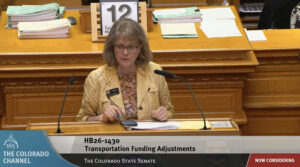
Colorado state Sen. Barbara Kirkmeyer discusses House Bill 1430 in the Senate on Tuesday.
Seeing that the current amendment wasn’t satisfactory to initiative supporters, Sen. Barbara Kirkmeyer, R-Brighton, tried to speed the working group’s schedule through an amendment of her own Tuesday. Her proposal would have required the group to begin working by June 15, offer a preliminary report by July 15 and make recommendations by August 10, all of which would allow Restore Our Roads to keep pushing ahead with its ballot efforts and decide before the September deadline to yank proposals from the ballot whether to accept the alternate plan.
Amabile, however, said that she and other HB 1430 supporters want to see a commitment from the roads coalition to pulling the ballot initiative before the working group starts, adding that the timeline Kirkmeyer offered is too rushed for good policymaking. (The sponsors’ amendment added to the bill now requires the group to make final recommendations to the Legislature by November.) And Kirkmeyer’s amendment died on a 21-14 vote, with only Democratic Sens. Kyle Mullica of Thornton and Janice Marchman of Loveland joining Republicans in supporting it.
Majority Democrats are expected to pass HB 1430 with the working-group amendment attached today as the clock runs out on the legislative session. If so, a new clock will begin counting down for just over a month to see if the offer of the working group can avert a ballot showdown over transportation funding.