
On the last day of the 2026 legislative session Wednesday, Colorado senators killed a bill to let state regulators oversee workplace safety for the first time, giving a win to business leaders who called the proposed rules unnecessary and potentially unconstitutional.
The defeat of House Bill 1054 seemed to offset, in large part, the passage Wednesday of a separate workplace-safety bill, HB 1272, which seeks to offer greater protection to workers laboring in extreme heat or cold. However, that bill underwent major changes and passed not as a regulatory measure but one that lets the state gather data on temperature-related workplace injuries and develop model temperature-related injury and illness plans (TRIIPs) that employers could choose to adopt.
HB 1054, sponsored by Democratic Reps. Manny Rutinel of Commerce City and Elizabeth Velasco of Glenwood Springs, bothered employers and employment attorneys more, however, because it threatened to set up confusing and potentially conflicting federal and state rules. And the final vote — which featured opposition from six Democrats, including a key “no” from Sen. Matt Ball, a progressive but pragmatic former attorney — seemed to indicate that questions about the bill’s applicability overshadowed sponsors’ desire to protect workers.
The bill sought to allow the Colorado Attorney General’s Office to adopt rules on workplace safety in any instance when the federal Occupational Health and Safety Administration were to roll back such rules. Bill backers, noting that investigations completed by the federal agency fell 35% during the first nine months of President Donald Trump’s second term compared to the average of the previous 16 years and that OSHA penalties fell by 47%, argued the president is dismantling federal workplace-safety rules.
Employers offered several concerns about workplace-safety regulations
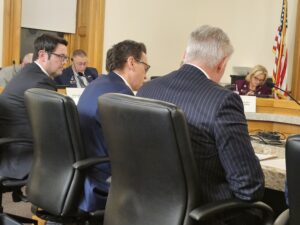
Former legislator Cole Wist testifies against House Bill 1054 Thurdsday while Colorado Association of Home Builders CEO Ted Leighty looks on.
But former House Minority Leader Cole Wist, a Squire Patton Boggs attorney representing the Colorado Chamber of Commerce, said such fears are overblown, particularly since the biggest change from the administration has been to propose that OSHA rules don’t pertain to professional athletes and animal-focused entertainers like those at SeaWorld. And Colorado Stone, Sand and Gravel Association Treasurer Chris Oestreich noted that OSHA funding is down just 0.5% year over year.
Beyond the issues with the current administration, Wist argued that Colorado could do as 23 other states have done and petitioned OSHA to enforce workplace safety from a state perspective, a process that could take years to set up a department and cost millions of dollars to staff. But HB 1054 did not go that route, instead seeking a hybrid path in which the state would not be the designated enforcer of rules but would only step in where it saw fit, setting up a confusing structure where employers wouldn’t know whether to answer to the U.S. or Colorado governments.
“It’s unclear whether the AG or OSHA would bring an action in” the case of, say, a fatal workplace accident, Wist told the House Business Affairs and Labor Committee on Feb. 26. “There is a path for a state to go down regarding workplace-safety regulation. This bill goes halfway and does damage in the process.”
In addition to all Senate Republicans, Ball was joined in his opposition to the bill Wednesday by Democratic Sens. Judy Amabile, Jeff Bridges, Lindsey Daugherty, Kyle Mullica and Marc Snyder.
Extreme-temperatures protections get a foothold
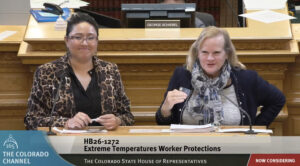
Colorado state Reps. Elizabeth Velasco and Meg Froelich discuss House Bill 1272 on the House Floor on May 5th.
In lieu of granting the state broad rulemaking powers over workplace safety, the Senate passed a bill instead that allows the state to take a more active role in protecting farm workers, landscapers, roofers and other laborers who work outside. And HB 1272, proponents said repeatedly, is just a first step in the discussions of what the state can do to ensure the safety of those workers.
Sponsoring Democratic Reps. Velasco and Meg Froelich of Greenwood Village brought a failed bill last year that was very prescriptive in its regulations for those workers, mandating employers actions as specific as providing 32 ounces of drinking water per hour, chilled to no less than 60 degrees, when temperatures at outdoor workplaces exceeded 80 degrees. After being told such levels of regulations were unworkable, the duo came back with a less specific bill this year that sought to study and analyze outdoor working conditions, though it still changed several times as it moved through the Legislature.
The version that will land on Gov. Jared Polis’ desk — and is expected to be signed after several business groups dropped their opposition — requires the Colorado Department of Labor and Employment to collect data from existing government sources on temperature-related workplace injuries, as well as to take reports from workers themselves. It then must develop a model TRIIP advising employers how they can monitor workplace conditions, train workers and provide workers relief through shade and shelter, water breaks, rest breaks and other measures.
A first step toward workplace-safety guidelines?
Some sector groups, such as Colorado Ski Country USA, argued even after the bill was narrowed that it should still be rejected because the model TRIIP plan advises employers to set “nonsensical” standards. But supporters like GreenLatinos and Voces Unidas said that with Latino workers disproportionately represents among laborers doing outdoor jobs, the state needs to understand better what harms they face and take the first steps to getting employers to protect them.
“To be clear, the larger goal is to prevent death and serious injury,” Alex Sanchez, president/CEO of Voces Unidas. “We’re talking about data collection. We’re talking about a sample safety plan. That’s it.”
HB 1272 passed the Senate by a 21-14 vote, with only two Democrats joining with all of the chamber’s Republicans in voting against it. It then repassed the House on a fully partisan, Democrat-led 43-22 vote.
The legislative session is required constitutionally to end by the conclusion of the day today. Polis has until June 12 to sign or veto bills.