

Emissions-producing Colorado companies from oil-and-gas drillers to manufacturing firms will see some of their reporting fees double over the next year, as state officials seek to make industrial leaders pay more for enforcement of the regulations that govern them.
Members of the Colorado Air Quality Control Commission on Friday approved more than $13.5 million in fee increases meant to cover the gap between revenues and operating expenses for the Stationary Source Control Fund programs that seek to limit air pollution. They also streamlined some reporting requirements for businesses and asked Colorado Air Pollution Control Division leaders to be more transparent about how the increased revenues are improving services.
Despite the hefty increase in fees just one year after an initial increase in the same fees by a smaller but still significant amount, business leaders didn’t oppose the cost hikes, saying they understand they are needed to keep the APCD functioning. However, they asked the division that oversees the SSCF programs to commit to using the new money to speed up permitting — a request that was granted only partially in the final rules around the fees.
Though the AQCC approved the fee increase unanimously, some members also said they were uneasy about the size of the increases, which will be borne by utilities, landfills, refineries, rigs and large manufacturers of everything from cement to beer. Commissioner Dan Blankenship said while he has concerns about the fee increases, he felt after a two-day hearing that they are a “reasonable allocation” for the growing work of state regulators — though more revenues should mean quicker permit processing, he added.
Why have costs risen so much?
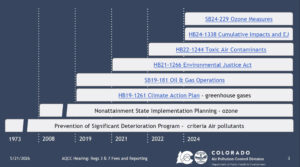
A Colorado Air Pollution Control Division chart notes some of the new laws that have led to cost increases in the division’s operations.
“I’m neither a fan of runaway government nor the spending that is associated with runaway government. But we have some of the most rigorous air-quality laws, and that comes at a price, which, according to the General Assembly, will be paid by the fee payers,” Blankenship said. “If we don’t establish fees to cover the budget expenses, we put the APCD into a conundrum … If the division is unfunded, which of these mandates do they not comply with?”
The reason that fees are going up, APCD staffers explained, is partly because the division has been given so many new mandates in recent years by the Legislature.
Two 2019 laws aimed at reducing emissions have spurred 50 rulemakings since 2021 adding air-pollution regulations on oil-and-gas producers, manufacturing facilities, large commercial buildings, landfills and even commercial users of lawn and garden equipment. Legislators also have established rules regarding environmental justice, the cumulative impact of multiple pollution sources and toxic air contaminants — contributing to a doubling of APCD staff since 2020 to more than 400 workers currently.
As workloads have risen, general-fund money going into the APCD’s SSCF has fallen during the ongoing multi-year budget shortfall, and federal funding has become less dependable as well. As such, the first increase in fees meant to offset those reductions, approved in April 2025, and this subsequent increase, which will take effect for some fees in July and for some in January, is meant to make the air-pollution programs self-sufficient.
Fees rising as much as 127%
Under the proposal approved Friday, emitters will see a 127% increase in permit-processing fees and 95% increases in annual per-ton fees on criteria pollutant emissions and on hazardous air pollutant emissions. Their Air Pollution Emission Notice filing fees will jump 86% and their annual fee on greenhouse-gas emissions will rise 11% per ton. And they will have to pay a new fee on emissions reporting notices.
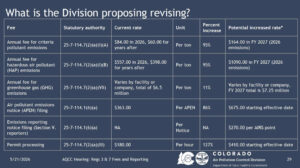
A Colorado Air Pollution Control Division graphic explains the increases in fees approved Friday by the AQCC.
Those hikes will come on top of 50% to 66.5% rises in existing fees that the AQCC approved one year ago. And they represent increases of as much as 40% over the fee hikes that APCD officials were seeking just five months ago as federal funding has become more unsure.
Officials representing utilities, the oil-and-gas industry and general business all said they were not contesting the fees, aside from a request from the Colorado Chamber of Commerce that sought unsuccessfully to reduce the cumulative increase by $2 million. However, after years of complaining about delays in construction and operations because of molasses-slow permitting speeds, they pleaded for the AQCC to require proof with the newest fee hikes that the money would make permitting more efficient.
According to APCD numbers, the median number of days to process permit applications more than tripled from fiscal year 2021 to fiscal year 2025 — from 314 to 1,036 (or more than three years) — before falling slightly to 837 days this fiscal year. And that comes despite the doubling of staff during that time, the significant increase in costs in these permits to companies and the fact that the statutory timeline for approving permits is supposed to be no more than 135 days.
Several reasons for permitting delays
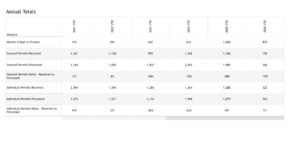
A chart shows the growth of time needed to process emissions permits over the past six years.
“This needs to change. We need to have permits issued in the statutory timeline,” said Chris Colclasure, a managing shareholder at Beatty & Wozniak who was representing the Colorado Oil & Gas Association. “It is reasonable for you to say that you expect these initiatives will make a difference.”
Asked why the backlog has grown so cumbersome, Colclasure said the new rules around topics like environmental justice and greenhouse-gas emissions reductions have added complexity to the permitting process and required more analysis. Stefanie Shoup, APCD deputy director for regulatory affairs, said that as the permitting threshold for major emitters has fallen due to longstanding violations of federal ozone limits, consideration of permits has gotten more technical and complex, slowing the process more.
Several efforts already are underway to increase permitting efficiency, Shoup noted. A legislatively mandated SSCF stakeholder group is reviewing operational-efficiency objectives with fee payers. APCD is undergoing an audit to determine whether it has sufficient funding and staffing to meet statutory objectives. And state leaders hired both a third-party consultant and a chief operational improvements officer for APCD to tackle the backlog as well.
With the changes having produced only longer permitting times to go with higher expenses, Colorado Chamber Regulatory Affairs Advisor Dave Kulmann argued that the AQCC should reduce the proposed $13.5 million fee increase by $2 million, cutting SSCF revenues next fiscal year from $44.1 million to $42.1 million. The increase would still amount to the largest single-year increase in fees in the history of the air-pollution program but could force efficiencies and give a break to businesses already spending significant resources on the amount of time they must wait for permits, he said.
Are boosts in fees burdensome or “modest”?

Julie Rosen speaks during an online meeting in 2025.
Julie Rosen, representing the Colorado Utilities Commission, further argued that taking steps to control spending is important because of the unique way the fees are assessed, which is based upon tonnage of pollution. As emitters continue their efforts to bring down pollution, the tonnage of emissions will decrease, requiring the state either to cut back on control programs or to increase the per-ton assessment on permit holders, meaning businesses expect greater efficiency if they’ll be paying more.
Several AQCC members pushed back, however, by saying that they didn’t believe they have the ability to change the budget for the program that was given to them by the Legislature. And Shoup said that a reduction in funds would leave the division unable to cover the costs of the regulations that the Legislature requires it to enforce.
Boulder County Air & Climate Policy Advisor Cindy Copeland, meanwhile, told the commission that she believes the 95% fee increases are “modest” because they still fall short of generating all the revenue the division needs for full operations. And representatives from groups like Earthworks and Mi Familia en Accion argued in public comments that the regulated companies should bear the brunt of the new costs because some of the targeted corporations are very wealthy.
Fee increases add to other recent regulations
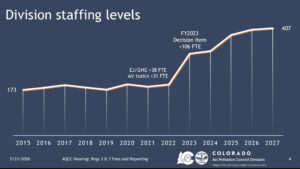
A Colorado Air Pollution Control Division chart shows increases in staffing levels in recent years.
Instead of cutting fees, Blankenship and fellow commissioner Gregg Thomas pushed the AQCC to add to the statement of basis and purpose for the new rules a provision requiring the APCD to provide commissioners more information on how fee revenues are being used. It specifically seeks more information on cost per program, with Thomas saying he wants to go deeper than the high-level information the division now provides.
“I agree that reducing permit wait times would be the single-best accomplishment APCD could make,” Thomas said. “I will support the division’s recommendation. But at this point, the questions from fee payers will only get harder as fees increase through 2030.”
The new fees come one month after the AQCC approved new regulations limiting toxic air contaminants — pollutants like benzene and formaldehyde that cause health problems — from facilities ranging from oil wells to wastewater treatment plants. Meanwhile, the commission is scheduled to re-examine rules on manufacturing facilities and on gas-powered lawn-and-garden equipment in the coming months.