
A group of nine environmental organizations has asked Gov. Jared Polis to request the U.S. Environmental Protection Agency reclassify the Northern Front Range as being in “extreme” noncompliance with federal ozone standards, which would trigger greater restrictions on emission producers ranging from oil-and-gas rigs to drivers of individual vehicles.
Business groups, including Denver South and the Colorado Chamber of Commerce, are pushing back on the request and asking the Democratic governor to look at other, more pragmatic options than seeking a voluntary reclassification. At stake is the level of regulations that energy and industrial firms, as well as many commuters, could face until the stubbornly high ozone levels come down in an area stretching from Douglas County north to the Wyoming border.
The Northern Front Range has been in violation since 2008 of standards that first limited ozone levels to 75 parts per billion and then, in 2015, lowered them further to 70 parts per billion. State leaders have passed many regulations to try to bring levels down — on oil-and-gas producers, manufacturers, commercial buildings and more — and while sectors like utilities and manufacturing have cut emissions greatly, ozone levels remain elevated.
This spring and summer, during what is known as peak ozone season, the area recorded 66 days of ozone over 70 parts per billion and 42 days over the 75 parts-per-billion mark — days that exacerbate asthma and other respiratory conditions for residents. Some observers have pushed back by noting the poor air quality is often coming from wildfire smoke — Regional Air Quality Council Executive Director Mike Silverstein attributed at least 12 of the bad air days to smoke during a September meeting — and have argued that severe restrictions will hurt the economy without cleaning the air.
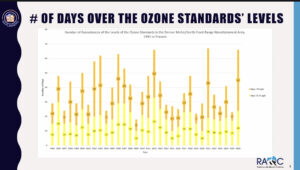
A chart shows the number of days that the Northern Front Range has exceeded federal ozone standards annually.
Why the groups want the new ozone designation
Still, on Oct. 14, environmental groups including the Center for Biological Diversity, Colorado Sierra Club and 350 Colorado asked Polis to seek a voluntary noncompliance upgrade to “extreme,” the highest level on the EPA’s scale.
Under the Clean Air Act, they noted, the EPA must approve any such reclassification requests from governors, as it did two years ago when Polis requested a voluntary upgrade from “moderate” to “serious” for the portion of the Front Range in violation of the 2015 standards. Much of the area, however, is now classified as being in severe violation of the 2008 standard because of the length of time of noncompliance.
Such an upgrade would trigger several key steps, noted Jeremy Nichols, senior advocate for Center for Biological Diversity, in the letter and in a follow-up email to The Sum & Substance in response to a request for more information. Those could include:
- Lowering the permitting threshold for major stationary sources of pollution from 25 tons of volatile organic compounds and nitrous oxide annually to 10 tons, which would pull more businesses under the stricter permitting regime for Title V emitters;
- Give the state more authority to limit traffic and motor-vehicle emissions, which it discussed but has not done yet; and,
- Trigger required emissions offsets, allowing the state to demand that producers cut 1.5 tons of emissions for every ton that the state allows new facilities to produce — a step that Nichols called “critical” as officials continue to permit new wells and industrial facilities.
Groups suspect EPA won’t act on its own
Colorado now faces an August compliance deadline with the ozone standards, but EPA won’t be required to act until February 2028, the letter from the coalition stated — and even then, it isn’t likely to act unless it’s sued, it speculated. Polis requesting the voluntary reclassification would send a message that Colorado is willing to take big steps to bring its air quality to an acceptable place, it said.
“While we sincerely hope the region experiences the lowest amount of ozone pollution possible in coming years, it seems unrealistic to believe the region will achieve the exceptionally low ozone levels needed to comply,” the letter states. “Although some emission measures have been adopted, the state has yet to utilize the fullest suite of tools available to confront pollution under the Clean Air Act.”
Business leaders, in letters sent to Polis on Oct. 30, argued that this reclassification not only could do major harm to the state’s already slowing economy but wouldn’t actually lead to cleaner air. And they asked Polis instead to require an evidence-based assessment of how much benefit additional controls could bring to the state and to prioritize feasible, cost-effective improvements instead.
Reclassification could mean at least 55 new facilities qualify as major emissions sources and must go through extensive permitting at a time when the permitting backlog for such projects already has stretched over two years, the Colorado Chamber letter noted. While that would slow commerce and discourage facilities from investing in upgrades, it wouldn’t mandate any emissions reductions, as major-source permitting requires new monitoring and reporting obligations but not a lowering of emissions limits, it added.
Higher restrictions unlikely to clean air, business leaders say
In fact, a study of nonattainment areas across the Rocky Mountain West shows that emissions reductions brought about by compliance-seeking restrictions have failed to produce commensurate ambient ozone reductions, the letter stated. And with the topography and meteorology of the Northern Front Range trapping ozone precursors like VOCs and NOx that constant sunlight transforms into ozone, an increase in restrictions and fines likely still won’t bring this area into compliance, it states.
Instead of seeking reclassification to “extreme” noncompliance, the state should look at more practical pathways that give it a greater range of ways to try to reduce ozone, said Colorado Chamber regulatory affairs adviser Dave Kulmann, writing for two of the organization’s policy councils. Those include seeking a Section 179B exemption from EPA reclassification due to exceptional events and international emissions as Arizona and Utah has done, which would give the state more options of air-cleaning steps to take.
“Colorado should not confuse additional regulatory obligations through reclassification to Extreme nonattainment with progress toward attainment,” Kulmann wrote. “The state can take its ozone challenge seriously while insisting that regulatory decisions be supported by evidence, that legally available relief be evaluated and that the consequences for business, government and households be considered before additional burdens are imposed.”
Ozone could become part of legislative debate
Quinn Schulz, director of policy and legislative affairs for economic-development group Denver South, added in a separate letter to Polis that an extreme reclassification risks speeding through regulations that haven’t been assessed thoroughly. Schulz pointed specifically to proposal put forth recently in the RAQC Blueprint, including regulation of indirect sources of emissions that attract a lot of vehicles, including entertainment and sports venues, warehouses and airports.
RAQC leaders, while pushing for study of the ideas before imposition of emissions limits on those areas, have said that such ideas are necessary because other regulations imposed over the past decade have failed so far to bring the state into federal compliance. The debate over whether steps such as those are necessary could find its way into legislative discussions in 2027.
Neither the environmental organizations nor the business groups that have penned letters to Polis on this matter made similar requests yet to Gov.-elect Phil Weiser, who is set to succeed the term-limited Polis on Jan. 12, leaders of those coalitions said. If Polis does not take any of the actions requested by either side, however, it’s likely that the debate will continue and possibly ramp up with the new administration.