
Even as the amount of financial work requiring the services of certified professional accountants is on the rise, a flood of retirements and lack of interest by younger workers in joining the profession has left that important sector with a significant labor shortage.
Combine that with the fact that anyone testing to become a CPA must complete 150 hours of classroom learning — the equivalent of a bachelor’s and master’s degree in accounting — and those financial and time requirements serve as obstacles to replenishing the sector. But at a time when both business and state-government leaders are emphasizing the need for more skills-based hiring rather than just credential-based qualifications, accounting professionals are teaming with legislators on a plan to rethink how to CPA numbers.
That plan is centered on Senate Bill 76 — a proposal to expand the ways in which people can be eligible for certification as a CPA. The credential, which is held by high-level tax planners and forensic accountants, is required to sign off on audits, represent clients before the Internal Revenue Service and file reports with the U.S. Securities and Exchange Commission, among other duties.
What the bill does
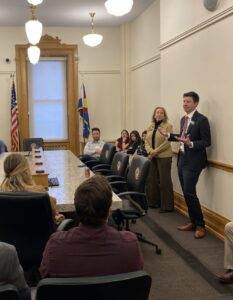
Colorado legislators Lisa Frizell and William Lindstedt speak in 2024 to the Leadership Colorado class at the state Capitol.
Sponsored by Democratic Sen. William Lindstedt of Broomfield and Republican Sen. Lisa Frizell of Castle Rock, SB 76 allows CPA candidates to put more emphasis on their work experience to make up for some classroom time, and it rewards working professionals. And while it is geared toward just one profession, albeit a very important one, the advancing bill could be used as a blueprint on how to boost labor-short professions without requiring candidates to spend tens of thousands of dollars on additional schooling.
The Senate Business, Labor & Technology Committee voted unanimously Thursday to send SB 76 to the Senate floor.
“At its core, this bill modernizes CPA licensure while preserving essential safeguards,” explained Claire Pearson, a principal at CliftonLarsonAllen, a professional-services firm that employees about 150 people in Colorado, including CPAs. “These changes are not about lowering standards. They are about offering flexibility and strengthening the pipeline into an industry facing workforce pressures.”
Diminishing numbers of accountants
While it’s difficult to put into numbers exactly how much the workload for CPAs has expanded in recent decades, the dropoff of people going into the profession is more measurable. The decline in accounting majors and other students completing requirements needed to become a CPA is three times higher than the average decline in other majors, Lindstedt said — even as 75% of the profession reaches retirement age.
Currently, Colorado requires CPA candidates to have a bachelor’s degree in accounting as part of 150 total semester hours of college education and one year’s experience in a field involving accounting, financial advising, tax or consulting. That commitment of resources — a one-year master’s degree program in accounting can cost about $25,000, one witness shared — particularly can discourage non-traditional learners who must balance earning and family-raising responsibilities with the return on investment an additional degree can get them.
SB 76 doesn’t change the requirement to receive a bachelor’s degree with some sort of accounting concentration or the overall 150-hour educational mandate, but it offers flexibility in how individuals can get there. Candidates with one year of work experience can have completed the 30 post-baccalaureate hours without earning a master’s degree, or they can bypass the post-baccalaureate degree altogether by completing two years of experience in the field.
A reduction in burden for potential accountants
Alexandria Romero, a former Pueblo city finance director and CPA, noted it can be particularly hard for people in rural areas to complete the post-baccalaureate requirements because of the paucity of accounting master’s programs in their areas. Adding this flexibility can encourage those professionals to stay in their communities while still requiring them to pass the same test as everyone else to become a CPA, she said.
About half of states have adopted a similar framework as SB 76 contemplates, and creating more pathways to becoming a CPA in Colorado will generate major benefits for local firms that now struggle to hire, others testified. Tobias Clary — a shareholder with Fort Collins-based accounting firm Soukup, Bush & Associates — said his company has had to turn away potential new clients at times because it can’t find enough CPAs to expand.
“For several years our profession has been addressing growing workforce challenges being driven by the compression of the working-age population along with the rising demand for CPA service,” said Alicia Gelinas, CEO of the Colorado Society of CPAs. “With fewer CPA candidates, workload increases and burnout grows, making the profession even less attractive for future candidates.”
One of many efforts to boost workforce development

Early-childhood-education professionals at the Grand Junction regional talent summit discuss ways to boost talent pipelines into their sector in May.
Companies’ unmet need for more CPAs is an example of the growing gap between the skills employers require and the skills job candidates have — an issue ranked as a top-three barrier to job growth by participants in Colorado Chamber of Commerce surveys.
For the past several years, business groups, including the quintet that came together to form the Education to Employment Alliance, have been working with government and education leaders to try to close that gap. Their efforts have included the series of Opportunity Now Regional Talent Summits that produced 232 action plans to boost talent pipelines in key industries and a soon-to-be-introduced bill that would seek to centralize all the state’s workforce-development and higher-education initiatives into one department.
Add SB 76 to the quiver of strategies that these groups seek to employ. Its success could further boost efforts to elevate work-based learning to the same level as educational credentialing in licensing and job requirements.
“I think this bill could go a long way to helping solve a real shortage we have in our state,” Lindstedt said.