
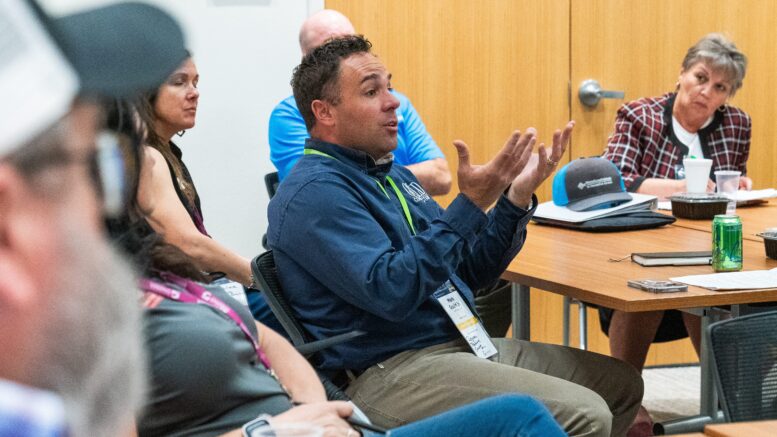
Colorado state officials on Tuesday released a wide-ranging yet focused set of recommendations garnered from seven regional talent summits that lay out strategies for boosting career pathways to help private-sector employers fill the most in-demand jobs.
The regional tactical workforce plans contain actions as broad as forming sector partnerships for underrepresented industries and plans as focused as boosting the number of tech students who get security clearances needed to work at large aerospace firms. They are divided into two- and five-year plans for each of three focus industries in seven different regions of the state, and the total number of proposed tactics — 232 in all — demonstrates the plethora of ways officials are seeking to boost talent pipelines.
In some sense, the reports are the culmination of two years of work that began with a recommendation from the business-led Education to Employment Alliance to hold such gatherings. The gatherings, stretching from Greeley to Durango, received funding in a 2024 law and occurred between February and June this year.
But in another way, these new plans are just the beginning of work that business and government leaders will undertake in conjunction with educators over the next five years to implement the ideas and increase the pool of homegrown talent substantially.
Colorado lagging badly in job creation

A graphic shown Tuesday during the release of the Colorado Talent Pipeline Report shows how much the state lags in private-sector job growth as compared to the rest of the country.
And the strategies come at a crucial time. In-migration to Colorado is slowing substantially, giving employers fewer hiring options. And while there’s roughly one unemployed Coloradan for every open position, private-sector job growth has ground to a halt, ranking 47th nationally in 2025 as employers report wide skills gaps between what applicants possess and what they need.
Eve Lieberman, executive director of the Colorado Office of Economic Development and International Trade, noted during an event Tuesday to release the annual Colorado Talent Pipeline Report, which contains the tactical plans, that the strategies are employer-driven. Thus, what the state is offering is at the behest of the private-sector leaders who will be responsible for hiring individuals over the next five to 10 years and is targeted by region to make it more achievable through partnerships with local educators and workforce trainers.
“We’re really executing and making it actionable,” Lieberman said of the tactical plans, which will move ahead as the state also seeks to reorganize the plethora of state workforce programs in a way that will make it easier for companies and students to take advantage of them. “All these plans are being integrated in a seamless and aligned way to benefit the employer and the learner.”
Though the plans span nine industries — from sectors like advanced manufacturing, construction and healthcare that were identified as priorities in numerous regions to region-specific sectors like agriculture in the San Luis Valley and tourism in the mountains — they share a number of similarities.
Marketing campaigns and industry job maps

Construction leaders discuss ways to develop more craft laborers and technicians at April’s Opportunity Now Regional Talent Summit in Pueblo.
Many sectors, particularly those that don’t require four-year degrees and have been marginalized as career options by some people over the past forty years, want to launch marketing and educational campaigns to inform students of career possibilities. These would be coordinated through newly developed or existing industry groups, just as leaders in the construction industry in southeast Colorado suggested, and could target both students and parents as early as middle school to plant the seeds of career paths.
Also common to many industries and regions were suggestions to boost experiential-learning opportunities, from internships to registered apprenticeships to student visits to workplaces, in order to give students the chance to develop skills. Some summit participants suggested this will require policy changes, such as lifting restrictions on what individuals under age 18 can do on a job site to making it easier for professionals to work with school districts to offer instruction.
Another cross-industry tactic will be the development of industry maps laying out the range of careers that students could enter in a field — delineated with the specific certifications those jobs require, so that learners could plan their pathways to the positions. This was a particular plea from healthcare leaders in areas ranging from northeast Colorado to the mountains, who emphasized that too many students foreclose on such careers because they think they must go to medical school without knowing the bevy of quicker-entry jobs that are in demand.
Specificity of plans a purposeful decision

Grand Junction Area Chamber of Commerce President/CEO Candace Carnahan speaks at May’s Opportunity Now Regional Talent Summit.
Some business leaders suggested at the start of the summits that the recommendations could be so specific as to back the creation of specific credentialing programs via partnerships between specific employers and specific schools. Indeed, none of the 232 tactics were narrowed that much, but regional business leaders said that was a purposeful decision that allows for more participants across vast regions to be part of the solution.
The report for the Western Slope region, for example, suggests tactics such as identifying ways in which technology like exoskeletons can extend the career of aging construction workers and establishing more employer-based childcare centers to boost the early childhood education sector, without pinpointing specific actors. But Grand Junction Area Chamber of Commerce President/CEO Candace Carnahan, who hosted that regional summit and sat on the committee that drew up the tactical plan, said that broader approach will let leaders disseminate these plans now and then find multiple partners rather than narrowing their targets from the start.
“Community partnerships can live and die on what’s on paper. And if you don’t have the ability to explain it properly, it can break relationships,” Carnahan said in an interview. “In this work, we can accidentally be exclusionary when we think we’re being definitive. And it can hurt these efforts.”
And while some suggested pathways were universal, some are unique to their sectors.
Developing talent in many ways

Julie Schafer of Breckenridge Grand Vacations offers ideas during a table discussion at June’s Opportunity Now Regional Talent Summit in Edwards.
Leaders in the tourism sector in the mountain region, for example, suggested they work with public and private partners to develop a seasonal workforce exchange program that allows them to import talent in high seasons and help that talent work elsewhere in the state or country when business slows. This will involve creation of matchmaking forms, shared benefit platforms and opt-in databases — but is something that participants believe can be done in the next two years.
Agricultural leaders in the San Luis Valley first will develop a sector partnership allowing them to speak with one voice and then will develop programs through that partnership that even include housing solutions to support seasonal workers.
Early childhood education leaders on the Western Slope will look to boost the workforce through expansion of concurrent-enrollment programs and apprenticeships specific to their industry. But they also will develop messaging about the need for public resources to subsidize an industry that must remain lower-wage in order to keep its services affordable, possibly through more government-funded training or other means, Carnahan said.
Aerospace talent requires security clearances
Aerospace leaders in the Denver area, meanwhile, said they’ve faced barriers to expansion because of the lack of workers who have achieved security clearances, a multi-year process that is required of one-third of sector workers and two-thirds of workers at military-focused companies like Lockheed Martin Space. So, the tactical plan calls for expansion of a model clearance class that sector leaders developed with state officials, followed by advocacy for policy changes around the process and development of a job-sharing program for individuals waiting for security clearance.

Joe Rice, director of state and local government relations at Lockheed Martin Space, discusses ideas with fellow participants at March’s Opportunity Now Regional Talent Summit in Arvada.
Joe Rice, the director of state and government relations for Lockheed Martin Space who participated in the March summit in Arvada and then served on the committee that wrote the tactical plan, particularly lauded the job-sharing program as a potential game-changer. It would let people who are awaiting security clearance and aren’t allowed to work at their proposed employers while they are undergoing such vetting work in the interim in a public service role like a governmental cybersecurity expert or even a teacher in the security field.
“I really appreciate that they took the feedback that was given to them by our industry on clearances, because I don’t think that was on their radar before,” Rice said of the process. “We’ve been talking about the problem for years and years and years. Well, now we’re going to try some things to see if they will work.”
What happens next

Eve Lieberman, executive director of the Colorado Office of Economic Development and International Trade, speaks at the Opportunity Now Regional Talent Summit in Arvada on March 18.
With the plans in place, the next steps now will involve putting them into action. Much like the summits and process of writing the tactical plans, that will involve a partnership between employers, state officials and educators to launch the marketing campaigns, experiential-learning activities and certification programs that industry leaders ideated.
While the Colorado Workforce Development Council will oversee the progress, the tactics in each plan specify that industry and education partners must develop sector organizations to advise on needs and lay out the skills that must be taught to get graduates workforce-ready. Carnahan said she believes that business leaders, seeing the benefits they could accrue in terms of both finding and retaining workers more efficiently, will be eager to help put these programs into place.
Officials at education-reform organization Colorado Succeeds, which worked closely with the Colorado Chamber of Commerce and other groups to come up with the idea for the summits and which has been heavily involved in the process, applauded the plans. added This process and others that Gov. Jared Polis is undertaking have moved the state toward a more employer-led, student-centered, data-driven model that will allow better measurement of the return on investment of workforce-development efforts, said Madison Knapp, a director at the organization who oversees pathways projects and talent strategy,
“We know that when business sets the direction and programs align to real demand, pathways become clear and navigable, regional economies strengthen and opportunity expands for learners across the state,” Knapp said.