

Colorado this week became the first state to create a permitting program to protect state waters after a 2023 U.S. Supreme Court decision reined it federal oversight — a program that could limit development and activity near 250,000 acres of wetlands and streams.
The rules approved Wednesday by the Colorado Water Quality Control Commission require state permitting for any dredge-and-fill activities that affect these waters and set up a program of compensatory mitigation to offset impacts to the waters. Businesses, farmers and cities asked commissioners to minimize the number of regulations over the course of a three-day hearing, while environmental and conservation groups sought greater protections. Both sides prevailed on some pleas.
“I think we have a really strong gap rule for the state of Colorado … a really strong rule for protecting Colorado’s waters,” WQCC secretary Nicole Poncelet-Johnson, who was a swing vote on several key provisions of the plan, said after final approval of the rules.
Why the rules for wetlands are necessary
The 2023 decision in Sackett vs. EPA limited federal oversight via the Waters of the United States program to waters that have continuous surface connections to navigable sources like rivers and lakes, leaving all other waters to state control. Because Colorado has a large number of intermittent or non-contiguous sources, roughly 50% of the state waters that under federal regulations lost that protection, leading legislators to step in and pass a 2024 law setting up a state permitting program.
This new program, overseen by the Water Quality Control Division in the Colorado Department of Public Health and Environment, will require construction companies, agricultural interests and anyone else that may disturb streams or wetlands with activities that dredge or fill water sources to get a state permit. Though the new law exempts several types of waters from the program, such as manmade ditches or canals used for farming, it encompasses a larger collection of natural features than previously had fallen under federal regulation.
Business and agricultural leaders clashed with conservation groups over several key provisions in the rules during the hearing, with each disagreement revolving around whether proposed regulations would be so strict as to discourage activities like farming. Utility leaders also weighed into the debate, noting that as the state calls for the expansion of transmission lines, most of those will cross streams and require permits under the new program that could delay progress and raise costs for consumers.
Debate over public impacts
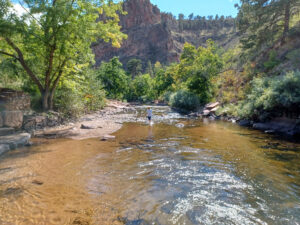
A child plays in St. Vrain Creek in Lyons.
One key issue, for example, was whether the WQCC, in assessing permit applications, should have to consider the public impacts of work beyond that construction project’s direct effect on waters.
Stuart Gillespie, attorney for a coalition of environmental groups including GreenLatinos and Conservation Colorado, argued that the U.S. Army Corps conducts public-impact reviews for project applications, and legislators intended to mirror federal rules. But attorneys for cities, utilities and water districts argued legislators chose not to require public-interest reviews as part of the extensively detailed bill establishing the program and said addition of such reviews would expand WQCC authority well beyond water impacts.
Commissioners voted 5-4 against authorizing public-impact reviews, with Poncelet-Johnson saying that such a broadening of scope could allow outside groups to slow the review process via legal actions, hurting Coloradans.
“It could cost those local ratepayers a lot of money and not necessarily result in improvements for Colorado waters,” Poncelet-Johnson said. “We were asked to focus on state waters. This already does a good job of that. The addition of public interest takes a giant leap that deserves a lot more discussion than ‘Why not?’”
Defining “adjacency” a huge sticking point
Maybe the most important issue for the agricultural community concerned a proposed exclusion from the new permitting rules for wetlands connected to manmade ditches and canals. Having such an exclusion in place means that farmers would not have to seek state permission to, say, build a fence near such a wetland — a requirement that could delay projects and eat up additional resources, particularly if groups opposed such an effort.
WQCD staffers proposed the exclusion for wetlands that are adjacent to ditches and canals, but they stirred controversy by defining “adjacent” narrowly. Specifically, they said permitting-excluded wetlands must be next to or adjoining the ditch or canal and must be supported by the ditch or canal to the degree that it provides a quantity or frequency of water to permit vegetation growth and saturated soil conditions.
That narrowed definition would force a lot more farmers to seek permits from the WQCD, which could in turn require an organization like the Rio Grande Water Conservation District to raise assessments to members, district president Greg Higel told the commission. This would disproportionately harm farmers whose canals feed wetlands that may not physically abut them, and it could be one more burden adding onto the growing number of reasons that small farmers think about leaving the sector.
“As farming becomes increasingly regulated and under additional scrutiny, it becomes harder and harder to maintain a viable farming economy in Colorado,” warned Wes Knoll, an attorney representing the Northern Colorado Ag Water Coalition.
What is ‘close proximity’?

Colorado state Reps. Karen McCormick and Julie McCluskie explain their dredge-and-fill permitting bill to the House in April 2024.
WQCD officials said they needed some way to inform permit applicants what constituted adjacency, however, and WQCC Chairwoman Jennifer Bock said she feared that without a definition, it could leave the state open to legal action like the Sackett lawsuit. State Rep. Karen McCormick, the Longmont Democrat who cosponsored the bill creating the new permitting program, added that broadening the definition of adjacency to land that lay a mile or miles away could exclude another 500,000 acres of wetlands from the rules and leave those areas open to unregulated development.
“The purpose in passing the bill was to establish a comprehensive dredge-and-fill program for state waters,” McCormick said during public comments at the hearing. “Be careful not to turn this exclusion into a dangerous and unintended loophole.”
The debate got to the point where water districts asked to add “close proximity” to the definition of adjacency as a compromise, while conservation groups countered that they wanted the term “very close proximity” instead. The WQCC settled on “close proximity” and added a provision that a wetland would have to cease to be a wetland without water from the ditch if it were to get the exclusion, but it otherwise passed the wording as proposed.
The WQCD will add staffers to run the permitting program and will fund them through new fees — a condition that the regulated community accepted. While water districts and others wanted to put a tight timeline on the division’s consideration of permit applications, WQCD leaders asked for an upper limit of one year, saying that they will have a limited staff and a lot of new applications and will try to turn around the applications more quickly.
“Important first step” for wetlands
WQCD leaders also will require, as part of the newly passed rules, that permit seekers that are disrupting streams or wetlands perform mitigation of an equal amount on other nearby wetlands or streams to ensure environmental balance. National mitigation banks have sprung up already in other states to offer mitigation credits to such applicants and help local officials determine the best way to preserve an equal amount of land.
In the end, both sides gave a little bit as the state wades into unchartered territory by taking over what had been federal responsibilities to protect these smaller but important waters. Now developers, road builders, farmers and others will see how smoothly the new permitting system can operate, and conservationists will watch to see how protective the division will be of streams and other wetlands.
A statement issued Thursday by the Protect Colorado Waters Coalition — a group of 26 environmental and wildlife-protection organizations — may best have captured the wait-and-see attitude that all observers to the process are taking.
“While the rules are not everything the coalition sought, this is an important first step for Colorado’s environment and economy,” the group said in a news release. “Because of the hard work of the state Legislature, the Colorado Department of Public Health and Environment and the Commission, Colorado’s waters are better protected.”