

The requirement to settle disputes via arbitration rather than through the court system has become a near-ubiquitous clause in many contracts, including those between employers and employees, merchants and consumers and investment managers and investors.
For roughly a decade now, some Colorado legislative Democrats have tried to make it harder for companies to enforce such requirements, though they, like officials in other states, have run into prevailing federal oversight of much arbitration law. So, this year, arbitration-reform advocates are tacking a new tact.
House Bill 1236, which is scheduled for its first committee hearing on Tuesday afternoon, would not try to reduce the instances of required arbitration so much as it would seek to ensure that the process runs more fairly, in the words of sponsors. And, just in case courts ever overturn federal oversight of the practice, it would give Colorado the ability to step in quickly prohibit compelled arbitration in so many contracts.
Changes sought to arbitration process
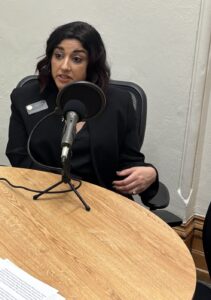
Colorado state Rep. Yara Zokaie discusses her arbitration reform bill on “Colorado Chamber Office Hours.”
It would seek to boost fairness, according to Rep. Yara Zokaie, D-Fort Collins, in three specific ways:
- It would prohibit compelled arbitration in employer and merchant contracts if the fees for the process “substantially exceed” the cost of filing fees in courts;
- It would prohibit individuals from acting as arbitrators if they demonstrate a pattern of conduct that discriminates against a party or type of party involved in the case; and,
- It would require employers or merchants to comply with the requirements of a decision in the case, including potential payments to the other party, within 30 days, giving arbitration decisions teeth that they often now lack.
To be clear, Zokaie, who is sponsoring HB 1236 with Democratic Rep. Javier Mabrey of Denver, would prefer federal reform of the law, so that people can seek relief from the judicial system if they prefer that route. That is why the bill prohibits provisions in arbitration agreements that waive a party’s ability to take the case to court unless preempted in going to court by federal law, which currently is the case with most contracts.
But it they can’t make it harder to force arbitration, they can at least protect the individuals who most likely don’t know in buying a product or taking a job that they’ve signed contracts allowing their legal disputes to be settled that way, she said.
More accessible or more confusing?
“This bill does not, in my mind, lead to less arbitration,” Zokaie told the “Colorado Chamber Office Hours” podcast. “It makes it so arbitration is a remedy that actually can be accessible to people.”
Several attorneys said, however, that what the bill does more than anything else is muddy the waters about whether federal or state law would prevail around arbitration requirements. And in doing so, they added, it could turn what is now a more efficient process for settling legal disputes into one that could become dragged-out and expensive.
First, there is little clarity in the provision about barring partial arbitrators to explain what defines discriminatory behavior — or who gets to decide that, noted Julian Ellis, a partner with First and Fourteenth law firm. That could lead to parties who want to strike a potential arbitrator having to go through the legal system to try to do so before any arbitral process could begin, he said.
Asked about how the provision may work, Zokaie admitted that someone may have to file a lawsuit — or, ironically, an arbitration claim — to generate a hearing to determine an arbitrator’s partiality.
“The first-layer result will be mass confusion,” Ellis said. “All of this is just going to have to be litigated, and it ultimately delays resolution.”
Cost comparison provision in bill

Julian Ellis speaks about the arbitration reform bill on “Colorado Chamber Office Hours.”
Similarly, the bill’s ban on arbitration filings being more expensive than court filings could create uncertain outcomes as well, skeptics said.
Zokaie said the provision applies only to initial filing fees, and she said she feels that plaintiffs in such actions could override the mandate in any contract to take disputes to arbitration if the cost threshold is violated.
However, Sean Gallagher, an employment attorney at Polsinelli, said he believes it’s worded broadly enough that someone could claim that the cost under comparison could include the cost of the arbitrator — a wide loophole, as parties to court actions don’t have to pay judges. And Ellis said he feels the language is obtuse enough to create a “foot-foul situation” where someone could point to a buildup of costs over time in a dispute and say the process should be invalidated because a court would have been cheaper.
Arguments for arbitration

Colorado state Rep. Javier Mabrey, D-Denver
Finally, both men argued that the disputes that Zokaie and Mabrey seek to regulate more closely — and potentially disqualify from arbitral fora — are inappropriate to be handled by a court system. Arguments about an electronic product that someone purchased or about the viability of warranties can move faster through arbitration, where consumers and employers don’t need to hire attorneys and where studies have shown they stand a better chance of success, Ellis said.
“I don’t know what they’re getting at. If there’s a particular problem they’re trying to get at, then the bill should be more narrowly tailored,” Gallagher said. “This is like using a sledgehammer to go after a gnat.”
HB 1236 is part of a broader effort being made by the two sponsors this year to bring about changes in existing practices that they feel are making life more expensive for Colorado residents. Mabrey is the co-sponsor of an advancing bill that would bar employers and online retailers from using consumer surveillance data to set individualized wages and prices, and Zokaie cosponsored an unsuccessful proposal that sought to limit what merchants at captive-consumer venues like sports stadiums and airports could charges for their goods.
The bill is expected to be heard by the House Judiciary Committee at 1:30 p.m. Tuesday.