
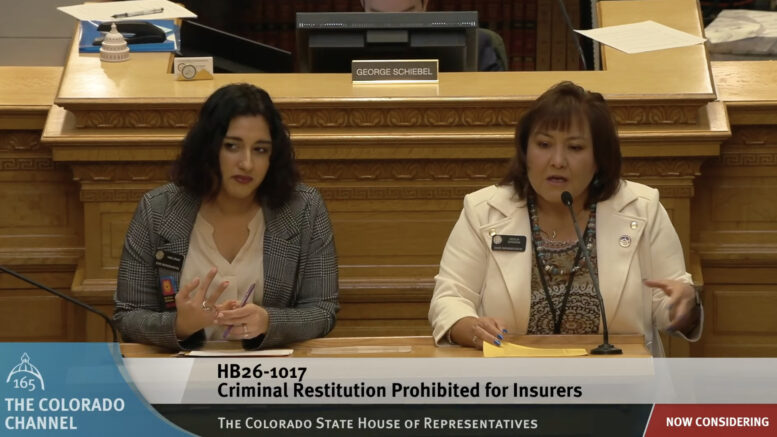
Colorado insurers no longer will be able to receive criminal restitution payments unless they are direct victims of a crime, according to a new law that Gov. Jared Polis has signed.
House Bill 1017, sponsored by Democratic Reps. Cecelia Espenoza of Denver and Yara Zokaie of Fort Collins, brings Colorado into alignment with a handful of other states across the ideological spectrum that have made similar changes in recent years. While it passed by a partisan vote — all Democrats supported it and all Republicans except Rep. Matt Soper of Delta opposed it — Espenoza rewrote the bill as it advanced to eliminate insurer concern by permitting some instances of restitution requests.
Colorado law previously has allowed insurers who were impacted by criminal acts — losing money, say, because of arson on insured home or theft of an insured car — to be included in court-ordered restitution payments that criminals must make to their victims. These orders, which are included in about 600 sentences annually, can prove an added financial burden to individuals who struggle to find work and achieve financial stability while reintegrating themselves to society, bill advocates said.
Rather than bar any insurers from receiving restitution through the criminal sentencing process, however, Espenoza made three exemptions in HB 1017. One allows restitution requirements for those that are direct victims of insurance fraud. Another allows insurers to collect restitution when their property is damaged or stolen in instances like break-ins. And the last allows workers’ compensation insurers to collect restitution.
Why backers sought to end criminal restitution requirements
The goal, sponsors said, is to ensure human victims of crimes are made whole via criminal restitution rather than companies that specialize in business models that analyze risks and price around them.
“When we are putting that person (who owes criminal restitution) through a cycle of debt to reimburse an insurance company, we are simply lengthening that cycle of poverty,” Zokaie said during House debate on Feb. 24. “I do not believe we should impose a lifelong debt on someone to reimburse an insurance company that builds loss into their profit model.”
Several Republicans, including Rep. Ken DeGraaf of Colorado Springs, expressed concern that the bill will add to insurers’ risks and lead them to raise rates on all customers.
“This is a tax. It is an increase in costs,” DeGraaf said. “This is about raising the cost of living in Colorado and making sure that crime does not have to pay.”
Civil lawsuits still allowed
Espenoza noted that the bill still allows insurers to pursue restitution through civil lawsuits if their losses are significant enough. However, sponsors and bill backers testified that few such suits are filed in states with laws similar to HB 1017, showing how inconsequential these particular losses can be to the companies’ bottom lines.
The law is set to take effect on Aug. 12. Polis signed it administratively on Thursday without making any comments.
While insurers expressed little concern with the amended version of HB 1017, many say they are still hurting from a change made during the 2025 special session. Legislators rescinded a longtime and substantial tax credit for insurers that located at least 2.5% of their national workforce in Colorado.