

As Colorado employers have decried the lack of skilled talent entering the state’s workforce over the past half-decade, Colorado has created new programs to boost apprenticeships, help workers get entry-level credentials and get input from employers.
But they’ve been mashed together into a “siloed … disaster” that makes it hard for learners and for businesses to take advantage of them, lamented House Speaker Julie McCluskie, the Dillon Democrat behind many of the laws.
So, on Wednesday, following a half-year of study that sprang from a May executive order by Gov. Jared Polis, state leaders released a report advocating an overhaul of Colorado’s workforce-development system that took input from business and education leaders. Their solution: Combine talent-creation initiatives from multiple agencies — particularly the departments of higher education, education and labor and the Colorado Office of Economic Development and International Trade — into one streamlined department.
While government-agency consolidation may not sound revolutionary, it is what is needed to ensure that students and mid-career workers looking for upskilling know how to utilize state resources — and that employers desperately seeking talent know as well, Polis said. When what is expected to be a multiyear process is complete, learners and businesses will have a one-stop shop with an easily accessible front door where they can get help with workforce training and find pathways to successful careers much more easily.
“If I can’t even name all the state agencies that are involved in these programs, how can a job seeker possibly navigate this?” the Democratic governor asked during an announcement at the Colorado State University Spur Campus in Denver. “There’s been so much innovation. This is really the systemic piece that catches us up with where our innovations already are.”
Skilled-talent shortage hurting employers

Gov. Jared Polis speaks about a plan to streamline workforce programs during a news conference on Wednesday.
The proposal comes at a crucial time for the economic future of the state.
Colorado’s in-migration of residents has fallen significantly since the end of the pandemic, reversing a two-decade trend where businesses leaned heavily on the recruitment of out-of-state talent to expand. Meanwhile, since 2020, less than half of graduating high-school seniors have sought advanced degrees of any kind — bachelor’s, associate’s or even specialty certifications — despite reports showing that 75% of all jobs and 95% of jobs that pay enough to sustain a family require advanced education.
This has left Colorado employers unable to fill key jobs despite the fact that 139,100 Coloradans were unemployed in August, pointing to a significant gap between the skills needed by employers and those possessed by its residents. And that contributed to economists at the University of Colorado Boulder Leeds School of Business forecasting this week that the state faces a year of tepid economic growth in 2026, with jobs growing at a rate of less than 0.1%.
With state business leaders having cited talent shortages as one of their top three obstacles to growth in Colorado Chamber of Commerce surveys since 2023, state leaders have passed several laws in recent years designed to help residents upskill. They OK’d free tuition for certificates in fields such as health care and public safety, funded regional-talent-development summits to bring employers and educators to the same table to discuss solutions and launched a state apprenticeship agency.
Workforce initiatives spread too widely

Colorado state Sen. Jeff Bridges plans to sponsor the coming bill to streamline workforce-development programs.
But as employer participants in the regional talent summits expressed repeatedly, they often are not aware of the state and educational programs they can tap into to contribute to local workforce-training programs or to offer work-based learning opportunities. Students too are left wondering how to access the credentials they may need to break into professions, particularly without four-year degrees, and job creators thus don’t know how to access a large potential talent pool in their backyards.
The state doesn’t need to keep creating new programs, said Sen. Jeff Bridges, the Greenwood Village Democrat who will be his chamber’s cosponsor of the bill to create the new department. It needs to streamline existing programs.
“It matters because that internal organization, those siloes we have, have real consequences to people out in the world who are looking to engage,” Bridges said. “The answer to their questions should be in one place. Right now, it is spread out in too many places.”
The bill, which House sponsor McCluskie said should be drafted within the next month, would put together a group of officials to study and recommend which existing programs should migrate from their current agencies into the newly formed department.
What would go into new department
The programs likely would include the Colorado Workforce Development Council, the Division of Employment and Training, Apprenticeship Colorado, all the initiatives housed withing the Department of Higher Education and some others. These divisions administer federal workforce-focused grant programs like the Workforce Innovation and Opportunity Act, oversee the state’s sector partnership program, fund apprenticeship grants and do other workforce-focused activities.
Colorado State University System Chancellor Tony Frank offered his support as a higher-education leader at the news conference, saying that the reorganization effort offers an experiment to determine if there is a better way to address this issue. The university system is “excited about rolling up our sleeves” to work on the initiative, he added.
Jason Wardrip, business manager with the Colorado Building Trades Council, offered the only note of caution, emphasizing that his union members had worked hard to create the state apprenticeship agency and don’t want to see it changed under a new department. It’s extremely important as the state makes changes to the administration of these programs that it continues to offer non-college pathways that will help students find careers like construction, he said.
“We’ve always been thought of as the second option. We are not the second option. We are a very high-quality first option,” Wardrip said. “There are going to be really hard conversations to preserve what we have built while still helping everyone.”
State leaders believe new workforce agency will quell skeptics
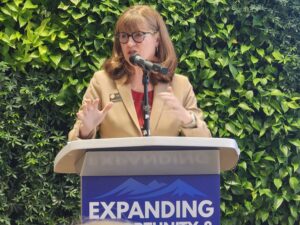
Colorado House Speaker Julie McCluskie discusses a report Wednesday on streamlining Colorado’s workforce-development programs.
Polis, however, insisted that he wants to allow even more employers to implement apprenticeships and that he believes a reorganization and creation of a “one-stop shop” to help residents and businesses utilize state programs is the way to do it. Even with the state facing an $800 million budget shortfall for next year, this process can be done in a budget-neutral way now and could generate “some modest administrative savings” in future years, he said.
And McCluskie insisted that the process of moving all the state’s workforce-focused program into one yet-to-be-named department will support learners seeking all levels of degrees, as well as the employers who are hoping to hire them.
“We’re siloed … It’s the disaster of a bigger government,” McCluskie said after listing off the numerous programs that legislators have passed to create more career pathways. “Coloradans clearly deserve better.”