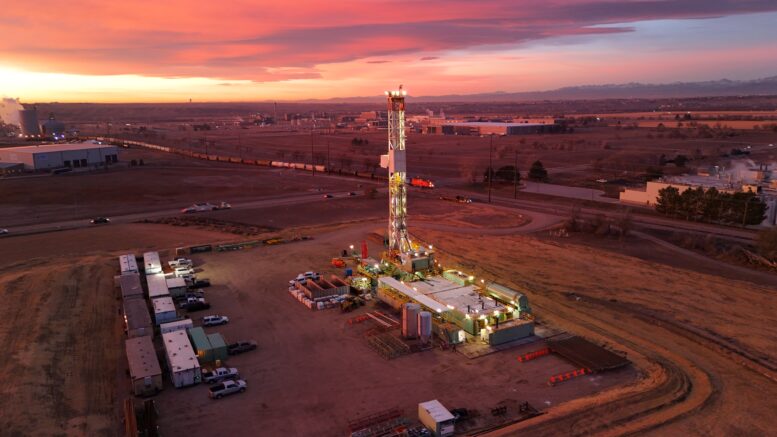
Colorado regulators want to oversee now-federalized permitting for the growing number of underground injection control wells — an idea that appeals to some geothermal and carbon-sequestration companies but raises concerns for others that the change could result in even more rules on them.
There are six classes of such wells. Colorado has held primacy over Class II wells — a classification that includes wells for disposal of brines brought to the surface during oil and gas extraction as well as wells into which such liquids are injected for enhanced recovery of oil and gas — since 1984. Officials have applied for similar oversight over Class VI wells in which companies can sequester carbon underground permanently, and they expect to hear back from the U.S. Environmental Protection Agency on that later this year.
But regulatory leaders would like to join the half-dozen states that hold primacy over all classes of these wells — a process that would start with them petitioning the EPA — and are backing House Bill 1112 as a vehicle to do so. They, along with bill sponsors, say that moving permitting oversight from the EPA to the state would allow Colorado to create its own tailored regulations that help it conserve water and attract emerging industries and would eliminate some redundant regulations between the two governments
Pulling all classes under state control means oversight of waste that is stored underground (Class I), wells into which dissolving fluid is injected to recover minerals like baking soda or uranium (Class III), now-banned wells into which hazardous or radioactive waste can be injected (Class IV) or wells for stormwater injections or aquifer refilling (Class V). And the idea is drawing mixed reaction.
Increased efficiency or increased rules?
Several companies that operate such wells testified to the House Energy and Environment Committee on Wednesday that moving from federal to state oversight would speed permitting and streamline duplicative regulations. Angela Zivkovich, environmental and conservation policy manager for Oxy, which is growing its carbon-sequestration wells, said she’s had to wait three years or more on some permits from the EPA and is confident the Colorado Energy and Carbon Management Commission would move more quickly.
But other business leaders said there is no guarantee in the bill that the new rules the state will develop won’t be far more stringent than EPA rules, which could lead to further difficulties for companies trying to operate in what already is a heavily regulated state. Gabe Racz, an environmental attorney with Clark Hill and chair of the Colorado Chamber of Commerce’s water subcommittee, asked sponsors to reword the bill to require that no regulations more stringent than federal requirements be permitted without scientific proof of their necessity.
Sponsoring Democratic Reps. Amy Paschal of Colorado Springs and Lesley Smith of Boulder added two amendments seeking to assuage some of those fears. One requires state regulators to make permitting more efficient if they are granted primacy. The other allows the state to create more stringent standards than the EPA only if such rules are needed to protect public health, safety and welfare and detailed in rulemaking through a statement of basis and purpose.
Pushback from well users, Republicans
The changes weren’t enough for some of those concerned that the bill could lead to regulatory increases on important industries. Water-rights attorney Bill Wombacher warned that additional regulations allowed by the wording of the bill could lead water companies to impose higher tap fees and rates. And three of the four Republicans on the committee opposed the bill, with only GOP Rep. Carlos Barron of Fort Lupton backing it.
But Paschal and Smith said that the bill opened the door both for more streamlined regulations and more uniquely Colorado solutions, particularly around water conservation. And they got backing from a mix of business and environmental groups who believe the change could speed permitting and could allow Colorado to offer more regulatory predictability than a federal government that’s pulling back on oversight.
Jack Conness, senior regulatory and policy associate for geothermal developer Fervo Energy, noted his company explores in Utah and Nevada — two states that have Class V primacy and are more efficient in their permitting. Those states now have an edge on Colorado when it comes to project development, but HB 1112 could help to change that, he offered.
“Our ability to develop this technology efficiently depends on a permitting process that is rigorous, comprehensive and cohesive,” Conness said before the committee advanced the bill to the House Finance Committee on a 9-3 vote. “This makes Colorado a competitive market for deep geothermal projects.”
How state regulations would work
ECMC, which also oversees many of the rules governing Colorado’s oil-and-gas industry, would control permitting for all the classes of wells under state primacy except Class III. Asked whether this would speed permitting for those wells, ECMC energy-transition senior scientist Michael Rigby said he could say “pretty confidently” that it would at least for the geothermal wells that now must get approvals from state and federal officials.
The Class III wells would fall under the purview of the Colorado Division of Reclamation, Mining and Safety. While just one existing well — used by Natural Soda to extract baking soda — in the category is operating now, division director Michael Cunningham said he thinks uranium extraction could pick up as both the federal and state leaders push development of nuclear power.
In addition to groups that are concerned about the addition of regulations that could come under state primacy, a few business and environmental and environmental organizations opposed the idea altogether.
Previous debates around carbon-sequestration wells
Colorado Livestock Association CEO Travis Grant said he’s concerned whether the state is the right entity to oversee the agricultural drainage wells that are necessary to protect against the runoff of manure from farms.
And Jan Rose of the Colorado Coalition for a Livable Climate noted that ECMC is still dealing with companies that falsified data and suggested it should not be given more responsibilities yet.
HB 1112 is in some ways a successor to a 2024 bill that allowed Colorado officials to set regulations around carbon capture and sequestration and seek primacy for oversight of those wells from the EPA. While some environmental groups question whether the practice of nabbing carbon from smokestacks and pumping into underground geological formations is safe, energy companies and the Colorado Energy Office have said that expansion of the practice is critical for the state to reach its carbon-reduction goals.