State regulators are looking to voluntarily downgrade Colorado’s noncompliance status with federal ozone standards from serious to severe throughout the northern Front Range — a move that will generate more operating restrictions now and in the future for industrial facilities.
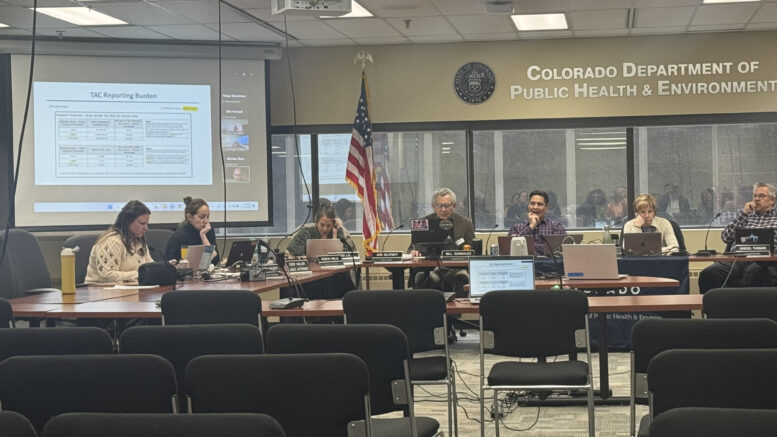
The Colorado Air Quality Control Commission is scheduled to meet on Thursday and Friday to update the State Implementation Plan — the outline of how the state will cut emissions of ozone precursors in order to bring Front Range ozone levels below 70 parts per billion. Colorado has enacted regulations on sectors from oil and gas to commercial buildings to manufacturers to try to reach compliance, but its continuing failure to do so is likely to generate small changes in the immediate future and talk of bigger changes moving forward.
Some of the short-term changes are not contentious, such a plan to extend an existing program to decrease the nitrous-oxide intensity of oil-and-gas operations through 2030, with increased intensity reductions coming in the next five years. Extension of those restrictions, first approved by the AQCC in December 2023, was part of a deal that producers and environmental groups reached during the 2024 legislative session in order to kill a trio of bills that sought even greater regulations.
Contentious provisions in SIP update
Other proposals worry industry and business-group leaders, however. One would require emissions producers seeking minor-modification permits from the Colorado Department of Public Health and Environment to go through an extensive public-comment process that business leaders worry would add cost and time to the already backlogged permitting system. Another would bar oil-and-gas drillers from doing planned maintenance on separators that vent emissions during the high-ozone months of May through September.
The biggest arguments. though, are likely to revolve around two changes that technically aren’t up for AQCC votes this week but that hang over the technical decisions it will make in significant way. One involves the CDPHE’s decision to downgrade its compliance status without an order to do so, and the other involves a “Blueprint” from the Regional Air Quality Council that would ask the commission to consider more extensive regulations in future rulemakings.
U.S. Environmental Protection Agency officials designated most of the northern Front Range in severe noncompliance last year, but the northern portion of Weld County remains in serious noncompliance because it was designated at a separate time. While the difference may sound semantic, it is significant in the fact that emissions producers in that area are not subject to the heightened monitoring and reductions regulations that other emitters are — conditions that will change with the voluntary downgrade.
Could changes hurt industry without reducing ozone concentrations?
The Colorado Chamber of Commerce in its prehearing statement warned the voluntary downgrade would undermine the state’s options to reduce regulations in the future if it can prove that federal compliance is unattainable because ozone concentrations from international emissions are too high. Other states, including Arizona and Utah, have discussed seeking what are known as 179B exemptions to federal standards that free them from some of the toughest restrictions on industry, and Colorado should not foreclose that option, the chamber wrote — especially because even these new restrictions may not bring the state into compliance.
“The division and commission must seriously consider whether additional regulatory programs and requirements on stationary sources can further impact compliance with the national standards,” Colorado Chamber regulatory affairs advisor Dave Kulmann wrote. “Given the exceptional events the region has experienced and the well-documented international transport of ozone of its precursors into the area, it may not be reasonable to expect that more stringent regulations passed by this commission to reduce local emissions would bring the area into compliance within the require timeframe.”
In rebuttal to that, Leah Martland, CDPHE regulatory development and compliance unit supervisor, wrote that preparing a full SIP update and defense of its current status that does not seek voluntary reclassification is not something the department can do by Jan. 1. A late submission of the plan would lead to mandatory sanctions that would be followed by the EPA usurping the state’s authority and submitting a federal implementation plan, and the state does not want to see that happen, she said.
Disagreement around RAQC “Blueprint”
The other elephant that will be present in the hearing room is a blueprint that the RAQC has announced its intention to submit that lays out a series of further emissions-cutting proposals that the AQCC could require over the next half-dozen years. Those include a request that Colorado investigate a program to limit emissions at indirect sources that attract many vehicles — places like warehouses, colleges, sports/entertainment venues and airports — by reducing travel of gas-powered vehicles to them.
While RAQC officials don’t plan to seek immediate adoption of any of those ideas so much as ask the AQCC to consider them as future options, the Local Government Coalition said in its prehearing statement that it supports all the control measures in the draft blueprint. What’s more, that group — representing areas like Adams, Boulder and Larimer counties — asked the AQCC to consider strategies as well like mandatory reduction of oil and gas production, as well as more regulations on commercial buildings.
“One key strategy that has been missing from Colorado’s ozone reduction efforts thus far is reduced oil and gas production,” the coalition wrote, in addition to suggesting that the AQCC considering rulemaking on indirect sources by April. “While Colorado has continued to implement emission-reduction regulations for the industry, production has steadily increased, keeping overall emissions from that sector high. Reduced production and focusing on energy transition are critical for both the ozone and climate crises that Colorado is facing.”
Outside of SIP scope?
Groups such as the Colorado Oil & Gas Association and American Petroleum Institute Colorado emphasized in their rebuttal statements, however, that the RAQC has not asked for immediate adoption of such proposals and that they thus shouldn’t be considered by the AQCC. And Kulmann agreed on behalf of the Colorado Chamber.
“None of the Blueprint strategies have undergone sufficient analysis that would allow them to be included in the SIP, and this rulemaking hearing is not an appropriate vehicle to consider the adoption of any of these strategies,” he wrote.
The rulemaking is scheduled to begin at 10 a.m. Thursday, with public comments being taken by the AQCC in a hearing at 5 p.m. Wednesday.