

A bill that sought to make Colorado companies post their reportable emissions on their websites died in a bipartisan vote Thursday, as legislators questioned the need for such a requirement and asked if the proper target of transparency efforts should be the state itself.
House Bill 1121 was a repeat effort from Democratic Reps. Bob Marshall of Highlands Ranch and Lorena Garcia of Adams County to make the emissions records of air polluters more accessible to Colorado residents. The sponsors came at the proposal from separate angles, with Marshall seeking greater accountability for what he said are hard-to-get public records and Garcia emphasizing that the bill could push companies to reduce emissions.
Similar to a bill that died last year, HB 1121 sought to achieve these goals by focusing on the companies that hold roughly 12,000 federal and state air-quality permits that already must record the levels of various pollutants that they emit. However, Marshall noted, some of those are required to submit records to agencies only upon request, and agencies also release some of the records to the public only upon request, leaving the public in the dark about what emissions may be traveling from others’ properties onto theirs.
HB 1121 would instead have required these permit holders to post the records they are required to collect and submit on their own websites at the end of the month in which they are required to submit them, in a form that is accessible to the public. Particularly along the Northern Front Range, which exceeded U.S. Environmental Protection Agency ozone limits 23 days in a row last year, this will help residents to know where pollution is coming from and decide what actions they can take, Garcia said.
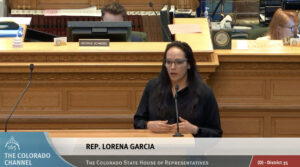
Colorado state Rep. Lorena Garcia speaks on the House floor in May 2024.
Disagreement over the reporting lift required of companies
“The EPA has made it clear that air-quality standards are only meaningful if they are enforceable,” Garcia told the House Energy and Environment Committee. “And enforceability depends on transparency.”
Marshall argued that the requirement laid out in the bill should be a minimal lift for companies that already must keep these records, noting that data storage costs just 6 to 8 cents per gigabyte.
But a host of businesses and industry associations disagreed.
Oil-and-gas companies, utilities, manufacturing firms, mining firms, agricultural interests and business groups all argued that the bill created duplicative regulations for employers that already must gather and report this data to multiple government entities. Translating the information in ways that the public could understand it is no simple task, they argued, and having to post the information on their websites could be considered as compelled speech, violating their 1st Amendment rights, they said.
Administration opposes bill as well
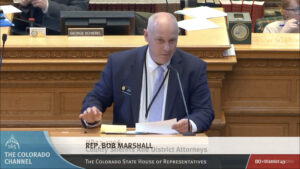
Colorado state Rep. Bob Marshall speaks on the House floor in 2023.
Several pointed as well to the fiscal note from the nonpartisan Colorado Legislative Council, which assumed that the posting of emissions information on corporate websites will lead state residents and interest groups to file 330 more complaints a year about companies allegedly violating their air-quality permits — an annual increase of 50%. The boost would be so great that the Colorado Department of Public Health and Environment would have to hire six more environmental specialists to investigate complaints and initiate enforcement action, the note stated.
CDPHE leaders joined business interests in opposing the bill. They expressed concern about the $814,000 additional cost to the department that could come from increased enforcement. And they also noted that they have spent millions of dollars trying to make records more accessible through their website.
Three Democrats joined with the four Republicans on the committee to vote to kill the bill Thursday, and each offered different objections.
Oil-and-gas leaders appreciate vote on emissions reporting
Rep. Lori Goldstein of Westminster said she feels that records already are accessible through CDPHE. Rep. Alex Valdez of Denver said he was concerned about the cost to companies of the bill and questioned whether any costs should be put on the department instead. And Rep. Amy Pashcal of Colorado Springs said that while she agreed that there may be data the public is missing, she had little confidence that asking corporations to post that data on their website was a solution.

Carly West is executive director of the American Petroleum Institute Colorado.
After the 7-6 vote to kill the bill, Carly West, executive director of American Petroleum Institute Colorado, said that while her organization is always willing to try to solve a problem, she didn’t believe there was a problem that was identified here.
“Our operators are really committed to transparency, to compliance, to emissions reduction. The question with 1121 is whether it improved transparency,” West said. “What it required was for businesses to duplicate information, some of it in a really challenging way.”