
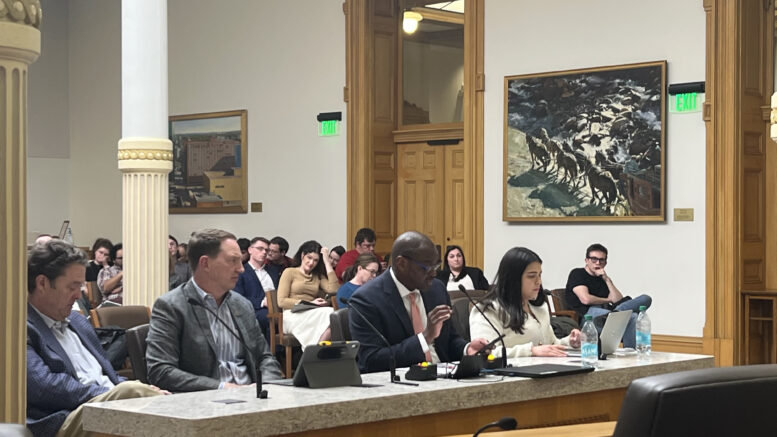
As proponents and opponents lined up to give such familiar testimony that it spurred the committee chairwoman to compare it to “déjà vu” on Thursday, legislative Democrats took the first step for the second year in a row toward upending the Colorado Labor Peace Act.
House Bill 1005, like last year’s Senate Bill 25-005, seeks to remove from state law the unique second election that requires 75% approval from employees at recently unionized workplaces to grant union security and have negotiating fees taken from worker paychecks. Without such resources, a union can’t adequately represent workers’ interests, supporters claimed, and the second election represents an unnecessary obstacle that’s responsible for Colorado having the lowest private-sector unionization of any non-right-to-work state.
If those arguments — as well as business leaders’ opposition to the proposal because they believe it quashes the voice of workers who opposed organization and don’t want to lose 2% of paychecks to fees — sound familiar, it’s because they were all stated in 2025 too. That’s when legislative Democrats voted unanimously over the opposition of all legislative Republicans to pass the bill, only to see Democratic Gov. Jared Polis veto it because the two sides could not reach a compromise that he sought to achieve.
The biggest thing that’s changed in the past year, backers said, is that the federal government has worked to take away collective-bargaining rights from some 1 million workers, demonstrating why it’s so important that Colorado make it easier to organize. In testimony where he labeled the recent Immigrations and Customs Enforcement killing of a Minnesota nurse as “one of our union siblings slain in the streets,” Colorado AFL-CIO Executive Director Dennis Dougherty argued unions can go as far as protecting democracy.
Authoritarianism and affordability
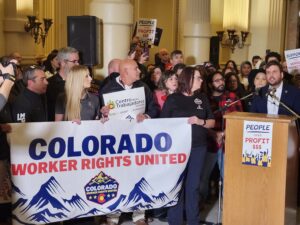
Colorado state Rep. Javier Mabrey speaks at a January rally at the Capitol to change the Labor Peace Act.
“I believe that unions will be the last institution in this country to defend us from full-blown authoritarianism,” Dougherty said in explaining why supporters do not want to compromise and want to eliminate the second election altogether. “A compromise on a less-rigged system is still a rigged system.”
Once again, the hearing in the House Business Affairs and Labor Committee — which advanced HB 1005 to the House Finance Committee on a Democrat-led, party-line 8-5 vote — pitted unionized workers and labor leaders against business groups and employment attorneys. Workers argued that the ability to organize more easily is needed to protect themselves against employers cutting benefits and reducing safety, while business leaders said the 83-year-old compromise law is one of the few advantage the highly regulated state has in its effort to attract company expansions and relocations.
Cosponsoring Rep. Javier Mabrey, D-Denver, argued that HB 1005 is a bill seeking to address the state’s affordability crisis — not by lowering costs of living but by raising salaries for unionized workers to help them afford residences and goods. Dougherty cited a Colorado Fiscal Institute study that noted unionized workers have salaries 10% higher than non-unionized workers in similar jobs and hypothesized that increased unionization could boost the average salaries of all Colorado workers by $2,300 annually.
Business leaders push back

Michael Gifford, advocacy manager for Associated General Contractors of Colorado, speaks at a 2024 council meeting at the Colorado Chamber of Commerce.
But Michael Gifford — advocacy director for Associated General Contractors of Colorado, whose members include both union and non-union firms — said high-skilled construction workers also choose to avoid union shops because they can make more money elsewhere. And Stacey Campbell, an employment attorney who chairs the Colorado Chamber of Commerce Labor & Employment Council, said the extra fee payments that the change could force on workers would not help them be able to pay for necessities.
“We talk a lot about affordability,” Campbell said. “What the Labor Peace Act actually does right now is allow employees to have a say about the affordability of their paychecks and whethere (fees) are taken from it.”
Much of the debate centered as well on whether the required second election is a help or a hindrance to workers.
Several workers, including those in the movie-theater and ski-patrol sectors, said their companies had delayed second elections repeatedly, sent in hired union breakers to convince workers to vote “no” and even failed to get them required ballots for the vote.
Rift on second vote required by Labor Peace Act

A Starbucks labor organizer speaks at a January rally at the Capitol in favor of changes to the Labor Peace Act.
United Food and Commercial Workers Local 7 general counsel Matt Shechter noted that only two of the 13 members of the business committee would have been elected had they been required to receive the same 75% approval as union security is. And when asked if elected officials should have to meet that same two-vote standard, unionized Kaiser Permanente medical assistant Justice Wilson offered an answer that left several committee members slack-jawed.
“If (Polis) had to have two votes, we wouldn’t have the same governor we have now,” Wilson said in response to a question from Rep. Chad Clifford, D-Centennial.
But Gifford analogized the two-vote process to that of residents first creating a homeowners association with a majority vote and then needing to give two-thirds support before the HOA could place a special assessment on their bills to do certain work. And Colorado Restaurant Association President/CEO Sonia Riggs argued that workers “deserve a second vote before having their wages garnished.”
There was disagreement too about the impact that repealing the second-election requirement could have on the state’s business atmosphere.
Will change slow job growth even more?
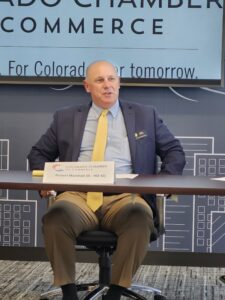
Colorado state Rep. Bob Marshall speaks to a gathering at the Colorado Chamber of Commerce in 2024.
Mabrey cited rankings from three different business publications that put states that grant union security with one simple majority-vote election ahead of Colorado, and he argued those rankings demonstrate that a change would not be an obstacle to job creation.
But Parker White, director of the Colorado Competitive Council, said that when site selectors speak to the Metro Denver Economic Development Corp., one of the first questions they ask is about labor stability. And removing a guardrail that requires more time and negotiation for unions to achieve union security would hurt the state, which already ranked 46th in job growth last year, he said.
“It sends a signal, whether intended or not, that Colorado is becoming a harder place to hire and grow,” White said.
No Republicans or Democrats offered amendments during Thursday’s hearing, though Rep. Bob Marshall, D-Highlands Ranch, said he may consider doing so when the bill reaches the House floor for debate. Marshall tried to offer an amendment last year that would have would have eliminated the second vote but would have allowed for union security only if the first vote received 60% approval.
Could Labor Peace Act change fall to next governor?
Once again, the bill to eliminate the second election is expected to move quickly through the legislative process, though Polis has said he would veto it again without changes and Democrats don’t have enough votes in the General Assembly to override such a veto.
Rep. Max Brooks, R-Castle Rock, asked Mabrey on Thursday whether the point of the bill was to get it in front of the term-limited Polis or to begin discussions in the interim with the potential next governor. The labor advocate acknowledged that he would be happy with either path if it resulted in the eventual elimination of the second election.
“We’ve been willing to sit at the table to talk about changes that we could make to get the governor to a good place,” Mabrey said. “But I intend, so long as the workers and the movement who have been working with me back this … to get it done. Whether it’s Polis or the next governor, I intend to pass this law.”