Colorado healthcare providers who remain under financial stress dodged what they called a bullet when a Senate committee rejected a bill Thursday to boost state oversight of medical-industry acquisitions, but they are expecting more fights this legislative session.
A pair of Democratic legislators, alarmed by the rising costs that studies have shown coming from health-system consolidation, sought to expand instances when the Colorado Attorney General could both investigate and block purchases and mergers. But three Democrats on the Senate Health and Human Services Committee joined with Republicans to kill Senate Bill 41 by a 6-3 vote, saying delays in such deals could imperil rural healthcare centers that often need to move extremely quickly to avoid shutting down key services.
Since Democrats took control of both legislative chambers and the governor’s office in 2019, they have put special emphasis on slowing price escalation in the sector; Gov. Jared Polis even launched the bluntly named Office for Saving People Money on Health Care. New laws in recent years have required greater transparency in hospital finances, mandated more openness about hospital charitable spending and studied whether the state should limit health systems from charging facility fees.
Still, healthcare costs remain a source of concern for voters, polls have shown, and Colorado has placed in the top five states for costs of inpatient hospital care per day in some rankings. And while health-insurance costs vary significantly across the state, certain parts, including the mountain areas and the Western Slope, have some of the highest average health-insurance premiums in the country, often due to a dearth of providers.
Healthcare industry, advocates see cost issues differently
While regulation-minded observers note these expenses and their impacts on the rising cost of living for Coloradans, however, hospitals note that increasing numbers of publicly insured or uninsured patients are impacting their finances and their ability to offer services. Roughly 70% of all Colorado hospitals reported unsustainable operating margins of 4% or lower last year, and Polis has suggested hundreds of millions of dollars of Medicaid spending reductions to balance a coming budget shortfall, concerning them further.
All those factors were on display Thursday when sponsoring Democratic Sens. Cathy Kipp of Fort Collins and Mike Weissman of Aurora presented SB 41, one year after they killed a similar bill and launched eight months of stakeholding to seek a compromise. The bill would have allowed the AG’s office to investigate healthcare acquisitions and mergers if they reached a certain financial threshold that is lower than the existing threshold, and it would have given it the ability to block those transactions if it found they’d lead to higher costs, reduced services or lessened community benefits.
Kipp noted she had started in on this bill after learning from a constituent that their costs to visit a doctor had nearly quadrupled following the physicians’ office’s acquisition by a large health system. Weissman cited studies finding that patient costs rise after industry consolidation — and that 77% of physicians now work for large health systems or corporate-owned practices. Sector workers in offices that had been acquired testified about physician exoduses when new owners forced them to see more patients, charge more and use cheaper equipment.
What is too much for ailing healthcare system?
“This is not a radical ask,” Kipp said of giving the AG’s office the opportunity to look into acquisitions and mergers. “This is the minimum we owe to Coloradans who are sitting in waiting rooms and living in healthcare deserts and asking why a routine healthcare visit now costs 650 dollars.”
But business leaders like Colorado Chamber of Commerce Senior Vice President of Government Affairs Meghan Dollar warned that giving state regulators more leeway to block such deals would discourage investment as a time when more institutions need financial help, and that the standards in the bill were vague.

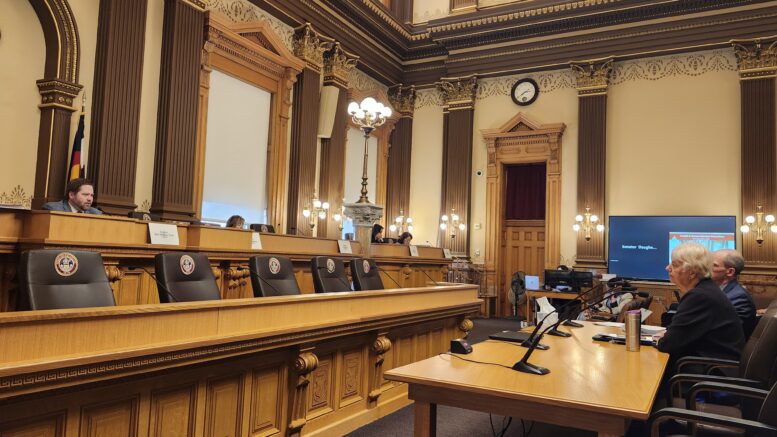
Meghan Dollar of the Colorado Chamber of Commerce and Rebekah Hernandez of the Denver Metro Chamber of Commerce testify against Senate Bill 41 on Thursday.
And numerous healthcare systems warned that the increased delays that could come from longer investigation periods and expanded public noticing requirements could shutter some facilities that testified that they were within days of shutting down for lack of funds had they not found the financial partners that such oversight could discourage.
Sen. Kyle Mullica, a Thornton Democrat and emergency room nurse, cast one of the deciding votes to kill SB 41because while the industry is dealing with financial struggles that impact its pricing, the state can’t afford to put even more restrictions on the providers with the tightest margins, he said.
“For many rural providers, we heard that it’s not about consolidation — it’s about survival,” he said. “When they are coming to us saying that there are potentially unintended consequences coming from policy, I think we should all perk up.”
Debt collection, insurance fees at issue
But while hospitals may have won this battle, there are several more fights expected.
Healthcare providers have expressed concern about House Bill 1267, which would limit their ability to collect medical debt by garnishing wages, threatening arrest or reducing a patient’s bank account and would require 30 days’ notice before collecting on debt. The bill is slated for its first hearing before the House Health and Human Services Committee on March 18.
Health insurers, meanwhile, are waiting for a yet-to-be-drafted repeat of a 2025 bill that sought to raise fees on policies and use revenue to boost subsidies for insurance for low earners and fund the OmniSalud program offering insurance to undocumented immigrants. That bill died under bipartisan concern about increasing fees that would be passed along to insured Coloradans, and a similar bill set to run during last year’s special session found its funding instead from sales of tax credits, adding $100 million to insurance subsidies.
But with Congress declining so far to extend enhanced premium tax credits that helped people to pay for health insurance, state leaders believe more must be done. And their goal is to get more money into the Health Insurance Affordability Enterprise.
Insurance costs will be center of debate
Enrollment in the individual insurance market fell by just 2% in Colorado last year, a far lower percentage than insurance regulators had predicted after cessation of the federal tax credits. But observers worry that more people who reflexively signed up again may cancel insurance policies midyear after seeing double-digit cost hikes, leading to a spike in uninsured patients that could force hospitals to raise prices for the commercially insured. That in turn could lead to significant premium hikes in 2027 if Colorado doesn’t act to keep people insured, Colorado Insurance Commissioner Michael Conway has warned.
However, Mullica, the Senate HHS committee chairman who sponsored the special-session bill that used tax-credit sales to help maintain some subsidies, is trying to thread a needle on how to do it again without raising fees — or without raising them too much. He told the Colorado Chamber Health Care Council in February that he’s searching for a solution that can be accomplished collaboratively with insurers, even as those insurers fear that fee hikes are coming.

Colorado state Sen. Kyle Mullica describes his conundrum regarding insurance-policy fees while speaking in February to the Colorado Chamber of Commerce Health Care Council.
“We have to do something. I don’t think doing nothing is an option,” Mullica said. “We have to generate revenue, but you have to generate revenue in a way that builds partnership and is not just a one-way street.”
At least on one bill so far this year, legislators have been able to thread that needle, boosting access to insurance for behavioral-health services without running into opposition from insurers.
One healthcare kumbaya
HB 1002, sponsored by Democratic Reps. Kyle Brown of Louisville and Lindsay Gilchrist of Denver, takes several steps to ensure that insurers offer significant networks of mental-health-care providers to a population that is seeking them. Studies have projected that the state needs 4,400 more behavioral-health providers to meet existing demand, and all 47 rural counties are considered mental-health-provider deserts, Brown told the House HHS committee on Feb. 10.
The bill would require insurers to address “ghost networks” by confirming that in-network mental-health-care providers are still active and are taking patients if they have gone a year without submitting a claim. It also would require insurers to consider and complete credentialing of mental-health providers seeking to be a part of their networks within 60 days of application (though it does not require insurers to accept all applicants).
And it seeks to boost the overall supply of providers by cutting from 3,360 hours to 3,000 the time that social workers need to practice for certification and by allowing pre-licensed providers going through the certification process to be reimbursed for seeing patients.
What is next for healthcare battles?
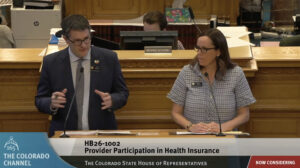
Colorado state Reps. Kyle Brown and Lindsay Gilchrist speak on the House floor about HB 1002 on Tuesday.
Several mothers of behavioral-health patients testified how frustrating it was to call through every provider in an insurance network and be greeted repeatedly by answers that they weren’t accepting new patients or that they had closed their practices. After some negotiated changes to HB 1002, the Colorado Association of Health Plans went neutral on the bill, and it passed the House on Thursday by a somewhat bipartisan 51-13 vote.
“There is a mental-health crisis across the country,” Gilchrist said, noting that Coloradans are 11 times more likely to have to go outside their insurance networks to find behavioral-health care than to find physical-health care. “We have to make sure both that we have the needed providers and that those providers are accessible. And this bill does that.”
The next two months will tell whether more of the healthcare problems that legislators are looking to solve will come to conclusions like the consensus around HB 1002 or will face the friction that marked the now defunct SB 41.