Last year, proponents of a far-reaching bill to make social-media companies rein in crime on their sites rallied on the west steps of the Capitol, bringing forth prosecutors and parents of killed children to try to coax the bill into law. Gov. Jared Polis vetoed it anyway.
On Monday there was a quieter scene, as the Democratic governor, surrounded by supporters of a much narrower bill to require social-media platforms to respond more quickly to warrants seeking information on criminal activity, signed that measure. Suddenly, it seemed, the debate over whether such safety measures were a needed protection against crime or an overreaching breach on technological innovation had been turned on its head.
Sen. Lisa Frizell, the Castle Rock Republican who cosponsored the newly signed Senate Bill 11 with Democratic Sen. Dylan Roberts of Frisco, said the shift in perception of such social-media-regulating bills has been a three-year process. Supporters stuck a toe in the water in 2024, piled a lot of big ideas into what turned into an overloaded bill in 2025 and came back this year with multiple measures that take different approaches to child protection without being too regulatorily rigid, she posited.
“Everybody’s got an opinion on this. But a lot of these bills are born out of a situation where real people have real problems,” Frizell said during an interview last week. “It’s a balance. I’m not a regulation person; I’m an anti-regulation person. So how do you balance between corporate responsibility and making sure these applications are safe and secure?”
What the new social-media bills seek to do
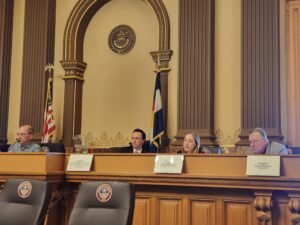
Senate Judiciary Committee members listen to testimony about SB 11 on Feb. 11.
In SB 11, that balance was requiring social-media companies to provide a staffed hotline that is available to law enforcement around the clock, acknowledge the receipt of search warrants within eight hours and comply with them within 72 hours. Applicable to websites and apps with more than 1 million Colorado users that allow those users to create profiles and share content, the new law also requires they prominently post contact information for warrant compliance on their homepages.
Another advancing bill, SB 51, seeks to put a less regulatory spin on the age-verification laws that have been passed and challenged in many other states. Rather than requiring sites with adult content to make someone prove they are 18 years old, it allows app developers seeking to age-restrict their product to request a signal from a computer or device that indicates the age range of the device’s primary user.
House Bill 1058, which the Legislature sent to Polis on Thursday, would require that minors featured in revenue-generating social-media content get a portion of the earnings put into trust funds for them once the content reaches certain milestones. Social-media companies are backing this proposal, as the responsibility for compliance lies with the adults who are producing the content, leaving the platforms only having to notify individuals of this responsibility.
While SB 51 remains strangely stuck in limbo — it passed the Senate by a 28-7 margin on March 3 but has yet to be introduced in the House — the bipartisan sponsors of HB 1058 have indicated that they believe the governor will sign it. And these different outcomes may speak most vividly to the different ways the bills were put together this year.
Limiting regulations that would be unique to social-media platforms

Chelsea Congdon, holding a microphone, speaks at an April 2025 rally on the Capitol steps urging Gov. Jared Polis to sign a bill regulating social-media platforms.
Last year, Senate Bill 25-086 combined the law-enforcement-response requirements in this year’s SB 11 with other requirements for the social-media sites to do policing and enforcing of the law themselves. It sought, for example, to mandate that social-media platforms remove users who sold drugs, trafficked guns illegally or engaged in child pornography within 24 hours of them being flagged by other users.
Polis called the proposal a dangerous infringement on civil rights, warning that users could be targeted by others for questionable reasons and lose access to the platforms that some rely on to run their businesses without a trial process. He also said the data collection needed by platforms to comply with the bill ran afoul of the 2021 Colorado Privacy Act. Though both chambers had passed it by veto-proof margins, the governor’s attacks got numerous House members to rethink their support, and that chamber didn’t take a veto-override vote.
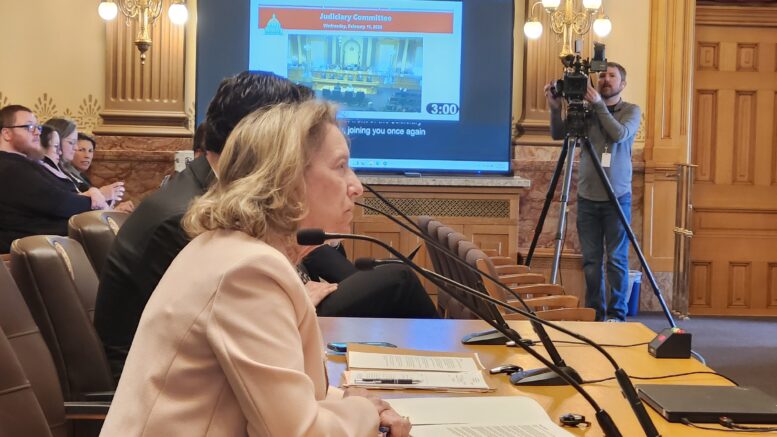
While signing SB 11 this year, Polis pointed out what most of the witnesses backing the bill had told the Senate Judiciary Committee during its first hearing on Feb. 11 — that this was purely about ensuring these companies complied with law-enforcement requests.
Parents testified about having children die from drugs sold illegally on the platforms and then watching the cases get stalled because social-media companies were not answering warrants. Brian Mason, district attorney for Adams and Arapahoe counties, said that time was of the essence in many cases he’s worked, particularly as social media has become “today’s marketplace for the sale of guns, for sex trafficking and for the sale of drugs.”
“Protecting internet freedom”
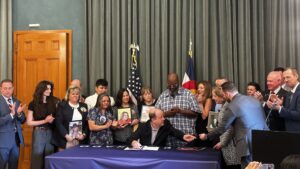
Gov. Jared Polis signs Senate Bill 11 while surrounded by backers of the law on Monday.
Polis, in signing the bill, called it a balanced effort that ensures the businesses respond to lawful search warrants.
“Today’s law is a major step in supporting law enforcement by providing them with the tools needed to quickly investigate activity that threatens public safety,” the governor said in a news release. “I am committed to protecting internet freedom and safeguarding our privacy while giving law enforcement what they need to keep everyone safe, and this new law does exactly that.”
The bipartisan sponsors of SB 51, Democratic Sen. Matt Ball of Denver and Republican Sen. Larry Liston of Colorado Springs, also have emphasized the balance they have sought through their proposal.
Ball told the Senate Business, Labor and Technology Committee on Feb. 24 that he wrote the bill to mirror a year-old law in California to ensure that operating-system developers are meeting one requirement in many states rather than a patchwork of laws across the U.S. Liston said in an interview that backers are “trying to put in safeguards for the industry without overregulating it.”
Indeed, while some developers of open-source software said they worry that the applications they write could leave them legally liable if they don’t include age-attestation signals, most criticism of the bill has been that it doesn’t do enough. An adviser for child-protection organization Blue Rising asked for the addition of full-on age verification, while Child First Policy Center policy director Melissa McKay said the bill “codifies the very practices that have allowed children to be exposed to harm for years.”
Uncertain futures for some regulatory efforts

State Sen. Larry Liston speaks in his office at the Colorado Capitol about Senate Bill 51.
Liston said he has not talked with Polis yet about whether he would sign that bill.
There are more regulatory social-media bills being debated during this legislative session as well, but they appear to have tougher slogs ahead of them.
HB 1148, sponsored by Democratic Reps. Yara Zokaie of Fort Collins and Jenny Willford of Northglenn, bars social-media sites from subjecting minors to algorithms aimed at keeping them on the site or sending them push notifications between midnight and 6 a.m. It also seeks to assess a 5% fee on any in-game or add-on transactions made by minors, and it would put the money toward the state public school fund.
That bill got its first hearing in the House Judiciary Committee on March 18, but the committee delayed a vote until Tuesday — typically a sign that a bill may be short of votes to advance.
Creating balance in dealing with social-media platforms
The same committee did advance HB 1255, sponsored by Democratic Rep. Tammy Story of Evergreen, that day, though it’s remained on the House calendar since March 23 without coming up for debate. That proposal would require social-media companies to respond to search warrants within 24 hours and to report to law enforcement individuals who violate their policies by threatening harm to themselves or others on the platform or by threatening to commit a specific crime — a self-policing requirement that may tougher to sell to Polis.
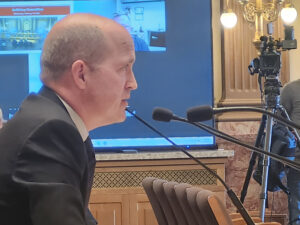
Brian Mason, district attorney for the 17th Judicial District, testifies for Senate Bill 11 before the Senate Judiciary Committee.
Though advocates for this type of social-media regulation have seen success this year that they did not see in 2025, Frizell said she suspects that they’ll need to be careful moving forward to not cross a line and overregulate the industry with future proposals. Having worked with social-media platforms to try to find the balance on SB 11, she also senses that social-media companies are grasping that they must be willing to face some public scrutiny as their applications become a ubiquitous part of life.
“I think they are starting to wake up a little bit and realize there is a societal pressure being placed on them that they created these platforms and there is a responsibility around them,” the Senate assistant minority leader said. “People are starting to realize how Wild West these platforms have become and saying, ‘You have a responsibility.’”