

Gov. Jared Polis this week signed into law a bill that will require some employers in coal-transition communities to give hiring preference to workers who are losing their jobs because of the phaseout of traditional forms of energy.
Senate Bill 52, which received significant bipartisan support in the Senate and some bipartisan support in the House, is the latest step in Colorado’s Just Transition program to protect communities losing jobs as coal-fired power plants shutter over the next five years. The closing of those plants is part of the Polis administration’s efforts to move from coal to alternative and emerging sources of energy, such as wind, solar and geothermal.
Over the past half-decade, Colorado has offered services including job training and public funding to help those communities retrain and keep workers. This new law, however, is the first that requires actions of private-sector companies as well.
Specifically, SB 52 requires employers in a coal-transition community that are in the construction, railroad-operation, utilities, energy-generation or advanced-manufacturing sectors to hire coal-industry workers for openings if they meet qualifications for open jobs. Those employers must consult with the Just Transition Office, operators of coal-fueled generation facilities scheduled for retirement and organizations representing coal workers to identify potential workers, and they must report annually to the Just Transition Office about their efforts.
Debate over mandates to private employers
Legislators from both parties long have signaled a desire to help those workers who need reskilling and to protect those coal-transition communities, located in northwest Colorado, Morgan County and the Pueblo area. But making hiring demands of area private-sector employers was something that several Republicans in particular felt should not be in the purview of the state government.
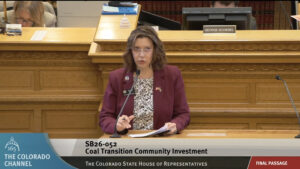
Colorado state Rep. Lori Garcia Sander speaks against a bill to require hiring preferences for coal workers on the House floor on Feb. 23.
“Government is now telling private businesses — not state government or local government, but private businesses — who they need to hire,” said Rep. Lori Garcia Sander, R-Eaton, before voting against SB 52 on Feb. 23. “And that is problematic.”
Some legislators, particularly those from coal-transition areas, said they were torn about the implications of the bill on private-sector employers but felt they needed to support the workers whose livelihoods had been upended by the state’s push for cleaner energy. All Colorado’s remaining coal plants are scheduled to close by the end of 2031, though President Donald Trump’s administration is pushing for companies to keep them open.
Others, such as cosponsoring Rep. Meghan Lukens, D-Steamboat Springs, offered full-throated support for a policy that they said will ensure that longtime coal-plant workers don’t have to relocate to find jobs. This law, while aimed at private employers, is supported by public funds that will continue to go to retraining these workers, she said.
Coal workers get advantages — with limits
Lukens, as well as sponsoring Sens. Dylan Roberts (D-Frisco) and Marc Catlin (R-Montrose) added several amendments as the bill advanced through the General Assembly to lessen some of the requirements on other private-sector employers. Companies promoting from within or hiring based on a collective bargaining agreement are exempt from the law, only employers within just-transition communities are affected and workers must meet all requirements of open jobs rather than just minimum requirements.
After sailing through the Senate on a 29-3 vote, SB 52 passed the House by a margin of 45-17. Six Republicans joined most Democrats in the chamber in supporting the bill, while Democratic Reps. Bob Marshall of Highlands Ranch and Alex Valdez of Denver joined the majority of House Republicans in opposing the measure.
Polis signed the bill administratively on Monday without making comments on it.
The law, which also allows public entities in coal-transition communities receiving settlement payments from coal-fueled generation companies that are closing down plants to invest that money through a private investment firm, takes effect immediately.