
A Colorado House committee rejected two attempts in the past two days to raise taxes or fees on beer, wine and spirits sales, heeding pleas from small brewers and distillers that additional costs could deal a significant blow to their already struggling sectors.
House Bills 1271 and 1301 sought to use revenues from the liquor industry to help subsidize the treatment of conditions that their products can exacerbate. Sponsors argued that at a time when the state faces an $850 million budget shortfall, they need to be creative with the ways they raise revenue for public-health and -safety services, and they noted Colorado’s alcohol excise taxes are among the lowest in the country.
Industry groups and some business organizations pushed back, however, noting that the sectors already are suffering under conditions ranging from new tariffs to falling levels of product consumption to rising ingredient costs that outpace price hikes they can take. The combined impact of the two bills would have increased fees and taxes on their products between 154% and 205% depending on the drink type — costs they would have had to cut from elsewhere in their budget, particularly from labor expenses, they warned.
So, on Tuesday, the House Health and Human Services committee rejected HB 1271, which would have instituted new fees on alcohol sales and put them to a trio of enterprises funding alcohol-use disorder prevention and treatment, by a bipartisan 8-5 tally. And on Wednesday, the same committee killed HB 1301, which sought to ask voters to raise taxes on alcohol and marijuana to fund a new mental-health hospital in Aurora, on a 7-6 vote.
Costs to businesses, potential job losses cited
While critics cited several reasons to oppose the measures, a common theme was their deleterious impact on jobs in the sector, which alcohol makers said they would have to cut if rising prices lowered consumer demand and reduced sales further. The local businesses’ push was aided by unions like the Teamsters Local 267, which sent a letter to committee members and showed up to testify at hearing, warning that the cost hikes could reduce distribution jobs and disproportionately harm lower-income Coloradans.

Colorado state Rep. Sheila Lieder speak on the House floor during the 2023 legislative session.
“I completely understand where the bill sponsors’ hearts are at,” said Rep. Sheila Lieder, a Jefferson County Democrat and union advocate who was one of the two Democrats who voted against both bills, about HB 1271. “But I also know that when companies have (price) increases, they pass them along to the consumers … And this bill, I really do believe, will cut jobs.”
Several legislators said the two bills put them into a difficult position of either supporting badly needed funding increases for behavioral-health and substance-abuse-treatment programs or supporting industries that boost Colorado’s culture and economy. The beer wine and spirits industries together account for about 118,800 jobs in Colorado that produce a roughly $23 billion annual economic impact and draw tourists to a state that’s become known for its craft beverages.
Rep. Jamie Jackson, the Aurora Democrat who cosponsored HB 1271, pinpointed the harmful impact of alcoholic beverages as costing Colorado some $5 billion annually in health, public safety and court costs. That number includes the costs of addiction, chronic disease, impaired driving, family instability and emergency care that are related to alcohol abuse, she told the committee.
How the bills would have worked

Colorado state Rep. Jamie Jackson, D-Aurora
HB 1271 would have created sustainable funding — about $35 million annually — for treatment and prevention programs that are now trying to navigate between short-term grants and federal dollars that are being peeled back, supporters said. And HB 1301 could have raised enough money to fund a 50- to 70-bed hospital when the state is 500 mental-health beds short of what is needed — an effort supported by behavioral-health experts, sheriffs and other public-safety leaders desperate for a suitable facility to hold criminal suspects who have not been declared competent to stand trial.
“The situation is bad. It’s getting worse quickly. And we’re doing nothing about it,” said Dr. Bill Berman, Denver Health director of public health. He noted that Colorado, which ranks eighth in alcohol consumption and eighth in alcohol-related hospitalizations, sees about 2,000 residents die annually from alcohol-related causes, a number that’s doubled in the past 10 years.
HB 1271 sought to assess a 5-cent-per-gallon fee on beer and hard cider sales, a 7-cent-per-liter fee to wine and a 35-cent-per-liter fee to spirits. The new taxes proposed by HB 1301 would have been even steeper — 7.3 cents per gallon on beer and cider, 8 cents a liter on wine and 60.26 cents per liter on spirits.
Some opponents, such as Wine and Spirit Wholesalers of Colorado Executive Director Micki Hackenberger, accused HB 1271 authors of trying to institute a new tax without a required vote of the people by calling it a fee. The fees would function “in every meaningful way” like a tax because they would be applied broadly across the alcohol industry and put to three new enterprises with wide-ranging functions rather than being focused on a specific program or programs, she said.
Alcohol producers warn of further workforce cuts
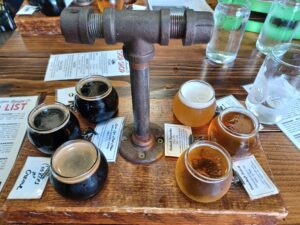
A sampler tray at Parts and Labor Brewing in Sterling.
Even more persuasive arguments came from alcohol manufacturers in towns from Poncha Springs to Durango and from Buena Vista to Montrose, who spoke of what impact the new fees and taxes might have on them. The impacts seemed to pack even more weight after industry association leaders noted that 102 Colorado breweries have closed in the past two years under rising costs and changing consumer habits, while Colorado spirits sales dropped off 8% in 2025.
Andrew Quarm, executive vice president of strategy for Breckenridge Distillery, estimated that the doubling of taxes HB 1301 would ask voters to approve would cost his business $200,000, which the brewery would have to reflect at least somewhat in labor cuts. Jason Senior, owner of Shelter Distilling in Montrose, warned small breweries and distilleries are “at a tipping point now where any small increase in costs can put them out of business.”
Cosponsoring Rep. Jennifer Bacon, D-Denver, pushed back by saying that the $6 million that HB 1271 would raise specifically from the beer industry was small compared to “all profits of the system, which has plenty of room to make up for the costs.” Jackson emphasized that they were asking a “multibillion-dollar industry” to be a part of the solution, just as lawmakers have turned to tobacco and marijuana to help fund treatment programs for the use of those products.
But small alcohol producers took offense to the characterization that they were all rolling in cash, particularly as more struggle to stay afloat. Sam DeWitt, state government affairs director for the Boulder-based Brewers Association, said he was shocked to be told by sponsors that “maybe it’s a good thing that breweries are closing,” and Ska Brewing cofounder Dave Thibodeau said he had to sell his 70-employee brewery to keep it open.
Bipartisan votes against boosting alcohol fees, taxes
“We are not billionaires or millionaires,” Thibodeau said, noting that he offers space in his brewery for nonprofit meetings. “Most Colorado breweries that I know of, including Ska, have not been profitable for years.”

A board above a line of beer taps lists offerings at Ska Brewing in Durango.
Bacon added an amendment to HB 1271 to exempt small breweries, wineries and distilleries from the proposed fees, but the concession appeared to be too little, too late. Meanwhile, sponsoring Rep. Bob Marshall, D-Highlands Ranch, did not offer such a carveout in HB 1301, and several committee members — including three who voted against the bill — mentioned that in their closing comments.
All five Republicans on the committee, as well as Democratic Rep. Katie Stewart of Durango, joined Lieder in voting against both bills. All the other committee Democrats voted for both of them, except for Rep. Karen McCormick of Longmont, who opposed HB 1271 but supported HB 1301.
Over the course of the two hearings, several opponents also questioned whether the bills would do anything to help ease the affordability crisis that both parties say is a top priority for them to address this session. And as legislators look at raising fees on other goods and services to try to offset issues associated with them, it will be worth watching to see if the pushback on these bills serves as a portent to overall dissatisfaction with the practice.