
Large Colorado businesses with substantial numbers of part-time employees on public benefits would have to help fund Colorado’s Medicaid and SNAP programs under a bill that is being floated by a Democratic House member who is a former Medicaid case manager.
Rep. Lisa Feret’s proposal is in an early stage of development, but the first-term legislator said she plans to bring it forward to try to bring a fresh idea to discussions on how to rein in the costs of the state’s public insurance program for low-income residents. Gov. Jared Polis has proposed cutting the expected increase in Medicaid spending in half for next year’s budget by capping spending and reimbursement rates on some services — a plan that hospitals worry could lead to reductions in some forms of care.
While Feret continues to work out the specifics of her bill, the gist is that companies with at least 1,000 workers in Colorado would be required to pay for a portion of the Medicaid benefits for each of their part-time workers enrolled in the program. Feret also is looking at requiring similar funding help for workers at those companies who are on the Supplemental Nutrition Assistance Program that funds food stamps for lower-income individuals.
Feret has detailed her proposal to some of the companies that would be affected by it, as well as to some business groups. And while the employers have appreciated her openness about the plan, they have pushed back hard on the idea and don’t see room for compromise, said Katie Wolf, lead lobbyist for the Colorado Retail Council.
A first-in-the-nation proposal
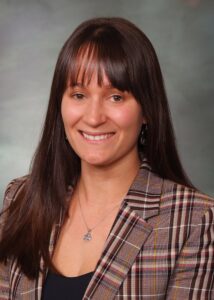
Colorado state Rep. Lisa Feret, D-Arvada
No state has done what Feret is proposing that Colorado would do, so the policy would be groundbreaking. But Feret said that she believes she has numbers to back her claims that a handful of companies are “high, high utilizers” of Medicaid services for their part-time workers and need either to help fund the program or to offer health insurance to them.
“These companies are making hundreds of billions of dollars — with a ‘B’ — in profits … and they are still getting hundreds of millions in benefits in Medicaid or SNAP for their workers,” Feret said in an interview this week. “If we are messaging and creating a conversation around this policy in the correct way, it should create behavioral shifts in these companies about offering health insurance.”
Wolf argued, however, that the policy is misguided in several ways. First, it assumes that the consistently increasing costs of providing Medicaid are due to corporate workers using the program rather than increasing state mandates on who the program must cover and what services it must provide, as well as rising costs of care.
Also, the proposal seems to ignore the strong possibility that employers who are faced with paying tens of millions of dollars into a state program to cover their part-time workers may think twice about employing those workers at all, Wolf said. Some people seek part-time jobs because circumstances prevent them from doing fulltime work, including individuals who want to work just enough to still qualify for Medicaid because they or a loved one have a complex medical condition that they need the public insurance program to cover. Those workers could lose jobs under this policy.
Twelve companies could have to help fund Medicaid
“One unintended consequence is this really does incentivize businesses to look at fulltime workers instead,” Wolf said. “I do think that they would not want to employ part-time workers as much.”
After getting this idea from a constituent, Feret said she dug into numbers provided to her by several state agencies on workforce utilization of public-benefits programs. She was surprised at how much she found.
After talking with business and worker-advocacy groups about her general idea, she decided that she needed to exempt some employers from the proposed regulations, including franchisees, those with seasonal workers and companies with union agreements. That narrowed the list of potentially impacted companies to a dozen of them: Amazon, Dollar Tree, Express Employment Professionals, the JBS USA plant in Greeley, Lowe’s, Natural Grocers, Ross, Target, The Home Depot, TrueBlue, Walgreens and Walmart.
Details remain in discussion
One idea that Feret has offered is to require those companies to pay 50% of the average annual cost of Medicaid benefits (about $5,000 per year) incurred by 50% of their part-time workers on Medicaid. Or, she said, she could look to require them to pay between 12% and 15% of the first $20,000 in pay for all part-time workers on public benefits, which would garner a similar amount of money.
The goal, she emphasized, is not to raise money to expand Medicaid services but to find funding from these employers for the services that their workers use at a time when potential Medicaid cuts driven by both state and federal policy loom large. Another exemption she plans to include in the bill is one for all companies that offer affordable health insurance (a federally defined term) to all their workers within 60 days, which would incentivize insurance offerings over fines.
“I’m not trying to take all their profits; I’m trying to offset the cost of what Medicaid costs,” Feret, who represents the Arvada area, said. “I’m asking for half. That seems fair.”
A fee or a fine?
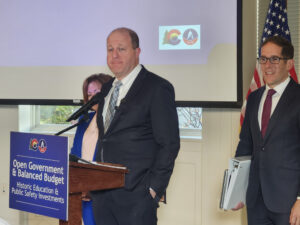
Gov. Jared Polis unveils his budget proposal, featuring a reduction in Medicaid spending, on Oct. 31 alongside Lt. Gov. Dianne Primavera and Mark Ferrandino, director of the Office of State Planning and Budgeting.
The potential mechanisms to collect the revenue also remain in flux.
Feret has looked at enacting a fee that could go into the Colorado Healthcare Affordability and Sustainability Enterprise, which now collects money from hospitals based on the occupancy of their beds and uses the revenues to expand the group of low-income adults that is eligible for Medicaid. Or she’s looked at making it a fine, which would, like the use of a fee, exempt the new revenue from the Taxpayer’s Bill of Rights revenue cap.
Feret said she believes the bill could raise around $100 million, the vast majority of which would go toward Medicaid and the rest of which, via a similar per-employee calculation, could go toward SNAP. Polis, for perspective, has proposed reducing Medicaid spending in the 2026-27 fiscal year by $334 million via his series of caps and service limits.
Wolf, whose organization includes as members eight of the 12 companies that likely would be subject to the bill, questioned how Feret and state officials came up with the revenue figure and the number of employees this would impact, for several reasons.
Is bill unworkable for employers?
First, she said, rising minimum-wage levels — the lowest allowable wage will reach $15.16 per hour statewide in 2026 and $19.29 in Denver — make an increasing number of workers ineligible for public benefits. Single adults can make no more than $21,597 a year and still be eligible for Medicaid in this state; Feret noted that her bill targets just part-time workers because most full-time workers can’t qualify for Medicaid.
Second, Wolf said, she is unsure how the state could even verify which workers at which companies are on the benefits that would require those companies to pay a fee or fine. Employers are not allowed to ask workers if they are on Medicaid, and the Medicaid forms themselves only include an optional question about employment — a question that is not updated even as part-time workers may change jobs.
Wolf and her members also don’t like the focus of a bill that targets a limited number of large retailers and employment-service firms, though she thinks that a future legislator could easily look to expand the program to more employers once it’s on the books. If the intent was to equitably make every employer whose staffers utilize public benefits help to fund those benefits, it would not be limited to the largest employers or to only for-profit companies, she argued.
“She’s focused on this group with the intent, I believe, to expand it,” Wolf said after both she and Feret have had conversations about the proposal with multiple members of the Colorado Retail Council. “This is, I truly believe, the beginning of a much bigger plan to pay for Medicaid.”
Spurring new ideas and talks about Medicaid
Feret — who gained a reputation as a moderate during her first year in the Legislature and sponsored a Medicaid-reform law that cut regulations on small assisted-living facilities — said her more progressive colleagues have suggested the fees in this bill be higher. But she said she’s trying to require the minimum she can from employers with sufficient loads of public-benefit-recipient workers while still pushing them to think about how they offer health benefits to part-time staff.
And she is looking forward to the discussions to come.
“I can justify it specifically to a cost,” Feret said of the proposed fees. “I’ll take a win, even if they’re just starting a conversation about this.”