
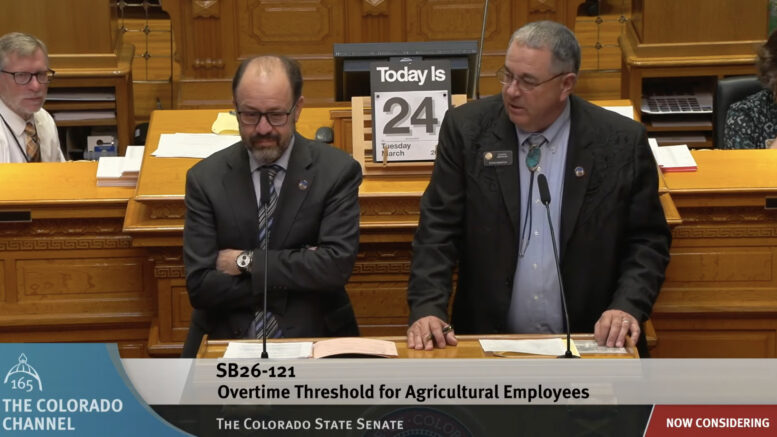
Sponsors of a bill to raise the threshold for agriculture workers to receive overtime pay lowered that threshold slightly but otherwise held strong against an onslaught of criticism over the past two days and passed the bill through the Colorado Senate.
Senate Bill 121, which originally would have reset overtime thresholds for farmworkers to begin only once they’ve worked 60 hours in a week, now would set those thresholds at 56 hours instead. Senate Majority Leader Robert Rodriguez, the Denver Democrat who is cosponsoring the bill with Republican Senate Minority Leader Cleave Simpson of Alamosa, said he did not drop the threshold because he needed to do so to get votes but did it just because that seemed to be the fairest overtime starting point.
After two days of intense debate in the Senate in which opponents tried to strip away numerous provisions of the bill, it passed by a slim margin of 19-16, with seven Democrats joining all of the chamber’s Republicans in passing it. SB 121 now moves to the more progressive House, where it could face an even more uphill climb despite House Majority Whip Matthew Martinez, D-Monte Vista, sponsoring the bill.
Why the bill targets the agriculture sector
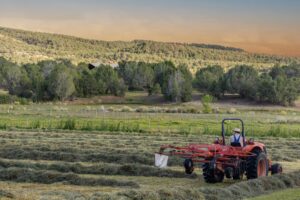
A tractor plows a field.
SB 121 comes in reaction to farm operators and farm workers saying that employees are getting their hours cut after passage of a 2021 law that ended the agriculture industry from having to pay time-and-a-half to workers once they reached an overtime threshold. A Colorado Department of Labor and Employment rulemaking process set that threshold at 48 hours, with an exemption for highly seasonal workers on operations that double their workforce during a 22-week harvesting period, whose overtime wages start after 56 hours.
The bill first cleared the Senate Business, Labor & Technology Committee in an unusual hearing last week where it was heard simultaneously with another proposal, SB 81, that sought to reduce the overtime threshold for ag workers to 40 hours. And much of the debate that permeated that committee, pitting the need for Colorado’s small farms to remain financially viable against what opponents called the unfairness of different overtime thresholds for one industry, continued on the Senate floor.
Simpson emphasized that 95% of Colorado’s 36,000 farms are small operations, making less than $500,000 annually, and are getting battered by tariffs and other factors causing input costs to rise while pricing for their goods is not going up. Those farmers are limiting workers’ hours to avoid paying overtime costs that no surrounding states require, causing laborers to leave Colorado or to seek out second jobs to make up for lost wages.
A long-running debate
The changes in SB 121, which also exempts managers and range workers like sheepherders from the overtime requirements, would allow financially struggling farmers to give more hours to workers without paying time-and-a-half, Simpson and Rodriguez argued. It would remove the competitive disadvantage Colorado farms are now at and would heed the requests of not only farm owners but farmworkers, including several who testified that the current law is hurting them financially and keeping them from seeing family.
“We need workers who are valued and respected, as well as a healthy, profitable industry to protect the sector,” Simpson said.
Opponents like Sen. Jessie Danielson, the Wheat Ridge Democrat who sponsored the 2021 law and sponsored SB 81 this year, argued the disparate overtime thresholds reflect the racism behind Congress exempting ag workers from overtime requirements in 1938. And they offered 12 different unsuccessful amendments that sought, among other things, to end the managerial and range-worker exemptions, set the overtime threshold at 40 hours and require overtime pay be double that of normal pay rather than time-and-a-half.
Sen. Janice Marchman, D-Loveland, said it did not feel right that the Legislature would make it tougher for only one group of workers in the state to earn overtime — a group that is more heavily Latino, immigrant and non-unionized than other sectors. She attacked both SB 121 and the current law that raises overtime thresholds for highly seasonal workers.
Are agriculture workers being treated differently?
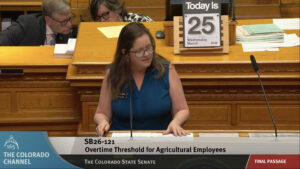
Colorado state Sen. Janice Marchman speaks against Senate Bill 121 on Wednesday.
“Do we do this for retail workers during the holiday crunch? Do we do this for construction workers in the summer season?” Marchman asked before the final vote on Wednesday. “The idea that seasonal work needs an exception has been done only once in this building.”
Advocates for the proposal noted repeatedly that the agricultural industry functions differently from any other sector and, as such, should not be subject to across-the-board labor regulations. Sheepherders who watch animals around the clock in distant locations can’t be subject to hourly wages, and no other sector could lose a whole year’s production if there aren’t enough workers in place when crops are coming out of the ground, they said.
“Far be it for me, somebody from the city, telling farmers and ranchers how to run their businesses when they’ve done it for generations,” said Sen. Larry Liston, a Colorado Springs Republican who supported SB 121.
Danielson noted, however, that these workers also don’t have the same basic protections as other workers and that her 2021 law also required that they have access to basic medical and religious services when they are living and working on a private farm. Sen. Chris Kolker, D-Centennial, noted that the savings achieved by farm owners under the bill will amount to $76 a week when workers can bump up from 48 to 56 hours without overtime pay — a total that he argued is more needed by workers than operators.
“On the backs of the workers”
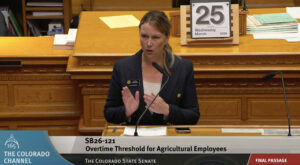
Colorado state Sen. Jessie Danielson speaks against Senate Bill 121 on Wednesday.
“Why do the leaders of this industry rush to relieve their burdens on the backs of the workers?” Danielson asked, noting that the Legislature could instead have looked at boosting tax breaks for small farms or lobbying the federal government to roll back tariffs. “I believe this is the wrong direction to take this law. I believe this makes a vulnerable workforce more vulnerable.”
In addition to Rodriguez — who said he stepped up to sponsor the bill to avoid opponents labeling this a racist bill — the Democrats who backed SB 121 were Sens. Judy Amabile of Boulder, Lindsey Daugherty of Arvada, Nick Hinrichsen of Pueblo, William Lindstedt of Broomfield, Kyle Mullica of Thornton and Dylan Roberts of Frisco.
Farm-sector leaders have spent much of the 2026 session battling what many consider attacks on their way of operating. In addition to the debate about overtime pay, they worked to kill a bill to limit the use of a common pesticide for crops and continue to fight a bill that seeks to limit the use of a common form of rat poison.
Rodenticide a major issue for sector too
Sponsors of the rodenticide bill, SB 62, pared it back significantly, removing proposed limits on glue traps and other poisons to require only that farmers and landlords seeking to use deadly second-generation anticoagulants have them applied by a licensed applicator. More than 2,100 cases of pet poisoning and 300 cases of human poisoning by these substances have occurred over five years, and the state must rein in the indiscriminate use of rodenticides that harm non-targeted populations, cosponsoring Sen. Lisa Cutter, D-Morrison, argued.
But requiring cash-strapped farmers to hire applicators to put in place a product they know how to use amounts to one more burden on an already suffering industry, argued Sen. Byron Pelton, R-Sterling. He tried unsuccessfully to add amendments to the bill that would have delayed its enactment until 2031 and would have limited any permit issued by the Colorado Department of Agriculture to apply rodenticides to be no more than $1.
Sen. Marc Catlin, R-Montrose, argued that both SB 62 and the efforts to lower the threshold for ag workers to receive overtime could lead to greater corporate ownership of farms in Colorado, as such owners have more capacity to absorb cost hikes.
SB 62 passed the Senate on March 18 on a fully partisan 22-12 vote. It is scheduled for its first hearing in the House in the Agriculture, Water and Natural Resources Committee on Monday.