The effort to replace Colorado’s uniform tax rate with a graduated income tax is moving ahead again, after a state board ruled Wednesday that a rewritten ballot proposal fits within the state’s requirements for such questions to have only a single subject.
A coalition led by the Bell Policy Center wants to ask voters in November 2026 to scrap the 4.4% tax rate paid by all state residents and businesses and replace it with a progressive system that requires individuals and companies that make more money to pay higher rates. The tax rates would fall slightly to 4.2% for those making the lowest amount of money but would rise as high as 9.2% on the portion of incomes exceeding $10 million.
Members of the Title-Setting Board ruled in October that the proposed initiative — which also would let the state keep money raised by the change above the Taxpayer’s Bill of Rights revenue cap and would end TABOR’s prohibition on surcharges — had multiple subjects. So, the coalition came back with a proposal that no longer eliminates the TABOR ban on surcharges (which are essentially taxes on taxes) but still creates graduated income tax rates and seeks to keep as much as $4.1 billion in annual revenue increases that they would generate.
A debate over single or multiple subjects
Representatives of organizations including Advance Colorado, the Denver Republican Party and the TABOR Foundation argued that the measure still contains multiple subjects and should not be given permission to move forward. But the board voted 3-0 that the initiative now contains a single subject and gave it a title, paving the way for backers to begin collecting signatures, barring any other setbacks, in the near future.
“Our proposal will only raise taxes on those making more than $500,000 per year. And those funds will be used to replace federal healthcare cuts and increase investments in public schools and childcare affordability programs,” Bell Policy Center President/CEO Chris deGruy Kennedy said in a video he posted on social-media platforms. “It is time for a fairer tax system and an economy that works for all of us.”

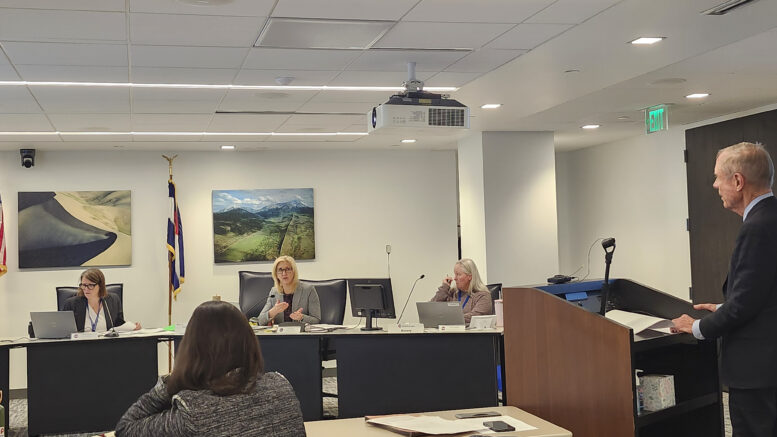
Title-Setting Board members Kurt Morrison, Theresa Conley and Christy Chase discuss a potential title for Initiative 181 during a meeting Wednesday.
Opponents of the measure argued, however, that the change is much more sweeping than even its title description of replacing Colorado’s uniform state income-tax rate with a graduated state income-tax rate — or its $4.1 billion price tag — implies.
Rebecca Sopkin, a TABOR Foundation board member, noted that by removing TABOR’s requirement for a flat tax from the state constitution, the initiative tells legislators first to implement a progressive tax rate, but it also leaves requirements regarding that rate in statute. That means legislators can change that again at any time without a vote of the people.
“Walking through the proposal piece by piece, it becomes clear that it wanders into several policy areas,” said Natalie Menten, an advocate for fiscal conservatism who argued that there remains more than one subject in the measure. “And voters deserve to vote on those changes individually.”
However, deGruy Kennedy added that putting the graduated income-tax rates into statute does not remove the TABOR requirement that Colorado residents must approve any increase in tax rates, regardless of whether those rates are in the constitution or in statute. The Legislature could reduce those income-tax rates without voter approval, but it could not raise them without going to the ballot, he noted.
How the income-tax change would work
The new initiative states that any money collected in excess of the TABOR cap because of the ballot measure would go to public-school education, healthcare, childcare and workforce development. It further specifies that the money can fund boosts in teacher salaries, innovative programs to reduce health-insurance premiums, programs to help families afford childcare and career and technical education, among other things.
A chart notes that the average Colorado resident or business making between $200,000 and $500,000 per year will see an annual income-tax savings of $200 — a number that drops as income drops until it reaches $3 savings for those making $25,000 or less a year. Those individuals and businesses making between $1 million and $2 million annually will pay an average of $6,048 more beginning in the 2027 tax year, however, and those making between $2 million and $5 million will pay $18,731 more annually.
Why business could pay more income tax
Business leaders have begun to express worry that because it’s much easier for companies to bring in revenues over $500,000 annually than it is for individuals to do so, corporate filers will feel the biggest impacts from the tax hike at a time of economic uncertainty. Several groups complained Wednesday that the initiative’s simultaneous changes to corporate and individual tax codes constitute separate subjects, but the title board said the actual change to law is the elimination of the single requirement in TABOR for a universal flat tax.
Initiative proponents also added a provision to the newest ballot proposal that would require an audit and public report on the spending of any revenue in excess of the TABOR cap, hoping to stir public confidence. Joshua Mantell, Bell Policy Center of government relations, said that requirement was so important that it should be noted in the ballot title, but board members declined to add to an already lengthy title they had set.
While opponents are likely to appeal Wednesday’s ruling to the title board, the fact that they have begun posting videos indicates they plan to begin a full-scale campaign to build support for the measure shortly into the new year. And all indications are that what is now known only as Initiative 181 will become one of the most-discussed issues on a 2026 ballot that also will include races for governor and U.S. Senate.