Gov. Jared Polis once again wants to end all government control over Pinnacol Assurance — and this year is banking even more of his budget-balancing plan on the willingness of the state-chartered workers’ compensation insurer to pay for its regulatory freedom.
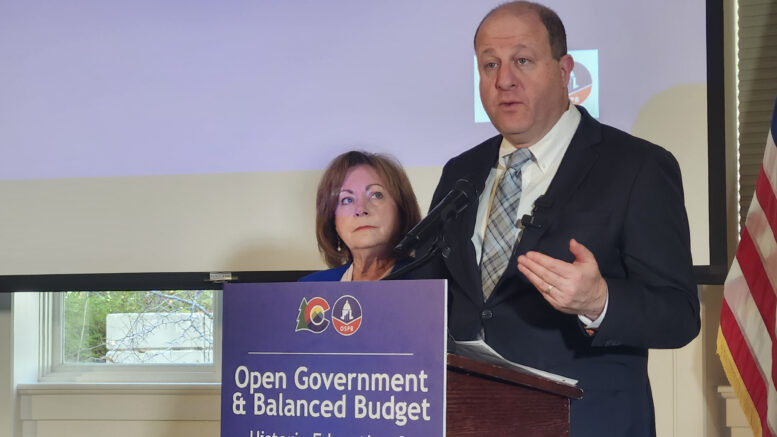
The Democratic governor unveiled his $47.9 billion budget plan Friday for the fiscal year that begins July 1 — a plan that involves some spending cuts and tax-break rollbacks to close a projected $800 million shortfall when compared to current spending projections. The general-fund portion of the budget, which is the portion that the Legislature has the most control over, equates to $18.2 million, a 2.3% increase over the current year.
Polis originally proposed converting Pinnacol — which now has its board appointed by the governor, has legislatively set operational limits and must serve as the provider of last resort in exchange for a full exemption from state premium taxes — last year. However, legislators balked at the idea amidst union pushback and concerns about who would provide workers’ comp policies to riskier companies that no private insurer will take on, and the plan did not move forward.
In unveiling his new budget plan to legislators and media members Friday, however, Polis said he will seek again to spin off the insurer into a fully member-owned company — and was budgeting that the move could generate $400 million for the state general fund. About half of that money — $193 million — would be used to fund the senior Homestead property-tax exemption next year, while $109 million would go to preventive maintenance and repair work for state facilities and $98 million would go to the general fund, he said.
Why Polis wants to separate from Pinnacol
Once again, the governor argued that the move is mutually beneficial. The state needs the money that the spinoff would generate, he said. And Pinnacol needs to be freed from existing rules that prevent it from selling policies in other states — a restriction that has eroded its market share as more employers hire remotely and threatens to jeopardize the company’s future if it’s not allowed to plot its own path.
“If we fail to act, Pinnacol will continue to lose market share, which over time will put upward pressure on premiums, downward pressure on benefit levels and hurt employees and employers both,” Polis wrote in a letter to legislators unveiling his budget proposal.
Mark Ferrandino, director of the governor’s Office of State Planning and Budgeting, confirmed after Polis’ news conference that officials have estimated the economic value of Pinnacol’s conversion at roughly $400 million, which accounts for the budget proposal. The insurer also must pay the Public Employees’ Retirement Association for the value the state pension fund would lose when Pinnacol workers exit and pay into Social Security like other private-sector workers— a total he estimated at an additional $180 million to $280 million.

Mark Ferrandino, director of the governor’s Office of State Planning and Budgeting, speaks at a news conference Friday between Lt. Gov. Dianne Primavera and Gov. Jared Polis.
Colorado Politics reported that Polis told Republican lawmakers Friday that he would consider selling Pinnacol to the highest bidder in an attempt to generate even more money — a move that Ferrandino confirmed is under consideration but not the most viable option. However, it is difficult to determine how the state could do that, given that the Legislature transferred the liability of Pinnacol’s assets to its policyholders in a 2002 law and given that Pinnacol would fight any hint of such a move aggressively.
Pinnacol leaders react to plan
Pinnacol President/CEO John O’Donnell on Friday called a full separation from the state “the most seamless and practical opportunity to modernize our structure to meet the needs of our members, while remaining under the ownership of our members.” But he cautioned that the company’s board will have to evaluate the details in the deal to ensure it makes financial sense and does not drain too many resources from the insurer.
Also, Pinnacol officials have said that when negotiating a separation price from the state, they will argue that the price should be lowered because the Legislature in August eliminated a tax break for insurers with large in-state workforces. The time-weighted loss of that regional-home-office tax credit could result in Pinnacol having to pay about $100 million more in taxes if it separates from the state next year than had it separated from the state last year.
“In recent years, we have explored initiatives to better meet the needs of a modern economy, which has been more pronounced as the state’s workforce continues to expand across state borders at an unprecedented rate,” O’Donnell said in a statement. “However, we remain committed to our core priorities as we navigate the discussions about our future. Chief among them is maintaining the financial strength and capital needed to support workers and ensure rate stability for the tens of thousands of businesses we serve. This commitment is non-negotiable.”

John O’Donnell is president and CEO of Pinnacol Assurance.
Workers’ comp attorneys push back on Pinnacol proposal
It remains to be seen how legislators react to the newest proposal, though opposition is expected to soften among at least some of them as they face a second straight year of budget constraints and have fewer options to close the budget shortfall. Any policy shift as significant as relinquishing state control over Pinnacol, which is Colorado’s largest workers’ compensation insurer, must be accomplished through a stand-alone bill rather than just as a part of the budget bill.
However, at least one prominent organization — the Workers’ Compensation Education Association, a group of attorneys who represent Colorado workers injured on the job — said Friday that the proposal is potentially unconstitutional. In a legal memo, it cited a 2009 memo from the state solicitor general that argued it was illegal to take funds currently belonging to Pinnacol and to transfer them to the state.
And the WCEA threatened to sue the state if the proposal were to become law.
“These funds belong to the employers who paid premiums and [to] injured workers, not the state,” WCEA President Stephanie Tucker said in a news release. “Privatization without clear legal authority could results in years of litigation and uncertainty for both Pinnacol and the state of Colorado. Filling our state’s budget gap with funds that belong to employers creates a risk that Colorado can’t afford right now.”
Asked about the legal threat, Polis quickly brushed it aside, noting that the 2009 memo was written at a time when legislators were considering taking money from Pinnacol’s reserves to balance the budget rather than asking Pinnacol to pay a fee to privatize. This transaction, if consummated, would involve Pinnacol freely paying money to the state for conversion rather than the state taking money against Pinnacol’s will, he emphasized.
“It’s a very low litigation risk,” Polis concluded.
Medicaid cuts in budget
While such a conversion would cost Pinnacol its lucrative tax break — it is exempt now from paying the 2% tax on policy premiums — it is unclear whether the state would seek to offer incentives for it to remain as the workers’ compensation insurer of last resort. Polis mentioned in his budget letter to legislators that the company could retain that status, and Pinnacol officials have said they are happy to talk about staying in that role, but no details have been offered as to how that could happen.
While legislators will begin again to debate the idea of allowing Pinnacol to separate from the state, there are several other aspects of Polis’ budget proposal expected to garner significant attention from both elected officials and business leaders.
Polis emphasized that he is working this year to rein in Medicaid spending after the public insurance program for lower-income state residents has grown an average of 8.8% annually for the past decade — twice the growth rate of the Taxpayer’s Bill of Rights revenue cap. That’s left the state to move more money away from other programs and to Medicaid — a trend the governor said must stop.
Polis is not proposing to limit Medicaid eligibility, a politically risky move that likely would push individuals off the public rolls and into the ranks of the uninsured, leaving hospitals to eat the costs of medical bills for those who can’t afford to pay. Instead, he is taking several steps to limit Medicaid spending, including capping adult dental benefits at $3,000 per year and lowering the benchmark provider reimbursement rates for some services to 85% of the reimbursement rates that Medicare pays for similar services.
Tax-break rollbacks in plan
Also, after the Legislature rolled back $153.2 million in tax breaks during an August special session to help balance this fiscal year’s budget, Polis will ask legislators for more rollbacks, though the proposed changes would cost taxpayers just $352,000 in total. Those rollbacks, which he detailed in his legislative letter, include decoupling state policy from a federal tax deduction for investing in out-of-state Opportunity Zones, modifying innovative motor-vehicle tax credits and reducing the fuel-tax loss allowance.
With Polis having introduced his proposed budget, the responsibility for crafting its details — and for accepting or rejecting ideas put forth by the governor — now shifts to the Legislature, and particularly to the six-member Joint Budget Committee. The group will begin hearing presentations from various departments next month and will get an overview of the plan from Polis himself on Nov. 12.
The full Legislature must approve the budget during the 2026 session, which is scheduled to begin on Jan. 14.