
Owners of aging and highly polluting diesel commercial trucks soon will be able to get state grants to help them buy newer and less-polluting — but still gas-burning — vehicles under a new law that changes Colorado’s approach to reducing transportation-sector emissions.
Gov. Jared Polis signed Senate Bill 21 on Monday after the proposal, which was heavily debated by an interim committee, received wide bipartisan support. The new law takes effect beginning next year and is likely to be watched closely as to the impact it can have on cutting emissions from a sector in which the state has made fewer gains so far than it has in sectors like utilities and manufacturing.
The bill, sponsored by Democratic Sen. Kyle Mullica of Thornton and Senate Minority Leader Cleave Simpson of Alamosa, allows the Clean Fleet Enterprise, launched in a 2021 bill, to expand the categories of potential recipients for grants to replace aging vehicles. Currently, only trucking companies that are jettisoning older semis in favor of electric trucks or those powered by compressed natural gas from recovered methane can receive the money. However, a lack of such vehicles on the market limited the state to putting just 23 grant-aided vehicles on the roads through mid-2025.
Under SB 21, owners of trucking fleets or small trucking companies can receive the grants if they replace trucks made in 2009 or earlier with EVs, compressed-natural-gas vehicles or gas-powered trucks made in 2018 or later. Trucks made since 2018 are operating under emissions regulations that have been updated twice since 2009, and it’s been estimated that removing 10 trucks made before 2009 would cut pollution as much as removing 60 trucks made after 2018.
Why older trucks are targeted

An older truck spews smoke.
Pre-2010 trucks represent just 25% of the heavy diesel fleet in Colorado but account for 75% of emissions coming from commercial trucks, Max Moreno told the Senate Transportation & Energy Committee on Feb. 18. Moreno, representing the Colorado Motor Carriers Association and the Hispanic Contractors of Colorado, said firms are reluctant to move to electric trucks in part because the heavier weight of an EV battery, combined with hauling weight limits, would reduce the weight of the goods they can haul by 10% to 15%.
In addition, those companies using the oldest trucks are often the smallest haulers on the market, meaning that they struggle to save the money to upgrade their vehicles and likely wouldn’t pay the significant additional cost to get an electric commercial vehicle. The sector is now two years into a “freight recession” in which fleets are running high volumes at lower margins and holding onto older trucks longer, said Daniel Gage, president of the Washington D.C.-based Transport Project.
SB 21, then, overcomes the myriad obstacles of unavailability and unaffordability to get the worst polluters off of state highways, noted sponsoring Reps. Amy Paschal, D-Colorado Springs, and Carlos Barron, R-Fort Lupton. They added an amendment limiting the size and annual revenue of companies that can apply for these new grants — which can comprise no more than the roughly $15 million the enterprise is able to award in any given year — in order to focus the bill even more on lower-margin, small and locally owned firms.
Changes eased environmental skepticism
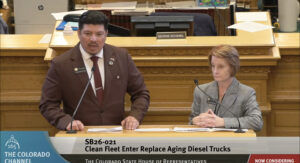
Colorado state Reps. Carlos Barron and Amy Paschal explain Senate Bill 21 to the House.
“I think this is good progress continuing the mission of getting cleaner vehicles here in Colorado,” Paschal told the House during debate on March 31.
The grant program, funded by fees consumers pay on Uber/Lyft rides and on retail-delivery services provided by companies like Amazon and DoorDash, represents a more carrot-based approach by a state that has imposed a lot of regulations to reduce emissions. Environmental groups have fought previously to limit such grants to zero-emissions vehicles but tamped down their opposition to SB 21 after asking for several guardrails to be added to the bill instead.
One of those guardrails, added via amendment, will require the enterprise to prepare an annual report that estimates the pollution-reduction benefits of its grants. Another change to the bill, passed in the Senate, requires the enterprise to prioritize grants to trucks made in 2006 or earlier, though it can still give grants for those made through 2009.
The expanded grants will be permitted just for five years, through 2031.