
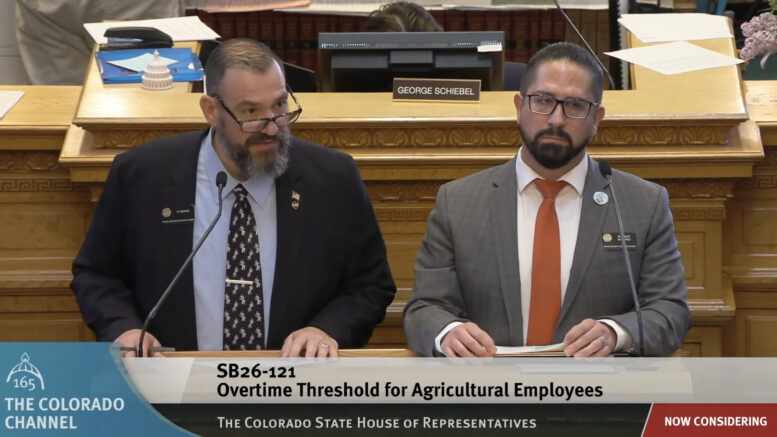
Following two days of lengthy and emotional arguments, Colorado House members passed a bill requiring agricultural laborers to work more hours before getting overtime pay by a single vote Thursday, leaving it one procedural step from landing on Gov. Jared Polis’ desk.
With the 33-32 vote, farmers and ranchers stand poised to get their biggest legislative win in years, one that reverses a key provision in the 2021 Agricultural Workers’ Bill of Rights, which established overtime standers for their employees for the first time. That bill led to rules requiring time-and-a-half pay for agricultural workers after 48 hours for most of the year, which has led farmers to cut hours for workers to avoid hitting that threshold, leaving some laborers to work multiple jobs or to leave the state for more lucrative opportunities.
Senate Bill 121, which cleared the Senate last month on a similarly narrow 19-16 margin, would raise the year-round overtime threshold for the sector to 56 hours, a point at which most farmers say they can get their needed work done without having to bust the bank. In addition to farm operators, supporters include some agricultural workers who say they’ve been left under the current law with the choice between earning less in a seasonal profession or having to spend more time away from their families working second gigs.
While the bill had bipartisan sponsorship in both chambers, more progressive Democrats lashed out at it, saying that supporters are trying to help farmers balance their budgets on the backs of laborers who work more overtime and still make well below average pay levels. They argued many factors have hurt Colorado farms — from low commodities prices to federal tariffs to labor shortages — and that this bill devalues already low-paid workers by making them work longer for overtime benefits than workers in any other Colorado sector.
A debate that involved federal policies, 90-year-old laws
An overhead view of rows of crops on a farm
Opponents pilloried the bill, calling the differentiated overtime standards a leftover from racist policies of the 1930s, but tried to add 31 amendments that sought to do everything from reduce the threshold to 40 hours to make overtime pay double the rate of regular pay. But the only change came from the sponsors, Democratic Rep. Matthew Martinez of Monte Vista and Republican Rep. Ty Winter of Trinidad — a 10% boost in wage-theft penalties for repeat violators and employers who misclassify workers as exempt supervisors.
Those sponsors and other supporters argued that the 2021 law, which made Colorado one of just four states with overtime requirements for agricultural workers, created a slew of benefits for farm workers. It mandated rest breaks and meal breaks, required they have access to health and other service workers, prohibited use of tools like short-handled shovels and allowed them to organize unions, Martinez noted.
But anecdotal evidence in Colorado, as well as studies in two states with similar laws, show that workers are actually earning less money because their hours are being capped when they seeks to work as much as they can over periods of four to five months, he said. SB 121 is necessary to correct a situation that, if not addressed, could lead more cost-burdened farmers to throw in the towel, could send more workers to Wyoming or Utah and could hurt the very workers that it portends to help, he said.
“People aren’t asking for less protections. They’re asking for a fair chance to make a living,” said House Majority Leader Monica Duran, a Wheat Ridge Democrat who was one of just 11 representatives from her party to join with Republicans in backing and passing the bill. “We can hold onto a system that sounds right, or we can acknowledge that for too many people, this isn’t working.”
Agricultural sector suffering
A tractor plows a field.
The $47 billion industry in Colorado — one that employs 195,000 people, including a disproportionate number of Hispanic workers. Predominantly on small farms — is in peril, Winter and sector leaders described in an April 6 committee hearing and during floor debate. Two farms reported losing money for every one that reported making profits last year, and 1.6 million acres of land has been taken out of production since 2022 as the average earnings per farm sits at $50,000, he said.
Workers who don’t plant or harvest during winter weather must work longer hours in the spring through fall, and those pulling up crops before a freeze of helping cows give birth can’t organize weeks into neat 40-hour periods like in other industries, backers said. States like New York that also have agricultural overtime requirements have begun offering tax benefits to farmers to help them pay those costs, but Colorado’s $1.5 billion budget shortfall makes such an idea unworkable here, Martinez said.
Labor advocates argued, however, that making it harder for farm workers, who already do some of the most physically exerting jobs, work 40% more hours to achieve the overtime benefits that everyone else gets is a slap in the face that minority-majority workforce. Rep. Tammy Story, D-Evergreen, and others noted farm workers were left out of the 1938 Fair Labor Standards Act because of bigotry — a chorus that became so repeated that Hispanic Rep. Carlos Barron, R-Fort Lupton, urged them from the House well to stop race-baiting.
Opponents accuse backers of balancing budgets on workers’ backs
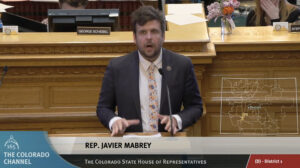
Colorado state Rep. Javier Mabrey speaks against Senate Bill 121 during debate on Wednesday.
Rep. Javier Mabrey, D-Denver, pleaded with colleagues to find other ways to help farmers, noting that the average Colorado farm worker makes less than $25,000 per year and saying the industry already “benefits immensely from paying people less.” Farm workers die on the job at six times the rate of workers in other industries and research shows overtime hours increase mortality rates by 20%, meaning SB 121 is sentencing sector laborers to more injuries with few rewards, he argued.
The litany of amendments offered during six hours of debate Wednesday and two hours Thursday — some proffered two or three times each — came as bill opponents accused President Donald Trump’s administration of hurting farms more than state law. One sought to allow farm workers to report wage-theft crimes anonymously to the state to avoid detection and deportation by federal authorities, and Rep. Meg Froelich, D-Greenwood Village, pinned the problems of farms on the “Epstein class.”
“This consigns the backbone of Colorado’s agricultural industry to a near-endless regime of back-breaking work without adequate compensation,” said Christopher Nurse, political director for the Colorado Immigrant Rights Coalition, during an April 6 committee hearing. “Senate Bill 121 delivers exactly what agricultural special interests want: Continued access to cheap labor.”
Agricultural communities exhale at vote
But it was a coalition of moderate and rural Democrats — Martinez’s district has one of the most agriculture-based economies in Colorado — that sent SB 121 back to the Senate, where that chamber must concur with the wage-theft amendment before the bill is fully passed.
And leaders of the agricultural sector and more rural economic organizations across the state breathed a sigh of relief that a key sector will have more flexibility to be able to compete with farmers in other states that have no similar rules.
“Our agricultural community cares deeply about its workforce and relies on it every day,” wrote Candace Carnahan, president/CEO of the Grand Junction Area Chamber of Commerce, in an open letter to House members earlier this week. “The question before us is not whether to support workers, but how to do so in a way that reflects the realities of the work and allows both employees and employers to succeed.”