

Budget shortfall be damned, Gov. Jared Polis signed two tax-credit extensions into law last week to continue Colorado’s best economic-development tool and the best help it offers to child-care providers, giving boosts in areas where the state is increasingly unaffordable.
With legislators having to close a $1.5 billion gap between expected expenses in the fiscal year that begins July 1 and the money they have to spend, Joint Budget Committee members killed most ideas that limited revenues or created new financial commitments. The fact that two bills got through that will cost the state a combined $48.2 million in tax revenue by the 2028-29 fiscal year speaks to the importance that legislators placed on these two breaks.
House Bill 1004, sponsored by the highest-ranking leaders from both parties in both chambers, extends until 2037 an allowance for taxpayers contributing to a childcare facility or program to receive a tax credit worth 50% of their contribution, up to $100,000 annually. In 2023, the most recent year for which statistics are available, 15,900 taxpayers claimed an aggregate $33 million in these credits, and the nonpartisan Legislative Council expects that total to rise to $44.1 million in the 2028-29 fiscal year.
Colorado faces a shortage of 70,000 childcare slots as measured against the current need, according to Executives Partnering to Invest in Children, and this has forced many parents, particularly women, to not be able to return to work after welcoming a new child. And it’s created a $3.3 billion annual negative impact on the state’s economy, taking into account parents who can’t return to work , parents who miss substantial time at work and employers getting lower productivity for these reasons, according to a ReadyNation study.
What the childcare-contribution tax credit has achieved

Gov. Jared Polis signs the bill to extend childcare tax credits Thursday in front of a group of supporters.
Leaders of childcare centers and organizations like the Boys & Girls Clubs in Colorado testified that donors pointed to the tax credit as a major reason for boosting contributions, and they said they’ve lowered fees and offered more services with the increased funding. Colorado also ranks in studies as one of the half-dozen most expensive states for childcare, with average annual costs topping $20,000 — more than instate tuition costs for University of Colorado.
Industry leaders say that making early childhood education more accessible and affordable will require a multifaceted solution. There is another bill sitting on Polis’ desk, Senate Bill 20, that would streamline licensing and other regulations for providers. And the Early Childhood Education Association of Colorado has said that the state must be less aggressive in trying to pull 3- and 4-year-olds from private care into school-based pre-K programs, as private centers are shutting down for lack of customers and leaving parents with infants with no childcare options, since those are not offered by schools.
But HB 1004 will offer private childcare providers a lifeline in terms of the incentives it presents for people to donate to these centers and supplement their customer fees with extra funding that can help them to increase their slots and keep prices down.
“Extending this tax credit by 10 years doesn’t feel like nearly enough,” House Speaker Julie McCluskie, D-Dillon, said at a Thursday ceremony where Polis signed the bill into law. “And yet it is such an important part of the landscape.”
Job-growth tax credit lauded by business leaders
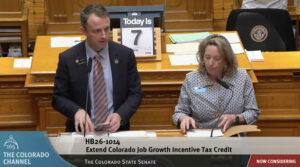
Colorado state Sens. Matt Ball and Lisa Frizell speak to the Seante last month about their bill to extend the Job Growth Incentive Tax Credit.
Economic-development leaders have expressed many of the same sentiments about the Job Growth Incentive Tax Credit, which was set to expire at the end of this year but was extended through 2034 by the bipartisan HB 1014. Polis signed that bill on Friday.
Launched in 2009, the JGITC offers employers who create at least 20 jobs — or at least five in a rural enterprise zone — a 50% credit on their federal FICA taxes, equating to a tax break of about $3,800 annually for an employee earning $100,000. They don’t receive the break until the minimum number of workers have been employed for one year at no less than the average annual salary for the county in which they work, and the break is available for up to eight years in which that workforce is maintained.
The JGITC is harder to attach a fiscal note to, as it’s dependent on companies accepting the credits and then following through on them, but the Legislative Council estimates it could reduce state revenue as much as $13.8 million annually over the next five years. That, however, is a loss of corporate income tax on jobs that otherwise would not have been created had the credits not helped to attract companies’ expansion or relocation, so most economists peg the impact on tax revenues as closer to a gain of four times that of what the state spends.
“The state’s most impactful economic-development tool”
More importantly, economic-development agencies testified, the JGITC gets Colorado a seat at the table for potential corporate expansions by giving Colorado skin in the game, even if the tax break it offers is far less than what’s given by rival states like Texas or Utah. And unlike the Enterprise Zone or Opportunity Zone programs that incentivize job creation specifically in economically underdeveloped areas, the JGITC is one of the few tools that seeks to boost jobs anywhere in Colorado, which is a boon especially for expanding firms.
The tool is increasingly needed at a time when Colorado dips in national economic-competitiveness rankings as costs of doing business and regulatory burdens on employers have left many looking to expand or move completely out of state, cosponsoring Sen. Lisa Frizell, R-Castle Rock, argued.
“It is really important to businesses in the state of Colorado and our ability to attract and retain businesses in Colorado,” Frizell said during Senate debate on May 7. “This is the state’s most impactful economic-development tool for attraction, retention and expansion of employment throughout the state.”
Both bills passed by significant bipartisan margines. HB 1004 advanced to the governor’s desk by a combined vote of 82-16, and HB 1014 passed through both chambers by a combined margin of 85-10.
Also: Loan help for small businesses

Gov. Jared Polis signs House Bills 1014 and 1003 at a ceremony Friday in front of supporters.
Polis on Friday also signed HB 1003, which makes permanent the CLIMBER loan program that launched during the coronavirus pandemic to aid lenders in providing working-capital loans to small business. The bill also reappropriates $5 million to the Colorado Startup Loan Fund for businesses in rural and underserved areas and boosts business access to the Small Business Recovery and Resiliency Fund by lowering a private leverage requirement from 4:1 to 1:1.
Citing both HB 1014 and HB 1003, Polis said Friday that he believes the two bills will boost job creation throughout the state.
“Colorado is the best place to live, work, play and grow a business,” said the Democratic governor, who began his career as a dot-com entrepreneur. “These new laws will support small businesses in Colorado, grow our economy, create more jobs and keep our communities strong.”
Polis has until June 12 to sign or veto bills passed during the 2026 legislative session, which adjourned on May 13.