Fresh off its precipitous drop to the middle of the pack in one major ranking of state business atmospheres, Colorado learned this week that it also fell from No. 11 to No. 17 in U.S. News & World Report’s annual Best States rankings.
The U.S. News rankings covered a broader swath of considerations than CNBC’s Top States for Business Rankings, in which Colorado plummeted this year from No. 11 to No. 25 and was pegged as the second-most expensive state for living. The host of areas in which U.S. News ranked states from No. 1 to No. 50 offered a window to where Colorado is succeeding as compared to the rest of the country — education and health, particularly — and where it’s failing in areas like public safety and fiscal stability.
Most positive for the Centennial State was it earning the ranking of No. 1 in education — a superlative that led Gov. Jared Polis and state educational leaders to crow in news releases on Tuesday. However, a dive into those numbers shows that even while the state has accomplished much in this area, it still has room to go to close the “Colorado paradox” that government and business leaders have sought to address for so many years.
Colorado passed Massachusetts to rank first in educational attainment, a subcategory measuring the percentage of state residents with at least a bachelor’s degree. It ranked third in the percentage of students who complete two-year degrees within three years, reflecting the career-focused efforts of the state’s community colleges. And it ranked third in terms of NAEP reading scores of eighth-grade students, also a focus of Polis’.
K-12 issues remain
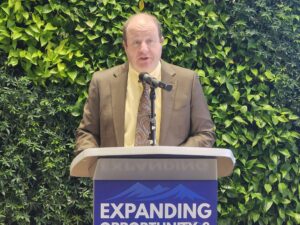
Gov. Jared Polis speaks about a plan to streamline workforce programs during a news conference in December.
“In Colorado, we start earlier, support school choice, invest in our students and teachers, focus on improving results, recognize that learning does not end at 3 p.m. and are making career and higher education more relevant and accessible,” Polis said in a news release. “Helping Colorado become the best state in the nation for education is one of the proudest moments of my time as governor and this moment belongs to all the education leaders, communities, teachers, parents and especially our students who made it possible.”
However, Colorado is still in the lowest quartile of states — 39th — in high-school graduation rate at 82.7% and ranked as having the third-worst education gap by race. Both of those statistics speak to the paradox of Colorado having one of the most educated adult populations, largely by importing talent for the past 20 years, and yet having a K-12 system with enough issues to make employers look outside the state for workers.
Colorado’s second-highest ranking among the eight categories evaluated by U.S. News was the economy, where the publication placed it No. 9 — a significant upgrade from the No. 28 placement CNBC gave it in that same category. But a comparison of the two lists shows that U.S. News considered different factors than its counterpart.
Two ways of ranking Colorado business atmosphere
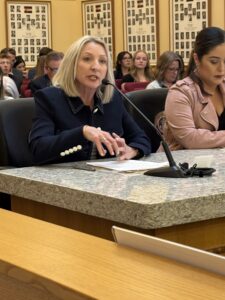
Colorado Chamber of Commerce President/CEO Loren Furman testifies in March before the Senate Finance Committee for a bill to boost the review of state regulations.
For example, CNBC dinged Colorado for being the 13th most-expensive state to do business in and downgraded it for its slow permitting times — two factors that U.S. News did not consider. Business leaders have pointed to those factors, both of which tie directly to the high level of regulations that Colorado Chamber of Commerce polls show is the biggest obstacle to companies expanding in this state, to argue why the business atmosphere is curdling here.
As part of its economy category, U.S. News ranked Colorado as having the No. 4 business environment — a subcategory in which it notably ranked California No. 1 despite that state having lost numerous headquarters because of its regulatory and tax burdens. The five state-to-state comparisons used to produce the high business-environment ranking, all of which Colorado ranked in the top 10 for, included per-capita venture-capital investment, low tax burden, patent- and business-creation rates and the number of Fortune 1000 company headquarters per 1 million residents.
Other subcategories of the economy rankings put Colorado more squarely in the middle of the pack business-wise, however. Those included its rankings for GDP growth (No. 17), net migration over the past three years (No. 24), unemployment rate (No. 28), growth of its population of 25- to 29-year-olds (No. 34) and job growth (No. 39).
A rosy infrastructure ranking?
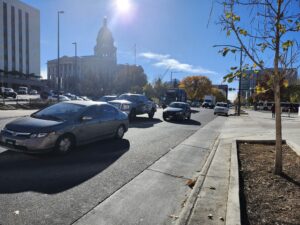
Traffic moves along Lincoln Avenue in Denver.
Similarly, while U.S. News ranked Colorado No. 10 for its infrastructure — much higher than the No. 32 slot it earned from CNBC in that category — the only subcategory in which it ranked in the top 10 was for the state’s internet access, for which it placed No. 5. While it placed 15th in bridge quality and public-transit usage, it was lower in commute times (No. 24), power grid reliability (No. 24), electricity prices (No. 31) and road quality (No. 35).
U.S. News ranked Colorado in the lowest quartile — No. 39 — it is Opportunity category, but this too was bifurcated by subcategory. Colorado ranked No. 6, for example, for economic opportunity, placing No. 7 or 8 for its low rate of food insecurity, its median household income and its poverty rate of just 9.6%.
However, it came in 43rd in affordability, ranking No. 39 for its cost of living and No. 47 for housing affordability, putting it ahead only of Massachusetts, New Jersey and California. And in equality — the third subcategory of opportunity — it scored in the top half of states for its low unemployment gap by race and relatively small income gap by gender but No. 39 for its income gap by race and No. 48 for its education gap by race.
Two areas where U.S. News particularly hammered the state were with bottom-six rankings in fiscal stability (No. 45) and crime and corrections (No. 47).
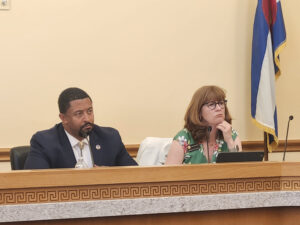
Colorado Senate President James Coleman and House Speaker Julie McCluskie listen to a presentation in July 2025 about the state budget shortfall.
Budget woes, property crime hurt Colorado
The fiscal-stability ranking comes after two straight fiscal years in which legislators have had to cut more than $1 billion to balance the budget — a situation Democrats attribute to federal tax cuts and Republicans peg to overspending on the part of majority Democrats. U.S. News ranked Colorado No. 49 — ahead only of Washington — for its short-term fiscal stability that involves budget balancing and keeping adequate reserves — and No. 31 for its long-term fiscal stability, a position buoyed by its AA-1 government credit rating.
Similarly, U.S. News ranked Colorado next-to-last for its public safety, noting it had the seventh-highest violent-crime rate per capita and the second-highest property crime rate, with only neighboring New Mexico touting a lower ranking. Colorado rose to No. 47 in the overall Crime & Corrections category because it ranked near the middle of states for its per-capita incarceration rate (No. 22) and its juvenile incarceration rate (No. 32).
In two final categories that speak more to the quality of life that economic developers long have touted, Colorado had divergent but still notable results, ranking No. 10 in healthcare and No. 22 in the natural environment.

A hospital nurse prepares an infusion for a cancer patient.
U.S. News placed Colorado No. 2 in the country for its healthcare quality, behind only Hawaii, pegging it No. 6 for its nursing-home quality, No. 22 for its hospital quality and No. 3 for its low percentage of hospital admissions of Medicare patients that were avoidable. It also ranked No. 9 for public health, with the publication touting Colorado for having the lowest obesity rate in the country (25.1%) and the 10th-lowest mortality rate, though it features the eighth-highest suicide rate.
In the subcategory of health access, the results were more mixed, with Colorado coming in just No. 33. While it ranked near the median for child wellness visits and health-insurance enrollment, it came in No. 40 in adult wellness visits and No. 39 in healthcare affordability, which measured the percentage of adults who skipped doctors’ visits in the past year due to cost concerns.
Obesity is low — but so is air quality
Finally, the No. 22 ranking in the Natural Environment category — an area in which Polis and his fellow Democrats in the Legislature have invested a lot of resources the past eight years — was achieved by a big split in the two subcategories. Colorado placed No. 12 for pollution levels, including No. 10 for its low level of industrial toxins, but No. 37 for air and water quality, with U.S. News noting its 172 days last year of unhealthy air quality.
While these newest rankings don’t represent the significant drop that CNBC offered in its more business-focused list, they are likely to add to the push to re-examine state regulations and ensure Colorado remains business-friendly. Just last week, Polis announced the launch of the Governor’s Competitiveness Council, composed largely of business and government leaders, to “strengthen our economy, attract more businesses and create more jobs.”
Such a goal is welcomed by business groups like the Colorado Chamber, which released a Relocation Tracker report in April identifying 98 companies that had relocated or chosen to expand outside the state since 2019 at a cost of 13,607 jobs. President/CEO Loren Furman emphasized good work is underway already — including passage of a 2026 regulatory review law and efforts to boost the workforce-development system — but that both rankings show Colorado must do more.
“Colorado’s drop in the rankings reinforces what the Chamber’s strategic research has already shown,” Furman said. “Regulatory burdens, housing, rising costs and workforce needs remain key issues affecting the state’s competitiveness.”
U.S. News ranked Utah as the No. 1 state for 2026, followed by South Dakota, Minnesota and North Dakota. Louisiana ranked last among all states, with Alaska, Mississippi and New Mexico ranking just ahead of it.