
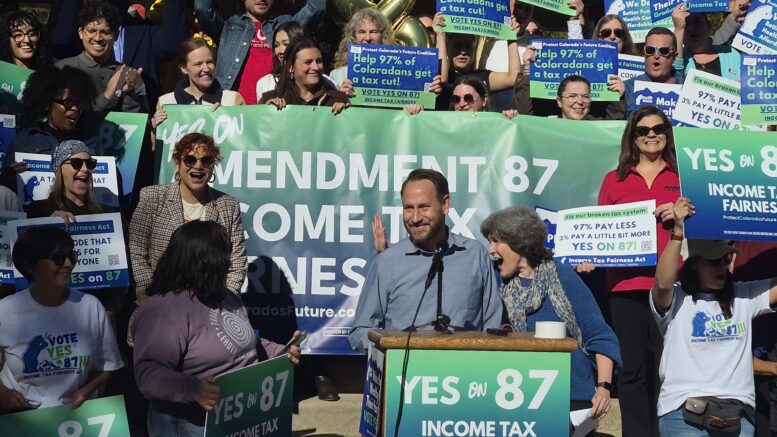
It’s official: After 39 years of a flat tax, Colorado voters have decided that they want to return to a graduated income-tax system where businesses and individuals who earn more money must pay their taxes at a higher rate.
The business-led opponents of Amendment 87 conceded early Friday that the amendment to create a graduated income-tax system has passed, following an announcement by supporters of the ballot measure on Thursday afternoon claiming victory. With 96.9% of votes from Tuesday’s election having been counted, the amendment holds a lead of 51.4% to 48.6% — a lead of 70,836 votes with just 85,391 votes still left to be counted.
Beginning on Jan. 1, companies and individuals will be taxed 3.7% on income of $25,000 or less, 4.2% on income between $25,000 and $100,000 and the current 4.4% rate on income between $100,000 and $500,000. But those rates will rise to 7.4% for income between $500,000 and $750,000, 7.9% for income between $750,000 and $1 million and 8.4% for anything above $1 million.
The change in structure is expected to raise $2 billion in additional taxes in the first full fiscal year for the policy — money that the initiative specifies must go to K-12 education, health care and childcare. Amendment 87 also specifies that all new revenue derived from this change will be exempt from the state’s Taxpayer Bill of Right’s revenue cap — a change that, combined with Tuesday’s passage of Proposition NN, essentially means legislators no longer will be constrained by any type of spending cap on state revenue.
Business leaders say hiring environment about to get worse

Colorado Chamber of Commerce President/CEO Loren Furman testifies in March before the Senate Finance Committee for a bill to boost the review of state regulations.
While supporters had touted that Amendment 87 will offer small tax breaks to 97% of state residents and 95% of state businesses — breaks ranging from $9 to $325 a year — business leaders noted that the tax increases on larger employers will be much higher. Those reach an average hike of $55,925 for employers with $2 million in taxable income, according to an analysis from the nonpartisan Colorado Legislative Council, at a time when many companies are struggling with increasing costs and with state regulations that rank among the most significant in the country.
“We are incredibly disappointed that Amendment 87 has passed. Small business owners work their entire lives to achieve the American dream, but this measure will penalize them for achieving that dream,” Colorado Chamber of Commerce President/CEO Loren Furman said. “The passage of Amendment 87 will now make Colorado even less competitive and will drive businesses to reduce their investments or locate elsewhere.”
The tone was much different when supporters of the measure gathered Thursday afternoon in Denver’s La Raza Park to celebrate its passage, breaking into chants of “Tax the rich!” before they popped open champagne bottles. Greate Education Colorado Executive Director Lisa Weil — leader of one of about 100 organizations that was part of the Protect Colorado’s Future coalition that backed Amendment 87 — said that money now will be available to attract and retain teachers, fund classes and help parents afford childcare (if they can find it in a state that has far fewer providers than needed for its population).
What’s happened in other states implementing similar policies?
“We have been living in this scarcity model for so long. We are turning the page on scarcity in the state of Colorado today,” Weil said. “We can look at kids and say, ‘You are going to graduate from a fully resourced high school.’”
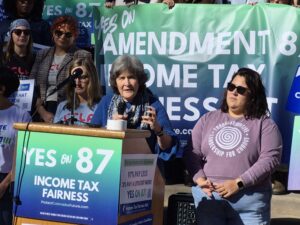
Lisa Weil, executive director of Great Education Colorado, speaks at a rally for Amendment 87 on Thursday.
But it will be telling to see how many jobs are as available for the parents of those children over the next few years.
Studies of other states that increased tax rates on high earners have produced mixed results. After such a hike in Massachusetts, for example, some high earners fled right away but the percentage of people earning $1 million eventually went up.
But the Romer Institute of Evidence-based Policy, in an analysis released last month, documented that multiple studies found increases in corporate tax rates are associated with at least some decrease in employment growth and in the number of business establishments. And it noted that when California raised its top tax rates by as many as 3 percentage points — less than Colorado is raising its top rates — new revenue was 61% lower than expected by the second year in large part because overall reported income declined.
More money for schools and childcare
Amendment 87 supporters such as state Rep. Lorena Garcia, an Adams County Democrat who is CEO of the Colorado Statewide Parent Coalition, countered that she believes that the business leaders that opposed the measure actually will see benefits from it. Education levels will improve and businesses considering growing here won’t have so many questions about the funding and outcomes of the school system, she said.
“This campaign is historic, not only because we are finally documenting that Colorado voters aren’t happy with TABOR but that Colorado voters want to invest in our future and our kids and our health care and our childcare,” Garcia said at the La Raza Park rally.
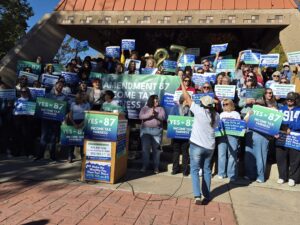
Colorado state Rep. Lorena Garcia speaks to a crowd of Amendment 87 supporters at a rally on Thursday.
But business leaders also will have to weigh those potential benefits against paying a top tax rate that will nearly double while they are facing other headwinds that have dropped Colorado’s business environment to the middle of the national pack, according to CNBC. Housing costs are among the five most-expensive in the country, according to multiple reports, and Colorado is the sixth-most regulated state in the nation, according to a study commissioned by the Colorado Chamber.
“I think we’re going to see businesses leave. I think 100% we’ll see data on businesses leaving Colorado,” said Doug Friednash, chief of staff to former Gov. John Hickenlooper and co-chair of the national government relations practice for Brownstein Hyatt Farber Schreck. “This may be the straw that broke our economic back. We’ve already dropped significantly in the last eight years. That’s a fact.”
Increase in revenue will impact budgeting process

Doug Friednash is a shareholder at Brownstein Hyatt Farber Schreck LLP.
While most of the financial gains for the state and reverberations for businesses will start to be seen when income-tax bills come due in 2028, there will more immediate impacts — and those could affect even the early-session efforts to supplement the budget for the current fiscal year.
Kathy White, executive director of the Colorado Fiscal Policy Institute and a key member of Protect Colorado’s Future, noted in an interview Thursday that corporations that pay taxes on a quarterly basis will begin paying the higher rates before the current fiscal year ends in June. Nonpartisan analyses of the ballot initiative suggest the state could bring in $958 million in the current fiscal year, and White expects community groups will ask legislators to reverse course particularly on many of the Medicaid spending reductions that have been implemented to balance the budget.
But that discussion particularly will become relevant as the Joint Budget Committee works to craft the financial plan for the fiscal year that begins on July 1 — a plan that Gov. Jared Polis recently proposed with more than $650 million in spending reductions for the Medicaid public insurance program. Those cuts are necessary to keep Medicaid from growing out of proportion to budgetary limits, Polis said — but those limits are no longer relevant after Tuesday’s election, White argued.
The Legislature also can put more money to K-12 education, which is expected to receive between $450 million and $550 million more next year because of Proposition NN alone, White noted. And it can look seriously at boosting a childcare assistance program that is meant to help lower-income parents afford to put their kids in early childhood education but that faces major waiting lists in most counties.
Will new revenue from taxes pause consistent rise in fees?
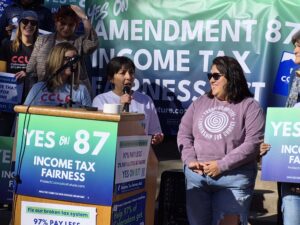
Kathy White, executive director of the Colorado Fiscal Institute, speaks at a rally for Amendment 87 supporters on Thursday in Denver.
“Just because health care costs as much as it does, just because we have an aging population that needs long-term services, just because teachers cost more … doesn’t mean that we need to cap our costs,” White said. “We have had 30 years of disinvestment. That has finally come to an end. And there is no place else to go with doing less.”
In recent years, legislators often have dealt with TABOR revenue limits by creating new fees on everything from Uber rides to industrial emissions-report submissions, relying on businesses to pay many of these fees. With the $2 billion boost in TABOR-exempt revenue coming from Amendment 87 and the $4.6 billion hike in the TABOR cap permitted under Proposition NN, Furman said she hopes legislators will stop assessing fees on businesses to pay for all of their new programs.
“We expect that the passage of this amendment will put an end to continued efforts at the Capitol to impose additional fees on Colorado employers to support the many programs that are now funded through these increased taxes on business,” Furman said. “The Chamber has fought these bills year after year, and employers simply cannot afford to keep absorbing new costs.”