

Colorado commercial landscaping companies will face restrictions on their use of gas-powered lawn-and-garden equipment beginning in 2027 as state regulators widen their efforts to reduce greenhouse gas emissions to yet another industry sector.
Members of the Colorado Air Quality Control Commission on Friday approved a plan to phase in limits on commercial operators’ use of such equipment over the next six years, until no more than 10% of equipment usage can come from gas-powered tools by 2032. The rulemaking followed a 2023 vote to limit use of such equipment by state and local governments, with an addendum to reconsider this year whether commercial operators too should migrate to mostly electric-powered mowers and trimmers.
While commercial operators acknowledged that they already are transitioning away from gas-powered leaf blowers and hedgers, they said the proposed state rules demand too quick a changeover at too high a price. Those rules also don’t consider the years-long wait companies face to get utilities to upgrade electric infrastructure enough to let them plug in significant battery-powered equipment, said Steven Kattau, maintenance division manager at Singing Hills Landscape of Aurora.
But AQCC members and Air Pollution Control Division staffers, who were in agreement on the principles of the rule but disagreed at times over the details, said the regulations are needed to help bring Colorado into compliance with federal ozone standards. The U.S. Environmental Protection Agency classifies most of the Northern Front Range as being in severe noncompliance, which has led the state to impose emission limits on sectors from oil-and-gas rigs to commercial buildings to large manufacturing facilities.
Why the state targeted equipment like leaf blowers
Lawn-and-garden equipment is the second-largest contributor of volatile organic compounds — which, along with nitrous oxide, create ground-level ozone — in the nonattainment area, behind only oil and gas, APCD officials said. The new regulations will reduce VOCs and NOx by 450 tons in the high-ozone season between June and August — five tons per day — and cut overall greenhouse gas emissions by 166,000 tons during that time, said Andrew Scherer, an environmental compliance specialist for the Colorado Department of Public Health and Environment.
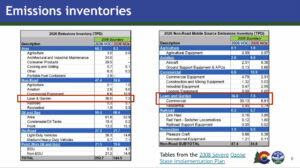
A Colorado Air Pollution Control Division chart shows the amount that gas-powered lawn-and-garden equipment contributes in terms of ozone precursors versus other sources of emissions.
“In the realm of emissions reductions, that is fantastic. That is an ice cream cone on a summer day,” Scherer said during a three-day hearing this week. “We believe this rule is going to deliver meaningful emissions reductions, especially when it comes to ozone production, that will benefit the residents of Colorado.”
Restrictions apply to six types of equipment with a threshold of 10 horsepower or less — trimmers, blowers, edgers, hedge trimmers, pole saws and push mowers — used by landscapers in the ozone nonattainment area stretching from Douglas County to Wyoming. Those restrictions will be in place just from June through August, though APCD leaders said they expect that many operators will end up using the electric equipment year-round once they begin employing it during the summer.
Commission approves more accelerated schedule than APCD recommended
Commissioners eschewed the implementation timeline proposed by APCD and instead backed, on a 5-3 vote, an accelerated timeline offered by the Local Government Coalition, which consists of officials from 49 different city and county governments. That timeline will require that at least 15% of equipment that commercial operators use be electric by as soon as next year and raise that portion annually to reach milestones of 60% by 2029 and 85% by 2031, topping out at 90% by 2032.
Advocates for that timeline, such as Adams County environmental specialist Amanda Perkins, argued that when local governments began to transition wholly to electric equipment, most were able to do so in just one year. Also, because most commercial companies replace equipment about every three years due to wear and tear, the schedule is feasible, she added.
“We had 66 days of ozone exceedance (above the federal threshold) this summer, and we really need reductions as soon as possible,” commissioner Jana Milford said.
Commercial landscapers and industry representatives said, however, that the economic impact analysis performed by the APCD didn’t account for several critical factors.
Companies expect financial burden to be significant

A lawnmower sits in a yard in the Denver metro area.
Companies will have to replace not just equipment but also the trucks that haul it, as the added weight of electric equipment and extra batteries that they must transport is too much for the shocks and struts of lighter trailers, said Mike Wagner, director of operations for Centennial-based Designscapes Colorado. Added costs for larger fleets will stretch into the hundreds of thousands of dollars, creating a financial burden for many firms.
Greg Knott, senior vice president of standards and regulatory affairs for the national Outdoor Power Equipment Institute, also said that state regulators vastly overestimated the amount of such equipment that is used and, thus, the emissions that can be reduced. Without an accurate cost-benefit analysis, he urged the AQCC to pause its rulemaking, adding that he believes the rule could be pre-empted by federal laws as well.
“Our concern is that available financial support does not go far enough to make the full transition financially sustainable,” said Terence Stovall, manager of state and local government affairs for the National Association of Landscape Professionals, pointing to 30% rebates the state is offering on electric lawn-and-garden equipment through 2030. “A pause would support reassessment and a more commercially workable approach.”
Equipment limits “another big step”
Commissioners did not pause the rules. But they did offer several other concessions to commercial landscapers.
They declined, for example, to expand the enforcement period for the new rule from its proposed frame of June through August to the longer period of May through September that the Local Government Coalition sought. And they declined to include in the regulations businesses that do their landscaping with inhouse crews, such as golf courses and country clubs, though they directed the division to study at a future time whether to expand the restrictions to those businesses.
With the new rules, Colorado joins a handful of other states as well as a small number of local governments that have similar limitations on the use of some types of gas-powered lawn and garden equipment for some period of the year. And while industry groups pushed back against the rules, several environmental organizations celebrated them on Friday, noting the restrictions will also reduce noise and harmful vibrations that workers suffer when using spark-ignition equipment.
“We should not tolerate harmful pollution from cutting grass and blowing leaves around, especially when cleaner, quieter technology is available, “said Kirsten Schatz, clean air advocate for the CoPIRG Foundation. “With this vote, our state leaders have taken another big step toward cleaning up the air pollution that is harming our health and quality of life.”