
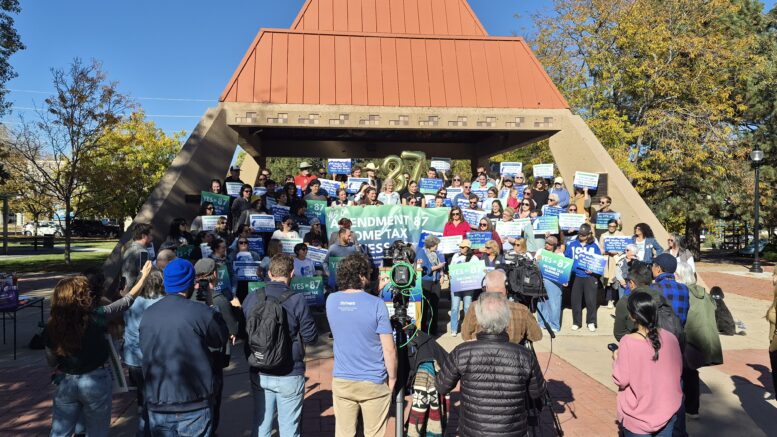
Amendment 87 proponents claimed victory for their graduated-income-tax measure on Thursday, though other election watchers have yet to call the results final for the closely contested ballot measure.
With 88.1% of the 2.74 million ballots cast by Election Day having been counted by 7 p.m. Thursday night, Amendment 87 had received 27,149 more “yes” votes than “no” votes — a margin of 50.6% to 49.4%. About 325,000 votes remain to be counted.
Chris deGruy Kennedy, a leader of the Protect Colorado’s Future campaign behind the amendment, said at an afternoon gathering of supporters at Denver’s La Raza Park that his coalition was declaring victory because of the composition of votes that remained outstanding. The four counties with the highest percentage of outstanding ballots are Arapahoe, Boulder, Denver and Larimer; Amendment 87 leads in each county and leads by a 2-to-1 margin in both Boulder and Denver counties.
With so few remaining ballots, Amendment 87 needs only 46% to 47% of the remaining vote to win, and the composition of outstanding ballots makes that outcome a near certainty, deGruy Kennedy concluded. As such, he pulled together some of the roughly 100 organizations that made up the coalition, popped bottles of champagne and declared that the additional $2 billion in taxes that the measure will raise annually will boost health-care services, allow for affordable childcare and retain and attract teachers.
What passage of Amendment 87 would mean
“This is a huge day for Colorado,” deGruy Kennedy said at the start of a news conference that later ended with campaign leaders egging on chants of “Tax the rich!” “This is the most significant change to Colorado’s fiscal policy in at least 20 years.”
Amendment 87 would scrap the state’s flat 4.4% income-tax rate for all businesses and individuals and replace it with a graduated system in which companies and residents making more money pay higher rates — as high as 8.4% for million-dollar earners. The new revenue would be required to go to K-12 education, health care and childcare and it would not be subject to the Taxpayer’s Bill of Rights revenue cap, which already was raised by $4.6 billion annually when voters passed the separate Proposition NN Tuesday.
But opponents of the measure — a coalition made up largely of business leaders who warn that doubling income-tax rates for large employers and successful small businesses — will stunt economic growth and lead to expansion outside of Colorado — aren’t conceding yet. And they point to four other counties where Amendment 87 is losing and where tens of thousands of ballots in each county remain uncounted.
Where the votes are still out
There is, for example, thousands to tens of thousands of ballots still uncounted in counties that have voted heavily against Amendment 87, including Weld, El Paso, Douglas and Pueblo counties, they note. And the margins continue to constrict for more conservative legislative and congressional candidates who are trailing now in uncalled races in El Paso and Douglas counties, pointing to the possibility that uncounted votes there are leaning heavily toward residents who also may well be “no” votes on Amendment 87.
And just as Amendment 87 supporters are optimistic about the impact of the measure they believe has passed — and would launch new tax rates on Jan. 1 — those business leaders watching the votes warn that passage of the initiative would be very damaging.
“Many of these employers are already struggling with rising costs to make payroll and support their employees,” Colorado Chamber of Commerce President/CEO Loren Furman said. “These tax increases would force businesses to make difficult decisions about wages, hiring and future investments.”
The Colorado Secretary of State’s Office has not offered a timeline for when it expects the rest of the votes to be tallied statewide. Until then, the fate of Amendment 87 — like that of the 3rd and 4th congressional districts and of several races that will determine how much of a supermajority Democrats control in the House — hang in the balance.