
In their first act as a supermajority, Colorado Senate Democrats on Thursday opted for more pragmatic rather than more progressive members to lead their caucus, saying that a “coalition-building mindset” is needed to pass the best legislation possible.
The 24-member caucus, which grew by one person in Tuesday’s election and now has a veto-proof majority, elected Sen. James Coleman of Denver to continue to serve as Senate president, as was expected after he held the post for the past two years. And in a contested race for the other leader who sits on the legislative Executive Council, members chose Sen. Dylan Roberts of Frisco to be majority leader.
Roberts defeated Sen. Mike Weissman of Aurora for his position, which sets the floor calendar and assigns committee memberships. Roberts is considered one of the more pro-business members of the caucus, having cast key votes in stopping business-opposed legislation and in advancing bills to reduce regulations on employers.
“Representing everyone”

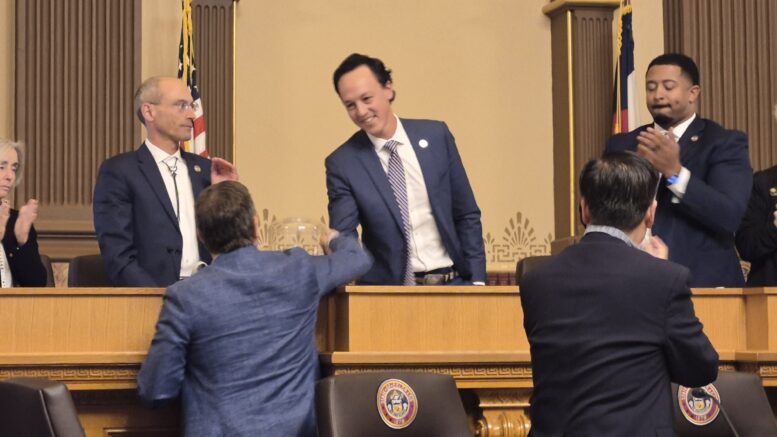
Senate President James Coleman receives applause after getting elected by his caucus Thursday to serve again as the leader of the legislative chamber.
While some observers thought the increased margin for Democrats in the chamber might push senators to be more aggressively progressive in leadership choices, caucus members spoke of the need to use power strategically to ensure lasting change. Sen. Marc Snyder of Manitou Springs, who nominated Roberts, noted Roberts had the experience of pushing through major legislation, including creation of the Colorado Option health plan offered by private insurers and multiple affordable-housing bills, but added he also understands how to build coalitions within the party and with Republicans.
“He also understands that leadership means representing everyone,” Snyder said. “He has the experience, political understanding, temperament and constitution to lead this caucus forward.”
Roberts, who served last session as caucus chairman and as chairman of the Senate agriculture committee, represents a largely rural former swing district that he just won by 20 points in his re-election bid this week. He was a key vote in passing a bill to raise the threshold for farm workers to get overtime pay, sponsored a bill to speed wireless permitting by local governments and several times was the decisive vote to kill a bill to make it easier to file deceptive-trade-practice lawsuits — a bill that Weissman sponsored.
In his speech to caucus members, Roberts tried to emphasize his progressive bona fides, noting that he sponsored a law to cap the price of insulin and led the effort to add protections for Colorado waters after the U.S. Supreme Court rolled them back in 2023. In the case of that water bill, Roberts also demonstrated his coalition-building capacity by working with the author of a competing Republican bill to produce a consensus first-in-the-nation law to give the state oversight of resources that no longer were subject to the Waters of the United States rule.
Seeking to concentrate on policy areas of agreement

Sen. Dylan Roberts delivers a speech to try to become majority leader of the Senate on Thursday while Sen. Mike Weissman listens.
But he emphasized too that the supersized caucus should spend most of its energy on the 95% of issues on which it agrees rather than the 5% of issues that divide it. And he acknowledged that there are “real divisions” in the caucus but said the way to deal with them is by talking through them rather than avoiding the topic and letting them simmer.
“I don’t need everyone to agree with me on every issue. But I need you to know your majority leader will stand up for you,” Roberts said. “I believe we can be ambitious in our values.”
Weissman, on the other hand, emphasized the nearly 200 bills he’s sponsored over his 10 years in the House and Senate to show that he knows how to fight for members’ beliefs and that he’s been willing to amend them to get them passed as well. Citing the national resistance that stood up to President Donald Trump and produced the blue wave that rolled over the nation Tuesday, he said that he was running for majority leader “to help us meet this moment.”
Democrats choose other leaders

Colorado state Sens. Katie Wallace and Kyle Mullica hug on Thursday. Both were elected to be a part of the Senate Democrats’ leadership team.
It wasn’t just moderates who ended up in the Democrats’ leadership team, however. Caucus members elected Sen. Katie Wallace of Longmont, one of the staunchest environmental advocates in the Legislature, as assistant majority leader, with Wallace saying she wanted to bolster the communication within the caucus.
And with Sen. Jeff Bridges of Greenwood Village soon to be resigning his seat after getting elected Tuesday as Colorado’s next treasurer, the caucus chose Sen.-elect Emily Sirota of Denver as his replacement on the powerful Joint Budget Committee. Sirota, who served in the House for eight years before her election to the Senate and has served on the JBC for the past four years, will join incumbent Democratic Sen. Judy Amabile of Boulder as a Senate appointee to the six-member committee.
Finally, members also chose Sen. Kyle Mullica as president pro tempore, Sen. Janice Marchman of Loveland as caucus chair and Sen. Iman Jodeh of Aurora as the majority whip.
House Democrats are expected to gather Friday to select new leadership — a crucial election, as Speaker Julie McCluskie is leaving due to term limits and Majority Leader Monica Duran was elected Tuesday to the Senate. House Republicans also will select new leaders on Friday. Senate Republicans have yet to set a date for leadership elections.