

Colorado House Democrats selected a trio of progressive members Friday to head their leadership team, announcing they would “meet the moment” of this national and statewide blue wave with officials who’ll push the envelope on issues from environmental protections to labor.
The 49-member supermajority caucus — the largest in the 65-seat House in 90 years — selected Assistant Minority Leader Jennifer Bacon of Denver to be the new House Speaker, replacing term-limited Speaker Julie McCluskie. Bacon is the first Black woman ever to hold the position.
Party members then elected Rep. Javier Mabrey of Denver — who, with Bacon, sponsored the Colorado Labor Peace Act overhauls that Gov. Jared Polis vetoed the past two years — as House majority leader. And they chose Rep. Jenny Willford of Northglenn, whose bills have included environmental proposals on which she worked closely with Bacon and several regulations on transportation network companies like Lyft and Uber, as assistant majority leader.
The selections — all chosen over a slate of more pragmatic candidates — came after Senate Democrats on Thursday went the other way in their leadership election, choosing centrist Sen. Dylan Roberts of Frisco to be their new majority leader. And they came just hours after House Republicans rejected a push to put archconservatives in charge of the caucus and re-elected aisle-crossing Rep. Jarvis Caldwell of Monument as minority leader.
“Don’t want the status quo”

Colorado state Rep. Jennifer Bacon speaks about a new slate of proposed environmental bills in February 2024 at the Capitol.
Bacon appealed to members to be bold in choosing her over Rep. Andy Boesenecker of Fort Collins, who’s spearheaded affordable-housing and technology-regulation bills and was nominated to be speaker by both a very liberal caucus member and a moderate one. She noted that voters chose progressives over moderates in the primary and that they chose Democrats of action in this week’s election, and she said the House must follow their lead in advocating for clean-air policies and laws to help working-class residents.
“To you all voters, I say, ‘Thank you, you were very clear.’ You were clear in June, and you were clear on Tuesday. You want change,” Bacon said. “You don’t want the status quo or predetermined outcomes or heirs apparent. You want people who will meet the moment.”
Meeting the moment was a theme of Democratic Sen. Mike Weissman’s campaign to be Senate majority leader on Thursday as well, but that effort fell short. Bacon appeared to benefit not just from representatives who support her more progressive efforts and what she described as her very conspicuous style of picking policy fights but from her push to be the first Black female to lead the House.
“Speaker Pro Tem Boesenecker will be a competent speaker. Assistant Majority Leader Bacon will be historic,” said Rep. Michael Carter of Aurora. “Our caucus is blue. This House is blue. My speaker is going to be Black.”
House Democrats acknowledge need to heal divisions

Colorado state Rep. Jenny Willford explains her workers’ compensation bill, HB 1300, to the House in April 2025.
Mabrey in turn defeated Rep. Meghan Lukens of Steamboat Springs, one of the handful of Democrats who still represent a largely rural district. And Willford defeated Rep. Regina English of Colorado Springs, who said she had seen enough division and wanted to build “a caucus where every member feels represented and included.”
To be sure, each of the new members atop the House Democratic leadership team emphasized that they want to help all the representatives in the caucus succeed, even if they may not agree with every bill. But like with the Senate Democrats on Thursday, there were undertones both subtle and overt running through the leadership elections about how they need to heal ideological fault lines within their caucuses and work together to take advantage of the record margins they hold in both legislative chambers.
While legislative Democrats should not have a hard time passing bills — and have a governor in newly elected Democrat Phil Weiser who may be more reluctant to burnish his veto pen against his party than Polis was — a caucus so large can cause its own issues. While nominating Lukens, Rep. Karen McCormick of Longmont referenced the 41-member 2021-22 caucus that faced intraparty divisions and couldn’t move bills fast enough to overcome Republican filibuster efforts at the end of session.
What will House Democrats prioritize?
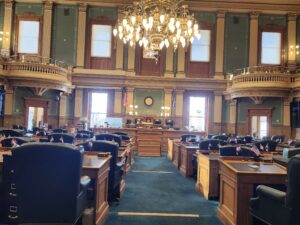
The Colorado House of Representatives chamber
Some issues coming before the Legislature next year are likely to have widespread support in the majority Democratic caucus. Bacon and Mabrey are expected to bring back the twice-vetoed effort to eliminate the second election needed to achieve union security in organizing efforts — a bill that was supported by every Democrat. And sponsors could reintroduce efforts to roll back several tax breaks that got widespread Democratic support in the House before they died in the Senate under the threat of veto from Polis.
But other issues could find more of a divided caucus. Progressives who won contested primaries in June said they will push for proposals to allow rent control by local governments or significant increases in fines for industrial emitters — proposals that have been scuttled before because of disagreements in the majority party.
The new leadership team didn’t list a host of legislative priorities, saying instead that they want to help push the bills that are suggested by all members. But Mabrey did single out efforts to boost collective-bargaining practices and protect immigrants’ rights as subjects that he said are non-negotiable.
“The people told us to keep our foot on the gas,” he told members on Friday.
House GOP deals with own fault lines

Colorado House Minority Leader Jarvis Caldwell offers remarks at a House Republicans’ news conference in January.
House Republicans, meanwhile, dealt with open divisions of their own as they gathered Friday morning after losing six seats during Tuesday’s election. Rep. Ken DeGraaf of Colorado Springs, arguably the most conservative member of the House, accused Caldwell of being a “status-quo obstructionist” and pushing for more moderate Republican candidates over true conservatives.
But Caldwell emphasized that his focus has been on fighting for economic relief and for less bureaucracy and that he’ll continue to do so, adding a news release he’ll lead “a unified front in the fight against the socialist agenda of the Democrat party.” He won 11 of the 16 votes in a three-way race against DeGraaf and Rep. Scott Slaugh of Berthoud — the House GOP is the only caucus to reveal vote totals in leadership races — and supported successful re-election of the other three Republicans on the House leadership team.
“Coloradans deserve more than they have been given in the policy space,” Caldwell said afterward. “While the House Republican Caucus might hold fewer seats than before, our commitment to the Colorado people is greater than ever.”
Senate Republicans, the only caucus yet to hold leadership elections, expect to do so sometime later next week. They lost one seat in Tuesday’s election.