

What could progressive legislators’ wins in Democratic primaries mean for business? The simple answer: Another push to upend the Labor Peace Act, efforts to fine companies violating environmental rules more and a focus on multimodal-transportation funding.
While there has been much talk about the political shift seen in the June 30 primary, in which Democratic voters favored liberals over moderates and ousted two middle-of-the-road state House incumbents, there has been less focus on what it means for policy. So, The Sum & Substance examined campaign websites of more progressive victors in contested Democratic legislative primaries, as well as those of progressives likely to be entering or returning to the General Assembly, to see what issues they prioritize.
In many cases, the answers are familiar ones, with both returning and likely new legislators wanting to try again on issues that either died in the legislative process or withered under the veto pen of Democratic Gov. Jared Polis, who is term-limited and won’t return in 2027. The business-focused issue cited by the largest number of progressive candidates — a group TSS identified based on endorsements, sources of funding in competitive primaries and their voting history — was making it easier for private-sector workers to unionize.

Colorado state Rep. Javier Mabrey speaks in January to a coalition of labor groups seeking to upend the Colorado Labor Peace Act.
But it’s clear that the group, which is expected to make up a bigger share of the Democratic caucus and have more influence on legislative leadership elections after the November election, will bring new ideas to the table as well. Chief among them, based on the frequency of mentions on their websites, are new crackdowns on emissions-producing industrial companies and a previously paused push to move Colorado to a universal, single-payer health system.
To be sure, many of the ideas will meet opposition — from businesses, from more moderate Democrats and from Republicans, who are working to hold onto vulnerable seats to avoid Democrats taking a supermajority in both the House and the Senate. But with many of the victors in contested Democratic primaries running in general-election races for heavily Democratic seats, the ideas listed below are likely to become bigger talking points than they would have been even this past session.
Economic Issues
Democrats had vowed before the primary elections to take a third swing in 2027 at passing a law to repeal the second election required in private-sector union organizing to allow labor groups to seek to take negotiating fees directly from all workers’ paychecks. But the commonality of passing this proposal among both returning and new candidates —combined with the exit of Polis, who vetoed the bill twice — indicates major changes to Colorado’s Labor Peace Act could be the first issue of the gate next year.
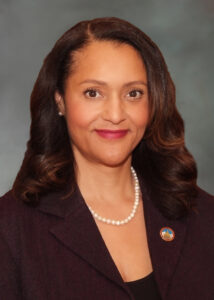
Colorado state Rep. Jamie Jackson, D-Aurora
Iris Halpern, who ousted Democratic Rep. Sean Camacho in Denver’s House District 6 via a primary, said she’ll back the bill known as the Worker Protection Act and would back further (though unspecified) measures to make it easier for workers to unionize. Appointed Rep. Jamie Jackson of Aurora, who beat back a more moderate candidate in her primary, used language on her website similar to other progressive candidates’ policies to say she’d advocate for policies “that strengthen unions and collective bargaining.”
Another theme expressed by several candidates is the desire to push for a “living wage,” a term that connotes going beyond a standard minimum wage and determining how much a fulltime worker must make to cover costs like housing, food and healthcare. Supporters of the idea — including Halpern and Rep. Javier Mabrey of Denver, a leading progressive voice now in the Legislature — don’t expound on their sites upon exactly what they’ll do beyond saying they will fight for it, but the sentiment is likely to impact discussions on labor bills.
Several candidates offer support on their websites for the proposed establishment of a graduated income-tax system that supporters are trying to get onto the November ballot, but such a change only can be made by a vote of the people. However, the sentiment of seeking higher tax rates from individuals and businesses that make more money could manifest itself in revived efforts to roll back state tax incentives or decouple state policy from recent federal tax breaks — efforts that died this year under a veto threat from Polis.
Finally, some businesses could benefit from the influx of progressives, as several candidates expressed a desire in their platforms to cut red tape for small businesses. Though most such statements are broadly worded, Chela Garcia Irlando, the primary winner in Denver’s heavily Democratic Senate District 34, wants to waive registration and licensing fees for new small businesses and streamline the licensing process for them.
Health Care
Two healthcare ideas dominate the platforms of Democratic candidates — the goal to create a universal, government-funded healthcare system and a wish to boost spending on mental-health and substance-abuse services.
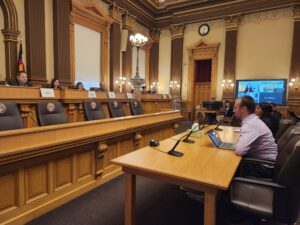
Clear Creek County Commissioner George Marlin testifies in February 2025 for a bill that would launch a study of establishing a single-payer healthcare system in Colorado.
The desire to examine how Colorado can create its own single-payer system has long been a topic of discussion, and a study on the subject that received legislative approval in 2025 is due to be finished by the end of this year, likely teeing up more talks in this area. Most candidates offer little detail on how a plan that’s typically undertaken by other countries on a national level could be done on a statewide basis, but several suggested Medicare-for-all plans or robust public options that would allow state residents to choose a government-funded plan.
Beyond that, though, it’s clear that progressives want to boost funding for behavioral-health services. Garcia Irlando wrote that she wants to rebuild access to inpatient and community-based mental-health services. Jackson, who sponsored an unsuccessful bill this year to raise fees on alcohol producers to boost alcohol-disorder-treatment services, said she’d like to integrate mental-health and substance-abuse treatment into community settings to have them treated like essential care.
Environment
There is a nearly universal sentiment among the more progressive candidates to want to crack down more on facilities violating emissions limits at a time when environmental groups have criticized negotiated fines paid by companies like Suncor Energy USA. The only debate seems to be on how to try to do that.
Garcia Irlando and Halpern suggested creating a “Colorado Climate Superfund” paid into by polluters shelling out larger fines, with Garcia Irlando backing “fee-based mechanisms on polluters and high-consumption industrial users to heavily fund state environmental enforcement agencies.” Gabriel Cervantes, who ousted moderate Rep. Jacque Phillips in the primary for the Thornton-area House District 31 seat, said the state should eliminate companies’ ability to appeal to have portions of their fine waived. Rep. Tammy Story, a progressive representing a tossup district in western Jefferson County, supports “higher fines for bad actors.”
Even as a Colorado Contractors Association-led coalition will ask voters in November to designate $700 million in already collected sales taxes to roadway construction, numerous progressive candidates support boosting funding for transit, bike lanes and sidewalks. Appointed Rep. Kenny Nguyen of Broomfield, who beat back a primary challenger, said more money also must go to expanding electric-vehicle charging stations. Rep. Junie Joseph of Boulder wants to revive a thrice-scuttled idea of requiring large employers to reduce single-occupancy-vehicle trips by their workers.

Colorado state Rep. Kenny Nguyen speaks at a Colorado Chamber of Commerce gathering in May.
Housing
Colorado legislators haven’t debated the idea of allowing local governments to impose rent-control or rent-stabilization laws since a committee killed such a bill in 2023, but that debate may well be coming back, as several progressives favor the idea. Mabrey, Joseph, Halpern, Garcia Irlando and Rep. Lorena Garcia, who has no general-election opponent, all espouse the idea of eliminating the state pre-emption on local rent-control laws.
A new idea — at least one that hasn’t been debated before by legislators — being put forward by Cervantes, Garcia Irlando and Halpern is to ban private-equity or corporate ownership of single-family homes as a way to boost housing affordability. All of them, as well as a slew of other progressive candidates, also tout desires to continue the three-year effort at zoning reform in order to bring higher-density and lower-cost residences to more neighborhoods — an effort largely opposed by local-government leaders.
Several candidates also wrote about renewing an effort to ban algorithmic price-setting by landlords, an idea Polis nixed multiple times but that progressive leaders say is needed to stop skyrocketing rents (though average rents have dropped in Colorado in the past year). And several also wrote of wanting to help first-time homebuyers more, with Mabrey espousing tax credits for first-home purchases and Garcia Irlando supporting “rebates and incentives” for such purchases.

A row of homes
Other ideas
These ideas are just a sampling of some of the priorities for more progressive candidates that have won their primaries or stand as Democratic nominees for the November election. They also represent ideas common to at least a few of the candidates whose websites include policy platforms, as this story tries to paint a picture of proposals that have some consensus among more liberal candidates in highly Democratic or swing seats.
Some other proposals are listed on only one or two candidates’ policy platforms, though they may well be included in one of the five bills each legislator is allowed to introduce.
Scott Baldermann, running in Denver’s House District 2, cites creation of a public bank as the first policy idea he discusses at length. Consuelo Redhorse, who won a primary in the central-mountains House District 13, writes of the need for stronger oversight of short-term rentals, which has produced pushback in the past. Aaron Gutierrez, who won the Democratic primary in Pueblo-area Senate District 3, an open swing seat, said he hopes to expand Medicaid access.
The candidates’ general-election success and their prioritization of their own ideas will determine which policy proposals will become bills. But for now, their websites offer an incisive look into how the success of more progressive Democrats could impact businesses in the form of potential new policies.