
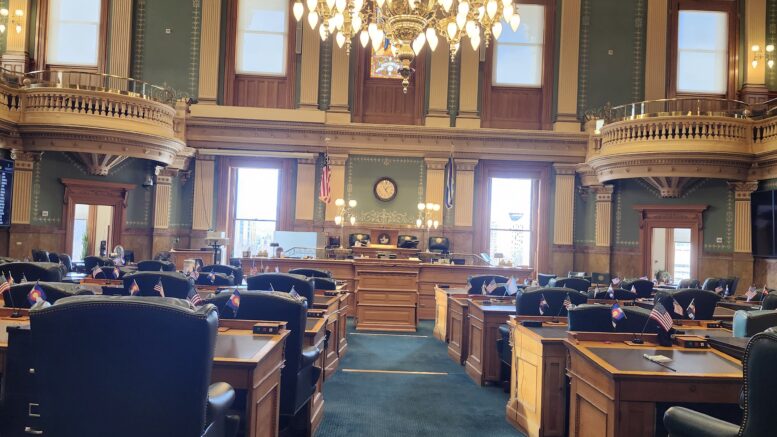
Two years after primary voters from both parties favored more pragmatic candidates, those voters reversed course in numerous races Tuesday, appearing to oust two moderate Democratic House members and push a pair of more conservative Republican candidates to victories in legislative primaries in GOP-heavy districts.
First-term Democratic state Reps. Sean Camacho and Jacque Phillips both appear on track to lose to primary challengers from the more progressive wing of their party, while appointed Democratic Reps. Kenny Nguyen and Jamie Jackson survived challenges from moderates. With each of those victories coming in races likely to be won by Democrats in the November election, the results will add drama to legislative leadership elections expected to pit more pragmatic House Democrats against more liberal representatives.
More progressive candidates also appeared to prevail in two key Senate primaries, with Aaron Gutierrez defeating Taylor Voss in Pueblo-area Senate District 3 and Chela Garcia Irlando doubling up the number of votes on Andres Carrera in Denver’s Senate District 34. While Gutierrez moves onto a tightly contested race to try to hold an open seat now represented by a Democrat, Irlando is essentially a shoe-in to represent her heavily Democratic Denver-area district.
Republican voters split primary votes between conservatives, pragmatists
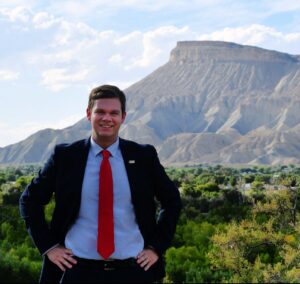
Jason Bias is running for the House District 54 seat on the Western Slope.
Meanwhile, Republican voters on the Western Slope and in southeast Colorado appear to back more conservative candidates in primaries for open, Republican-dominated seats, though both races remain tight as ballot-counting continues. As of early Wednesday, former local Turning Point USA leader Jason Bias held a three-point lead over business owner Nina Anderson in Mesa County-centered House District 54, while conservative-backed Canon City Schools board member Matt Alexander held a 1.4% lead over Pueblo County Republican Party Chairwoman Michelle Gray in House District 60.
However, Republicans also pushed back against the most conservative candidates in several key races. Former state Rep. Terri Carver unseated appointed Sen. Lynda Zamora Wilson, arguably the most conservative member of the Senate, in northern El Paso County. Amy Parks easily beat a more conservative opponent to win the nomination for an open Loveland-area seat. And appointed Rep. Ava Flanell brushed off a right-wing challenger in a Colorado Springs district in her first time on the ballot.
A third Democrat was ousted in Tuesday’s primary, as business owner Sarah Amelia Woodson unseated state Rep. Mandy Lindsay in Aurora-area House District 42 by a vote margin of more than 2-to-1. Woodson positioned herself as the more pragmatic candidate in that race, though the outcome likely also was influenced by a House ethics investigation into Lindsay’s alleged misuse of Democratic caucus funds.
Coming debates on union elections, data centers
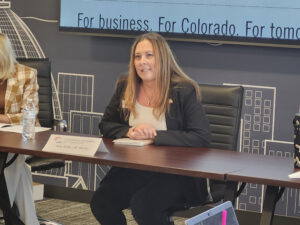
Colorado House candidate Amy Parks speaks to a Colorado Chamber of Commerce gathering.
It’s unknown exactly how the mishmash of results will impact business policy at the Capitol. But there is no question that it will as legislators prepare to dive into significant debate next year on further regulatory reform, a revived discussion over modifying the Colorado Labor Peace Act and unresolved arguments surrounding the regulation and incentivization of data centers.
Several of the Democratic results were notable because the races had become flashpoints in the growing fight between pragmatic and progressive voices in the caucus that have been arguing for different directions, particularly after term-limited Gov. Jared Polis’ vetoes this year of several more progressive bills. Polis nixed an effort to eliminate the second election required for private-sector unionization, a bill to ban the use of surveillance data in individualized consumer price-setting and a proposal to reform Colorado’s arbitration system.
Camacho had ousted liberal Rep. Elisabeth Epps in a 2024 primary race in eastern Denver’s House District 6 and emerged as a leader of the pragmatic caucus. But he trailed his challenger, civil-rights attorney Iris Halperin, by six points as vote-tallying efforts reached Wednesday morning.
Phillips, representing Thornton-area House District 31, was a key moderate on several votes. She appears to have lost her seat to Gabriel Cervantes, who was endorsed by U.S. Sen. Bernie Sanders and the Colorado Working Families Party, by seven points.
Some primary contests remain very close

Colorado state Rep. Kenny Nguyen speaks at a Colorado Chamber of Commerce gathering.
Nguyen, appointed to the Broomfield-area House District 33 seat just before the start of the 2026 legislative session, said in an interview with The Sum & Substance that he felt he was running against One Main Street Colorado, which backs more moderate Democratic candidates. He appears to have beaten Broomfield City Councilwoman Heidi Hinkel by eight points in their primary.
Jackson, appointed last year in Aurora-area House District 41, beat back a challenge from Aurora Public Schools board member Anne Keke by a margin of 55% to 45%. Keke earned the endorsement of several business groups and more moderate elected Democrats.
Another race in which a more progressive candidate leads a more moderate Democrat is in House District 13, the six-county mountain region represented by term-limited Democratic House Speaker Julie McCluskie, who clashed at times with progressive members. Chris Floyd, who McCluskie asked to run to succeed her, trailed Summit School District Board of Education President Consuelo Redhorse by about 2 points as of Wednesday morning.
Republicans go pragmatic in two key swing districts
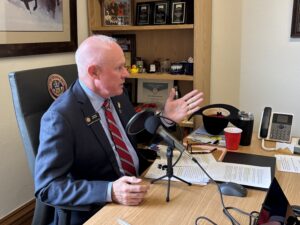
Colorado state Rep. Anthony Hartsook speaks about his opposition to new price-gouging regulations on the “Colorado Chamber Office Hours” podcast in March.
The list of Republican primaries favoring more pragmatic candidates remained longer than the list of races in which more conservative candidates won. In addition to the victories by Carver, Flanell and Parks — the latter of whom will face a tight general-election race against the former Democratic mayor of Loveland, Jacki Marsh — Tuesday’s election saw:
- District 11 School Board member Jill Haffley defeat Charis Bible College coordinator Jamie Koch in the GOP primary in central Colorado Springs’ House District 16. Haffley will face former Rep. Stephanie Vigil in the general election race for the seat now held by GOP Rep. Rebecca Keltie, who beat Vigil by just three votes in 2024 and then decided against seeking re-election.
- Rep. Anthony Hartsook of Parker, the House Minority Caucus chairman, easily beat back a primary in House District 44 from retired policeman Bob Davis, who wanted a more conservative representative for the district.
- Army veteran Brenda Miller, who was endorsed by retiring Rep. Mary Bradfield to be her successor in the House District 21 seat in the Fountain area, defeated Air Force veteran Alexander Africa to capture the nomination for that seat.
Democrats need to pick up just one more seat in both the House and the Senate to hold veto-proof supermajorities for the 2027 legislative session. While several swing races — including those involving Parks and Haffley — will determine whether that can happen in the House, the road to winning another seat in the Senate will be decidedly harder, leaving Republicans believing they have a chance to close the 23-12 gap in that chamber.