
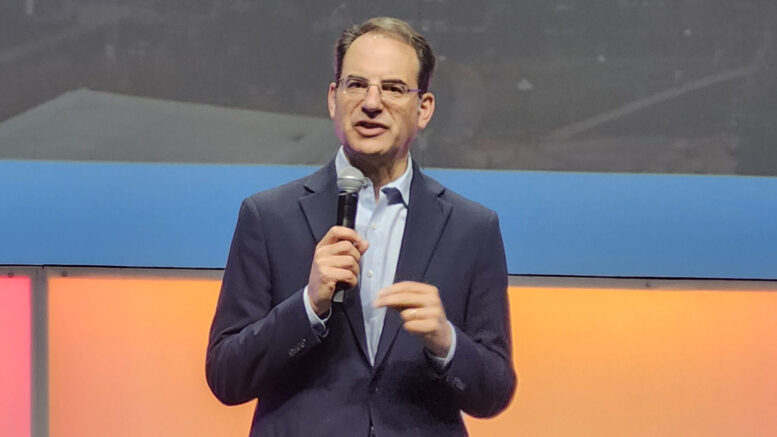
Colorado Democratic voters picked Attorney General Phil Weiser as their nominee for the open gubernatorial seat on Tuesday, while Sen. Barbara Kirkmeyer led the Republican race for the same office, though the outcome remained too close to call.
Weiser took down U.S. Sen. Michael Bennet to win the Democratic nomination in the race to succeed term-limited Democratic Gov. Jared Polis. Weiser took a 10-point lead as soon as the first round of early votes were announced and held that lead throughout the night in a result that must be considered a surprise in a race where early polls taken months ago gave Bennet a significant advantage.
On the Republican side, state Kirkmeyer — who formerly spent 20 years as a Weld County commissioner and was executive director of the Department of Local Affairs under Gov. Bill Owens, the last Republican to hold the office — held a lead on two opponents. Kirkmeyer was ahead of minister Victor Marx and state Rep. Scott Bottoms — getting 41% of the vote versus Marx’s 39% and Bottoms’ 20% — in a contest that pitted her pragmatic conservatism against two opponents more focused on conservative social issues than her.
Meanwhile, in other statewide races, Democrats chose Secretary of State Jena Griswold as their nominee in the open attorney general’s race, while Republicans went with experience and nominated the district attorney for El Paso and Teller counties. And Jefferson County Clerk Amanda Gonzalez handily defeated state Sen. Jessie Danielson to win the Democratic nomination for the open Secretary of State’s race — the only other nomination for statewide office that was up for grabs on Tuesday.
Differences between candidates on business issues
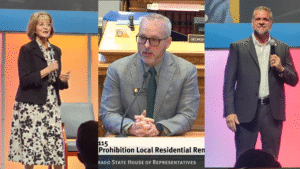
Colorado Republican gubernatorial candidates Barbara Kirkmeyer, Scott Bottoms and Victor Marx
The Republican gubernatorial race pitted candidates from different wings of the party — Kirkmeyer, who has built her reputation on trying to work across the aisle as a member of the Joint Budget Committee, against two very conservative ministers. Marx is a first-time office-seeker arguing that the state needs someone other than a politician to solve its problems and Bottoms a two-term state House member who had clashed with both Democratic and GOP leaders trying to fight against abortion and child trafficking.
Kirkmeyer focused her campaign on fiscal issues, saying that the state needs to tame its budget shortfalls by limiting regulations that hurt businesses and grow government and by reprioritizing spending on areas like roads and water storage. Marx and Bottoms also focused on cutting the budget but offered more radical solutions, such as Bottoms’ proposal to eliminate the state’s income tax.
The Democratic contest, meanwhile, pitted two men whose positions on business issues — as well as many other issues — were more a matter of nuanced differences rather than opposing priorities. Bennet, for example, opposed elimination of the second unionization vote under the Colorado Labor Peace Act while Weiser said he wants to talk through any changes with all stakeholders, while Weiser said he wants to undertake cost-benefit analyses on new and proposed regulations to ensure they are not doing more harm than good to the state economy.
Weiser win could impact Labor Peace Act debate

U.S. Sen. Michael Bennet speaks at the “Building Colorado’s Future” forum in May.
Weiser began as the underdog, lagging in name identification against the 18-year U.S. senator, but he traveled the state extensively, repeating his message that Colorado must continue on the path it’s begun to increase affordable housing and to improve the state’s business atmosphere, which has made it more difficult to attract and retain employers. Bennet, meanwhile, seemed to push more of a change agenda, saying overregulation has led to the high vacancy rate in downtown Denver and arguing that the state must do more to embrace artificial intelligence in workforce training.
While Bennet captured more total counties on Tuesday, Weiser captured the most populous Democrat-controlled counties in the state, including Denver, Adams, Arapahoe, Jefferson, Boulder, Broomfield and Larimer — some by 30-point margins. Bennet fared better in rural and more traditionally Republican counties, winning in places such as El Paso, Summit and Pitkin counties.
Weiser will begin the general-election contest as the favorite, as Colorado voters have trended far more Democratic since the first election of U.S. President Donald Trump and haven’t voted for a GOP governor since Owens’ re-election in 2002. Weiser also has proven he can win a statewide race, having been elected attorney general in 2018 and re-elected in 2022 by a healthy margin.
Republican candidates, however, are arguing that eight years of all-Democrat rule at the state Capitol have led to the budget shortfalls, overcrowded roads and diminished public safety that voters complain about repeatedly.
Griswold wins scrum to be Weiser successor as AG
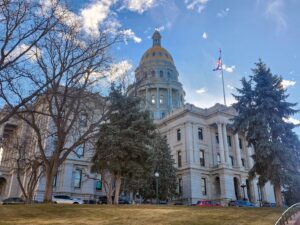
The Colorado Capitol on Jan. 14, 2026
Meanwhile, voters on Tuesday set up three other races for statewide office.
Griswold easily won a four-way primary for the Democratic nomination to succeed Weiser, capturing roughly 47% of the vote as of 10:30 p.m. on Tuesday. Michael Dougherty, district attorney for Boulder County, grabbed about 20% of the tally, while Towards Justice founder David Seligman garnered 17% and former federal prosecutor Hetal Doshi pulled in 16%.
She will face Michael Allen, the 4th Judicial District Attorney who garnered support from a host of sheriffs and DAs as well as Republican figures like former Colorado AG John Suthers, in getting past David Wilson by a margin of roughly 60% to 40%. Wilson aligned closely with Bottoms and campaigned on restoring constitutional rights.
Gonzalez captured about 63% of the vote in a contest that pitted two Jefferson County elected officials who campaigned on protecting voting rights against what they say is an attack from Trump. She will face Republican nominee James Wiley, who wants to protect elections by requiring in-person voting on paper ballots that are hand-counted.
Neither party had a contested primary for the treasurer’s position, which is being vacated by term-limited Democratic Treasurer Dave Young. That race will pit Democratic state Sen. Jeff Bridges, former chairman of the Joint Budget Committee, against Republican Kevin Grantham, the last GOP official to hold the post of Colorado Senate president (in 2017-18), in a matchup of two influential leaders at the state Capitol.