
The race to be Colorado’s Republican gubernatorial nominee pits a state senator with decades of experience in government against a two-term state representative who’s tried to knock down government walls and a man with no experience in government whatsoever.
On a base level, many of their business-focused ideas are similar: Reduce regulations, keep taxes down, encourage innovation in growing industries to attract new jobs to the state. But the difference in their approaches reflects their background in many ways, with some plans being very detail-oriented and others more open to interpretation.
This may be seen most directly in their plans to boost housing affordability — a shared theme that, in each case, involves less oversight from government, a decided turn from the policies of eight-year Democratic Gov. Jared Polis, who is barred by term limits from seeking reelection. The winner of the GOP primary will take on one of two Democrats — U.S. Sen Michael Bennet or Colorado Attorney General Phil Weiser — in seeking the support of voters who haven’t elected a Republican governor since 2002.
Three plans to boost housing affordability

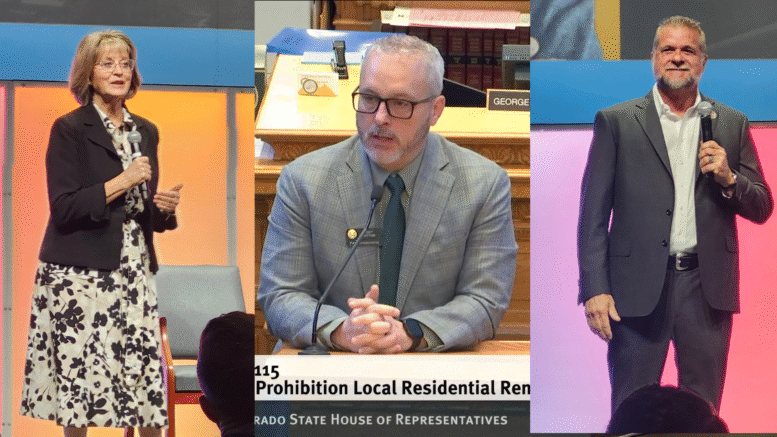
Republican gubernatorial candidate Barbara Kirkmeyer speaks at the May 28 “Building Colorado’s Future” forum.
Sen. Barbara Kirkmeyer wants the state government to be able to offer guidance on the elements that should be involved in local governments’ comprehensive housing plans, but she wants to end top-down mandates and reduce regulations that increase building costs. Kirkmeyer is the only one of the trio who incorporates into her housing plan a push to boost water storage — via dams and underground aquifer storage — believing this a way to cut the rising cost of water taps that are helping to drive up home prices.
Rep. Scott Bottoms, who has focused his two terms in the Legislature on reducing the size of state government, wraps his housing strategy into his larger goals of making the state more affordable without as much detail on zoning or building issues. He writes on his campaign website that he wants to cut unnecessary licenses and permits and wants to eliminate environmental, social and governance mandates that harm builders.
Ministry leader Victor Marx touts his plan to get 150,000 new homes constructed by expediting building permits through a one-stop shop, giving permitting agencies a 90-day limit for consideration and offering automatic approval if the clock runs out. But Marx hasn’t delineated what powers he sees the state taking from local governments that now control the permitting process and how such a one-stop shop would work.
“We have to reform some laws to make it reasonable and common-sense,” Marx said at the May 28 “Building Colorado’s Future” gubernatorial forum sponsored by a sextet of business groups. “You do that, and then you fast-track permitting.”
Republican gubernatorial candidates’ approaches to regulation
Colorado state Rep. Scott Bottoms speaks on the opening day of the 2025 legislative session.
Just as the candidates’ backgrounds lead to different levels of detail in their focuses, they also lead to different pitch points on why voters in the June 30 primary should cast ballots for them. Marx boasts of not being a politician and seeking to bring outside points of view to long-brewing debates. Kirkmeyer, who served many terms on the Weld County Commission before her current six-year tenure in the state Senate, notes that she sponsored the two biggest property-tax cuts in state history, passed in the 2024 regular and special sessions, as well as sitting on the powerful Joint Budget Committee. Bottoms wears the dearth of bills he’s passed as a badge of honor, saying he’s tried to reform on significant social issues from child-trafficking prosecution to abortion bans and has run into an entrenched Legislature so far unwilling to step out on those issues.
In speaking about how to make Colorado more economically competitive, all three favor continued reduction of regulations, with Marx pushing more audits and Bottoms favoring a state plan that mirrors the D.O.G.E. efforts Elon Musk led on the federal government. Kirkmeyer, who last year sponsored a bill boosting audits on two major regulatory agencies, wants to push that further now with a “Regulatory Bill of Rights” that holds agencies accountable for the private-sector costs from new regulations.
Kirkmeyer also has said that her first action, if elected, will be to replace numerous members of key rule-making commissions, such as the Energy & Carbon Management Commission and Water Quality Control Commission, with more pro-business appointees. That would stop some of the regulatory increases from unelected boards that are weighing on businesses like energy companies, she said.
Transportation and artificial intelligence

Traffic moves along Lincoln Avenue in Denver.
“Governors should be leading. Governors should be setting the stage and be sure we are open for business on day one,” she said at the business-focused forum. “We’re going to start bringing businesses back into our state.”
Kirkmeyer also has arguably the most detailed transportations plan of the trio, pledging to boost road funding $6 billion over four years by reducing administrative growth and refocusing spending away from multimodal options to expansions of Interstate 25 and I-70. Bottoms and Marx both say they would like to boost apprenticeships and workforce training in fields that include road construction but don’t go into detail about highway funding.
Bottoms, meanwhile, has arguably the most detailed artificial-intelligence plan, saying he wants to use AI to drive prosperity and hopes to integrate AI literacy more into education with an emphasis on career readiness. As governor, he would try to grow AI startups and use their research to create high-wage jobs in agriculture, energy, healthcare and the trades, he said.
“Colorado will lead in artificial intelligence by fostering innovation, economic growth and security, while building accessible opportunities for all Coloradans, ensuring no one is left behind,” he wrote on his campaign website.
Each Republican gubernatorial hopeful has unique ideas

Republican gubernatorial candidate Victor Marx speaks at the May 28 “Building Colorado’s Future” candidate forum.
Marx too has several areas of focus that set him apart from his competitors. He has three industries that he wants to prioritize — advanced manufacturing, clean-tech production, and outdoor recreation — via targeted tax credits, expedited permitting support and eligibility for job-retention workforce grants, he writes.
And while Kirkmeyer and Bottoms both seek to reduce the cost of homeowners’ insurance through lower regulations that they believe would increase competition, Marx writes on his website that he would seek to get government more involved in the sector. He would use the Colorado Division of Insurance to conduct market analyses, restrict “excessive” rates and establish new reinsurance mechanisms to try to bring down costs, he said.
All three are proponents of minimizing regulations on energy-production companies, with Bottoms pushing a proposal to support oil, gas, coal, nuclear, geothermal and hydropower innovation, he said. Kirkmeyer, meanwhile, would seek to leverage workers, land and transmission from decommissioned coal plants and co-locate energy-production plants of any kind in those facilities that would be the most cost-effective and ready to go.
All three of the candidates agree that Colorado must go in a wholly new direction when it comes to its business policies. The differences are more about their focuses and how they want to use their individual experiences to try to create a new atmosphere for employers.