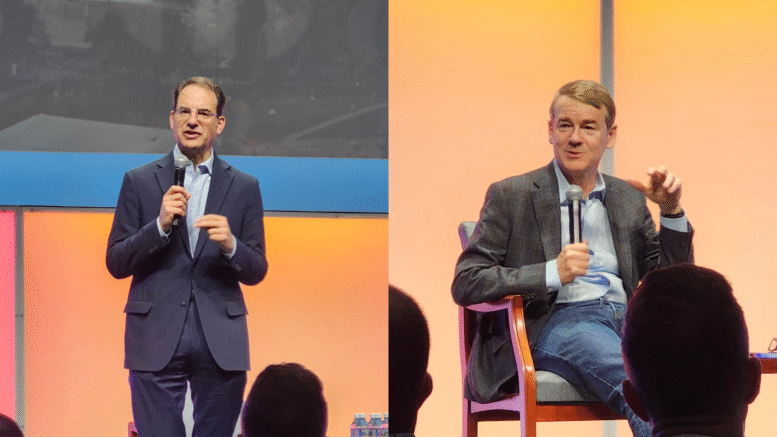
Both men seeking the Democratic nomination to be Colorado governor are emphasizing that the state’s next top elected official must do something to improve the business atmosphere — though their approaches differ in some notable ways.
That sentiment, when uttered by U.S. Sen. Michael Bennet and Attorney General Phil Weiser, comes with nuance. Regulations need reform but also need to be strong enough to protect public health and safety, they say. The state must attract data centers but also should have strong guardrails in place around their power and water usage. The Labor Peace Act should be changed — but not exactly in the way union leaders have demanded.
Still, in business-related campaign forums, as the two seek to succeed term-limited Democratic Gov. Jared Polis, both have given examples of how they want to change Colorado’s business reputation to win more battles for job relocations and expansions. The primary is set for June 30, the same day that voters will decide which of three Republican candidates will face either Bennet or Weiser in November.
“No attachment to the status quo”
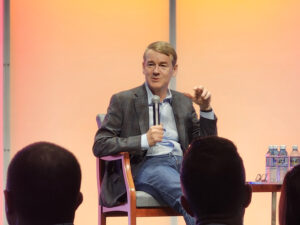
U.S. Sen. Michael Bennet speaks at the “Building Colorado’s Future” forum in May.
Bennet, who moved to Colorado in 1997 to handle distressed-asset sales and debt for billionaire businessman Phil Anschutz, speaks of the number of Denver office vacancies and the inability to build workforce housing with an urgency bordering on aggression. He told the Colorado Technology Association in March that the next governor needs to be “an evangelist for our business economy” and said at another forum last month that he’s willing to make big changes if it can help the state attract jobs again.
“I have literally no attachment to the status quo. What I know is that has led to us being the third-most-expensive state. I know it has led to businesses leaving Colorado,” he said at the May 28 “Building Colorado’s Future” forum hosted by six business groups. “The question for Colorado is: Are we going to complain about it, or are we actually going to address the challenges we are facing?”
Weiser, founder of the Blackstone Entrepreneurs Network and former University of Colorado Law School dean, often speaks more analytically, citing Colorado business leaders who have chosen to expand in other states and noting lessons gleaned from those losses. One of the things he learned as senior advisor for technology and innovation in President Barack Obama’s White House National Economic Council was how to do cost-benefit analyses on potential regulations — a policy he intends to enact if elected governor.
“The simple challenge is too many businesses feel the wind is in their face. I want them to feel the wind is at their backs,” he said on the “Colorado Chamber Office Hours” podcast. “We should start with a mindset change.”
Regulatory reform in the Democratic primary
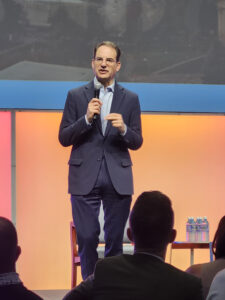
Colorado Attorney General Phil Weiser speaks at the “Building Colorado’s Future” gubernatorial forum in May.
Diving into their proposed policies, there are more nuances that set them apart.
On regulatory reform, Weiser said he intends to measure proposed new rules with such cost-benefit analyses and think about where smaller businesses could be exempt without causing problems, as he did when leading rulemaking for the Colorado Privacy Act. Bennet doesn’t have such a structured plan but says he’s learning lessons on what not to do from places like downtown Denver, whose building energy codes he blames in no small measure for the large number of vacant offices.
“We have to balance it much better than it’s being balanced now,” he said of public protections and business attraction at the business-led forum. “That’s one of the reasons that Denver is 40% empty, because we’ve made commitments that are too expensive for businesses to fulfill.”
Unions wrote to both men in April, after it became clear that Polis would veto for a second time a bill that would have removed the second unionization vote required under the Colorado Labor Peace Act, and asked both to sign the bill unamended if they’re elected. Neither will commit to that, but Bennet’s constraints are clear than Weiser’s.
Bennet told The Sum & Substance he won’t support doing away with the second election for union security but would like to lower the current threshold that 75% of workers have to vote to let union negotiating dues be taken from paychecks to something that is lower. Weiser said in an interview that he will bring business and labor leaders together to hear their arguments before deciding a course of action, though he said he has not decided even if he would consider trying to eliminate the second election.
Data centers in the discussion
On data centers — a topic the next governor is likely to deal with after legislators killed opposing bills this year to incentivize and to regulate the sector — both candidates also want to seek a middle ground.
Weiser said he would require three things in any regulatory bill regarding data centers — consumers can’t have to pay more for energy because the centers go up, the centers must meet state emissions-reduction goals and the community must be involved in any discussions. However, he said he believes incentives should be used to attract the labor-intensive centers in some instances, particularly in places like Craig where the coal-fired power plant is shutting down and data centers can represent a just transition to new jobs.
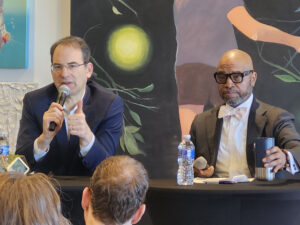
Phil Weiser speaks at a January Colorado Technology Association event after being interviewed by former Colorado House Speaker Terrance Carroll, now an attorney for the Taft law firm.
“I worry that there is this sentiment that we don’t need any data centers at all,” Weiser told a CTA gathering in January. “It just isn’t realistic. We need them — and we need there to be a balance.”
Bennet believes AI holds untapped benefits from improving health care to shortening the certification cycle for worker training, and data centers are needed to store the information that makes AI run. He too said that the state needs to ensure that electricity prices don’t go up because the facilities strain the electric grid, and he also said it should ensure water supplies aren’t overtapped because of their construction.
Democratic candidates on taxes, workforce development
Asked if he supported a proposed ballot measure that would replace Colorado’s flat 4.41% income-tax rate with a graduated income tax, Bennet replied: “It wouldn’t hurt my feelings if we had a more progressive income-tax rate than the one we have in Colorado.” But he said that must done holistically with a discussion about how to eliminate the hard Taxpayer’s Bill of Rights revenue cap that constrains the budget and has led to too much “bloodletting” via service cuts over the past two years.
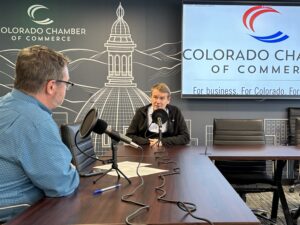
U.S. Sen. Michael Bennet answers a question from host Ed Sealover during taping of the June 22 episode of the “Colorado Chamber Office Hours” podcast.
Weiser said he hasn’t taken a position on Initiative 195 but believes the constraints of TABOR are hurting the state’s ability to provide needed services. However, he said that the state would need to say clearly where the billions of dollars in new revenue from such a change in the tax system would go — a discussion he’d like to have in civic forums throughout the state.
Both men say improvements are needed for the education and workforce-development system, as the gap between skills that employers need and the skills students have upon graduation is leaving too many young adults unemployed or underemployed. Bennet said schools need to link classes more closely with the skills that employers are seeking, and Weiser wants to launch a Colorado Corps where enrollees can learn skills for high-need jobs like teachers and police officers and work in those fields for several years.
Pressed at the May business forum on how to boost affordable housing, Weiser said the state needs to use its power to convene state and local governments, lay out goals for building more housing and find partners who can help to implement them. Bennet urged some rollback in housing regulations that could cut construction costs and serve as a new type of incentives to put up workforce housing.
Regulations still needed, both insist
“We have to make it profitable for the private sector to build workforce housing,” he said.
Even with all the talk about regulatory reform, however, both men said the state still needs to play a role in particular areas of policy to protect Coloradans.
Bennet told the Colorado Chamber of Commerce Board of Directors in March that the state needs to create a “true public option” to bring down health-insurance costs, including possibly letting residents join the insurance plan that covers state employees.
Weiser has called in his Colorado Blueprint for new environmental protections, including allowing the state to write new rules in areas where the U.S. Environmental Protection Agency is rolling them back and expanding the state’s air- and water-quality monitoring.
“Please be careful, particularly at this moment, not to fall into the trap that we don’t want regulatory oversight. What we’re at risk of right now is more of an ‘anything goes’ culture,’” he told the Colorado Chamber board in March 2025. “Regulations should be like garlic in cooking, which is only as much as you need and no more.”