
It would vastly oversimplify the 23 legislative primary races set to be decided on June 30 by saying that the majority pit one candidate who is more pro-business against another who is less inclined to vote with businesses’ wishes.
A close look at records shows that the contenders in the 11 Republican contests — nine in the House and two in the Senate — generally all support lessoning regulations and taking steps to bring down the cost of doing business. And while some of the 12 Democratic primaries — 10 in the House and two in the Senate — feature candidates with different approaches to regulation or to capitalism in general, most opponents vow to back small business and push for an increase in the housing supply that’s so crucial to employers.
Rather, what marks this year’s primaries is differences in priorities, as many contests in both parties pit a candidate focused on economic issues against a candidate more focused on social issues who usually is considered more to one end of the political spectrum. And those differences could be enough to determine whether efforts to help employers deal with high costs of living and working in Colorado will float to the surface in what is expected to be a 2027 legislative session overstuffed once again with significant debates.
“I think we see this a lot, especially in primaries. Some people really are one-issue voters, and it’s more of the cultural issues,” said Amy Parks, a Republican focused on economic issues in the primary for the Loveland-area House District 51 seat being vacated by GOP Rep. Ron Weinberg. “It’s not that I disagree with those things. But your average person who is trying to get by, that’s not what they base their decisions on.”

Colorado House candidate Amy Parks speaks to a Colorado Chamber of Commerce gathering.
Many incumbent challenges in primaries
Several things are notable about this year’s primary races, which stretch from Grand Junction to Pueblo and from the San Luis Valley to northern Colorado.
First, nearly half the races — 10 in all — feature an intraparty primary challenge to a sitting legislator, which is a high number. And several of those have more moderate or pragmatic candidates taking on more liberal Democrats or more conservative Republicans, with several challengers going after legislators who won mid-term vacancy-committee appointments.
In northern El Paso County, former state Rep. Terri Carver is challenging Republican Sen. Lynda Zamora Wilson, who won a vacancy-committee appointment last summer for the seat of former Senate Minority Leader Paul Lundeen. Carver has worked with local chambers of commerce to understand business issues better, while Zamora Wilson is one of the most conservative members of the Senate, and she touts that her opposition to bills is aligned with the Liberty Scorecard focused on limited government and individual rights.

Colorado state Sen. Lynda Zamora Wilson speaks on the Senate floor during the 2025 special session.
Aurora Public Schools board member Anne Keke is taking on Democratic Rep. Jamie Jackson, appointed to a vacant seat early in the 2025 session, in House District 41. While Jackson touts her work to stop corporations from avoiding accountability and sponsored an unsuccessful bill this year to establish a fee on adult beverages to fund alcohol-disorder treatment, Keke’s listed priorities include reducing regulations and boosting hiring incentives for small businesses.
Can a candidate be progressive and pro-business?
And in the Broomfield-area House District 33 seat, Broomfield City Councilwoman Heidi Henkel is challenging Democratic Rep. Kenny Nguyen, a former city councilman appointed to fill that vacant seat one day before the start of the 2026 session. Outside groups have put a lot of money behind Henkel, who boasts of her votes on council for tax rebates and against increases in water rates, versus Nguyen, who calls himself a progressive.
Nguyen acknowledged that he’s taken positions that give businesses unease — such as his desire to put safeguards on data-center development and transition from oil and gas to renewable energy sources — but he defended himself as supporting small business too. And he’s been shocked by the intensity of the campaign against him — he estimates groups have spent some $300,000 attacking him, based in part on reporting by the Colorado Sun — when he, like his opponent, is talking about housing affordability and workers’ rights.

Colorado state Rep. Kenny Nguyen speaks at a Colorado Chamber of Commerce gathering.
“I may not be a left-leaning socialist. But just saying I’m a ‘progressive’ leaves some people with concerns,” said Nguyen, comparing himself more to environmentalist state Rep. Jenny Willford than to fiery Democratic Socialist-aligned Rep. Javier Mabrey. “Everyone is inundated with these negative ads right now all over Broomfield.”
Some are challenging incumbents from left or right
In two instances, Democratic challengers are taking on House incumbents who are more moderate than them, accusing the sitting representatives of siding too often with corporations. Civil rights attorney Iris Halpern is vying against Rep. Sean Camacho for the House District 6 nomination in east-central Denver, and nonprofit leader Gabriel Cervantes is battling Rep. Jacque Phillips in the Thornton-area House District 31.
And in two others, Republican incumbents are defending their seats against primary challengers who argue that more needs to be done to protect conservative values at the Capitol. In House District 14 in northern Colorado Springs, Rep. Ava Flannel, who was appointed by a vacancy committee last year, is getting a challenge from parental-rights advocate Troy Vanderhule. And in Parker-area House District 44, House Caucus Chairman Rep. Anthony Hartsook is battling with retired policeman Bob Davis.
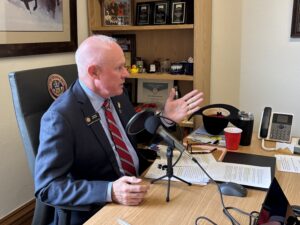
Colorado state Rep. Anthony Hartsook speaks about his opposition to new price-gouging regulations on the “Colorado Chamber Office Hours” podcast in March.
Several other races feature a similar dynamic between newcomers battling for heavily partisan seats whose holder is likely to be determined by the outcome of the primary.
Some primaries ask: Prioritize job creation or safety nets?
In Senate District 34 in northwest and downtown Denver, Democrat Andres Carrera, the former political director for Denver Mayor Mike Johnston, is battling with environmental nonprofit leader Chela Garcia Irlando for the seat being vacated by arguably the most progressive member of the body, Sen. Julie Gonzales. Carrera has endorsements from U.S. Sen. John Hickenlooper and host of moderate Democratic legislators (such as Sens. Dylan Roberts and Lindsey Daugherty and former Rep. Shannon Bird), while Irlando touts backing from U.S. Sen. Bernie Sanders, Gonzales, Mabrey and the Jane Fonda Climate Action PAC.
Carrera touts himself as a progressive, but he leads his pitch by saying that creation of jobs is the surest pathway to move people out of poverty, and he espouses the need to help business thrive and to stop raising the minimum wage, which he says hurts small business. In stumping for proposals like his idea for the state to help fund down-payment assistance on homes for all graduates of Colorado trade schools and higher-education institutions, he said he doesn’t see the Democratic races divided on values so much as they are divided on whether to prioritize expansion of safety-net programs or boosts for job creators.
“I just believe that Democrats need to be unapologetic in our support for job growth,” he said in an interview. “Creating good jobs is not a corporate talking point. It is a working-class principle.”

Colorado Senate candidate Andres Carrera speaks to a Colorado Chamber of Commerce gathering.
Different approaches on the Western Slope
In the other party on the other side of the state, Republicans Nina Anderson and Jason Bias acknowledge that they agree on many issues as they seek to succeed term-limited GOP Rep. Matt Soper in the House District 54 seat representing Mesa and Delta counties. But while Anderson is more likely to discuss her experience owning a small business and the need for Colorado to offer strong workforce-development programs, Bias dives quickly into discussions of parental rights and 2nd-Amendment rights.
Even in talking about those issues, Bias, a restaurant kitchen manager with a background in electrical work, says they are economic issues; he argues that if the cost of living was not so high, families could allow one parent to stay at home and not have to battle the indoctrination of certain values that he sees going on in public schools. But he acknowledges that this can translate for the average voter to he and Anderson expressing different priorities, even if their voting records could be pretty similar.
“I think we’re both focused on the same issues. We just may have different approaches,” Bias said.

Jason Bias is running for the House District 54 seat on the Western Slope.
There also are primary battles happening in what are likely to be swing seats that could play a big role in determining the makeup of the Legislature. But the conversations there don’t seem too different than in the decidedly red or blue seats.
Primaries in three key swing seats
In central Colorado Springs’ House District 16, which outgoing GOP Rep. Rebecca Keltie won by just three votes in 2024, her potential Republican successors list different focuses. District 11 School Board Vice President Jill Haffley wants to reduce business regulations and taxes and fees; Charis Bible College coordinator Jamie Koch has large sections on her website on protecting parental rights and upholding constitutional freedoms.
In the Democratic primary for Pueblo-area Senate District 3 — the seat held by outgoing Democratic Sen. Nick Hinrichsen and considered a top Republican pick-up opportunity, Aaron Gutierrez lists judicial reform and environmental protection as priorities. Taylor Voss’ platform is led by advocacy for job training and includes a focus economic development through small-business support and infrastructure investment.

Colorado Senate candidate Taylor Voss speaks at a Colorado Chamber of Commerce gathering.
And in HD 51, where Weinberg won re-election by just 5.4% in 2024, both Parks and her primary opponent, Thompson School District Board member Nancy Rumfelt, list affordability as their top issue and increased public safety as an issue that’s not far behind. But only Parks in her website-listed goals cites the need to develop new water supplies and support energy policies that don’t drive up costs for Colorado residents and businesses.
Are these different goals or just different focuses in both parties’ key primary races? The candidates who are pushing what might be considered “business issues” say they don’t describe them that way so much as they focus on the issues that voters want to discuss when they knock on their doors.
“Voters, they may not say ‘the economy’ specifically (is a priority), but they talk about economic pressures every day,” Carrera said.