
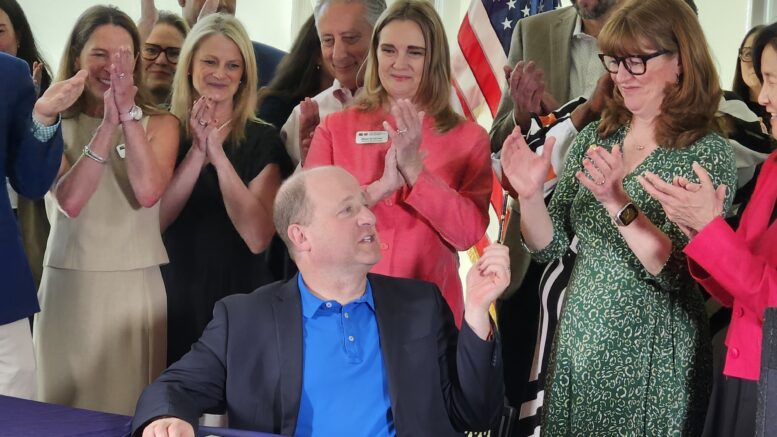
Gov. Jared Polis and House Speaker Julie McCluskie have worked together over the past eight years to reassess the state’s workforce-development and higher-education systems and remake them to create more direct pipelines for students into meaningful careers.
On Thursday, with both term-limited and staring down the ends of their legislative careers this year, they gathered once more in the governor’s mansion as Polis signed a final collaboration between them aimed at reforming the state’s talent-development system. This time, however, the bill will hand over to a new group of leaders — a 27-person commission — the job of streamlining the efforts they have set into place such that employers and learners can access them all in a “one-stop shop.”
House Bill 1317 tasks the commission with studying and recommending how training and education programs now spread across 20 agencies in 7 departments can improve career-pathway development by fitting under one roof. This new agency, replacing the Department of Higher Education, could include everything from workforce-development centers to the state apprenticeship program to its four-year universities and allow them to work together more efficiently to guide Coloradans on a path of continuous learning and upskilling.
It calls for the commission — made of representatives from schools, state agencies, business, labor, local governments and education-advocacy groups — to be put together by the end of June and to recommend the new department’s makeup by December, leaving the suggestions for Polis’ successor. Over the next six months, commissioners will meet with a wide range of interests, study the interaction of many state programs and determine what must be de-siloed to ensure learners have the skills that they and local employers need to grow Colorado’s economy.
Bill could be a boon to talent-seeking employers
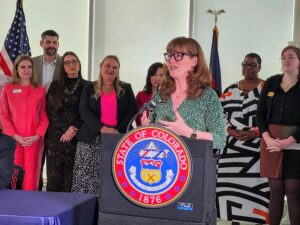
Colorado House Speaker Julie McCluskie speaks Friday before Gov. Jared Polis signs House Bill 1317
“This bill is much more than a process bill, but the process is so important,” McCluskie said just before Polis signed the bill into law Thursday morning. “We have a civic responsibility to make sure we improve our own governance in this state — a one-stop shop, if you will.”
While the results of the work may take several years to become evident — HB 1317 and the report that jumpstarted the process of putting together the bill call for the new department to launch in July 2028 — it should lead to badly needed help for employers. Company leaders have ranked a skilled-talent shortage as their No. 2 or No. 3 obstacle for several years in Colorado Chamber of Commerce surveys, so much so that many say they’ve delayed job-creating expansions or even looked to grow in other states instead.
The bill’s genesis, McCluskie has said, goes back to efforts launched by former Gov. Bill Ritter to develop more of a career-pathway pipeline from early grades up through graduate degrees, and those efforts generated several initiatives she spearheaded with Polis. The two passed laws to make it easier for high-school students to earn college credits simultaneously, to boost work-based learning opportunities for students and to incentivize public-private partnerships to train both future and existing workers for high-demand jobs.
Employers have struggled to access workforce-development programs
But employers hoping to take advantage of the new initiatives complained they couldn’t figure out who to work with in state government to apply for job-training grants or to help develop curricula, as the programs were separated between departments and spread out. And with about 50% of all students now declining to seek additional degrees or technical certificates after high-school graduation, they found too many job applicants without skills for today’s economy and few clear pathways to get them those skills.
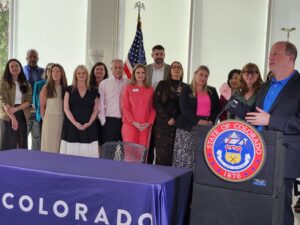
Gov. Jared Polis speaks to supporters of House Bill 1317 before signing the bill on Thursday.
The Transition Advisory Committee launched by HB 1317 will create a unified state agency where employers can inquire about talent-building grants, partnerships with educational institutions on skills training and help setting up apprenticeships and internships. In addition to helping companies ensure applicants have needed skills, it will give state officials a way to get more feedback from employers on what those skills are in order to incorporate them into higher-education curricula and workforce-training programs.
Likewise, students can benefit from the new agency by being able to examine a full range of career-training options that can help them to discern how to get skills and whether they need a four-year degree or can seek more direct pathways into the workforce. With state officials also in the process of developing a longitudinal data system to measure outcomes of higher-ed and workforce-training programs in terms of job placement and earnings, students also can compare what options work best to get them into chosen careers.
What happens now
TAC members will have to filter through a bevy of state programs to determine which ones need to work side by side to make this vision a reality, and they’ll be asked to do so on a compact schedule to shape 2027 legislation to set up the new department. But if done correctly, the work will take what Polis calls a “complicated web” of state programs and turn them into an easy-to-navigate set of options that prepare students to earn living wages rather than minimum wages.
HB 1317, which McCluskie called her “favorite bill of the session” and which the Dillon Democrat cosponsored with Republican Rep. Rick Taggart of Grand Junction, passed the House and Senate by a combined vote of 89-10. Discussions about how to shape the new department may involve more substantial debate and disagreement than occurred in the General Assembly, but the outcome will have a long-lasting impact on both talent development in this state and on the state’s business friendliness.
“I’m proud of how the Legislature came together in a bipartisan way to find an easier way forward … and to make sure we can look at success across different kinds of providers,” Polis said Thursday. “This bill asks us to boldly reimagine how higher education and workforce programs can work together.”
Then, after signing it, the Democratic governor turned to supporters gathered behind them and gave them a simple but direct message.
“This work is just beginning,” he said. “Let’s get it done.”