
Supporters of a ballot measure to disaffiliate Pinnacol Assurance from state control and use the proceeds to launch a fund to train skilled workers will end their efforts to put the initiative before voters in 2026, believing a legislative solution can be achieved next year.
The decision, announced Thursday by Colorado Succeeds and Pinnacol in conjunction with two major construction workers’ unions, comes after negotiations over the past few months that nearly produced a late-session bill this year. It appears to represent the end of efforts to break the state-chartered workers’ compensation insurer free from government oversight, as the announcement laid out framework for a plan that, if passed, would keep Pinnacol under state control but reform it significantly.
Scott Laband — president/CEO of Colorado Succeeds, which works with businesses to reform education in regard to workforce training — said in an email Thursday morning to the coalition backing the initiative that if continued talks don’t produce a workable solution, he and other leaders are prepared next year to restart the ballot effort. However, with Pinnacol itself asking to pause the initiative for now, he believes it’s appropriate to let the insurer and labor leaders work in good-faith to a mutually agreed-upon solution that could avoid a costly battle on an already packed ballot.
“Importantly, this is not the end of the conversation. It is the beginning of a new phase,” Laband said in the email. “Over the summer and fall, there will be structured conversations among business, labor, Pinnacol and other stakeholders to co-design a legislative framework that modernizes Pinnacol while protecting Colorado employers, workers and the long-term strength of the workforce system.”
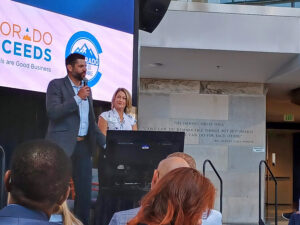
Colorado Succeeds President Scott Laband and Colorado Business Roundtable President Debbie Brown speak at the Future of Work event in July 2023.
Why Pinnacol seeks governance changes
Pinnacol operates as an independent mutual-insurance company but is chartered by the state, has its board appointed by elected leaders and is exempt from Colorado’s insurance premium tax because it acts as the insurer of last resort, offering policies to companies deemed too high a risk to receive other offers on the private market. It remains the state’s largest workers’ comp insurer, with a share just under 50% of all policies sold, but that share has sunk by at least 10% over the past decade, spawning calls from company leaders and Gov. Jared Polis for change.
Arguably the biggest issue is that Pinnacol’s charter bars it from selling policies outside the state — and many other states bar companies that have a public tie from marketing within their borders because they feel it is unfairly subsidized competition. With remote employment growing over the past decade, particularly during and after the coronavirus pandemic, many larger Colorado-based companies have dropped Pinnacol rather than use different workers’ comp insurers to cover employees spread between different states.
Polis proposed in each of his past two budgets that Pinnacol be allowed to disaffiliate from the state for a sum around $400 million along with money it would owe to the Public Employees Retirement Association for pulling 500 workers from the state pension system. However, Pinnacol CEO John O’Donnell said late last year that the cost was too high for the company, and legislators also questioned whether the plan could leave workers in injury-vulnerable industries like construction in a lurch if the state lost its insurer of last resort.

John O’Donnell is president and CEO of Pinnacol Assurance.
Initiative was a response to stagnating legislative discussion
In December, Laband unveiled the proposed initiative, which would allow Pinnacol to disaffiliate for the much lower cost of $150 million plus PERA fees — and would not put the money to balancing the state budget. Instead, it sought to create a new fund that would generate about $15 million annually to help learners get non-degree credentials needed to fund pre-apprenticeships in the trades, get into data analytics in the tech field or enter health jobs like a certified nursing assistant or imaging technician.
While this plan sought to keep Pinnacol as the insurer of last resort through 2028 and then set out a process for how the state would determine its replacement, labor groups still worried whether they would be able procure policies and whether Pinnacol would shift its attention from worker protection to profits as it sought to expand.
Legislators drafted two bills to try to intervene, though neither was ultimately introduced.
The first, from House Speaker Julie McCluskie and a pair of Joint Budget Committee members in April, would have set the disaffiliation fee at no less than $300 million, laid out how it would be used to balance the budget in future years and created tax advantages for future insurers of last resort.
The second, floated by Senate Majority Leader Robert Rodriguez in the session’s final 10 days, simply would have permitted disaffiliation and required Pinnacol to be considered an independent mutual insurance company for the purpose of licensing in other states.
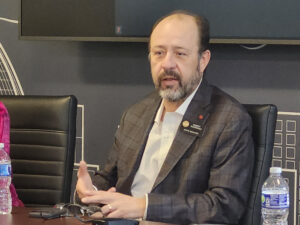
Senate Majority Leader Robert Rodriguez speaks to the Colorado Chamber Board of Directors in December.
How the new plan would change Pinnacol
The skeleton of the new plan being negotiated by Pinnacol and Colorado Succeeds with IBEW 111 and the Colorado Building and Construction Trades Council would maintain the company’s state affiliation and keep its employees within PERA. It also would keep Pinnacol as the insurer of last resort indefinitely and retain its member-owned structure, though it would add organized-labor representation to its board.
However, the proposal also would let Pinnacol write policies out of state, follow its existing members across state lines when they expand and allow it to diversify risk, likely through sale of other lines of products. It would update the board to support Pinnacol’s efforts to get licensed in other states and would require it to join the Colorado Guaranty Fund, a safety net into which insurers pay fees to cover policies in case an insurance company becomes insolvent and is unable to meet obligations to its customers.
And while details are still being worked out, the plan also would strengthen long-term state investment in registered apprenticeships, skilled-trades training and other talent pipelines. Several efforts, including a series of regional action plans coming from last year’s business-backed Opportunity Now Regional Talent Summits, have advanced ideas on how to improve Colorado’s workforce-development system, but little funding has been identified.
“We remain committed to helping build a stronger, more durable workforce system that strengthens opportunity and supports Colorado’s long-term competitiveness,” Laband said in a statement. He emphasized in a later interview with The Sum & Substance that getting more resources for workforce development will be a core part of the proposed legislation.
Talks to proceed in coming months

Jason Wardrip, business manager for the Colorado Building and Construction Trades Council, speaks at the December announcement of a new workforce-development initiative from Gov. Jared Polis.
O’Donnell said in a news release that he is “deeply encouraged” by the ongoing talks and believes they will lead to the modernizing steps the company requires — but will do so by fostering consensus. The coming stakeholder talks will involve business, workers’ groups and Colorado Succeeds.
Curiously, the union that has expressed the greatest concerns about Pinnacol disaffiliation, Colorado AFL-CIO, was not a part of the news release sent out on Thursday announcing the plans to seek a legislative solution. But the two labor organizations that were represent construction-industry workers — a group that makes up about 40% of lives covered by Pinnacol — and said they feel Pinnacol both needs modernization and needs to continue playing a state-supported role in insuring workers and educating them on safety measures.
“We agree that Pinnacol should be positioned to support a modern economy and workforce, which stands to benefit our members and is a priority to ensure a strong safety net for generations to come — but it must be done in a way that maintains the safety net and its public accountability,” said Jason Wardrip, business manager for the building and construction trades council. “We are committed to working with Pinnacol, the Legislature and other stakeholders to modernize its structure if it also guarantees strong, long-term protections for workers that depend on Pinnacol the most.”